Post by : Saif
Sri Lanka’s farming communities are facing a painful and uncertain future after Cyclone Ditwah caused massive destruction across the country. The storm damaged rice fields, ruined homes, and pushed thousands of families deeper into hardship. For many farmers, the hardest work is only just beginning.
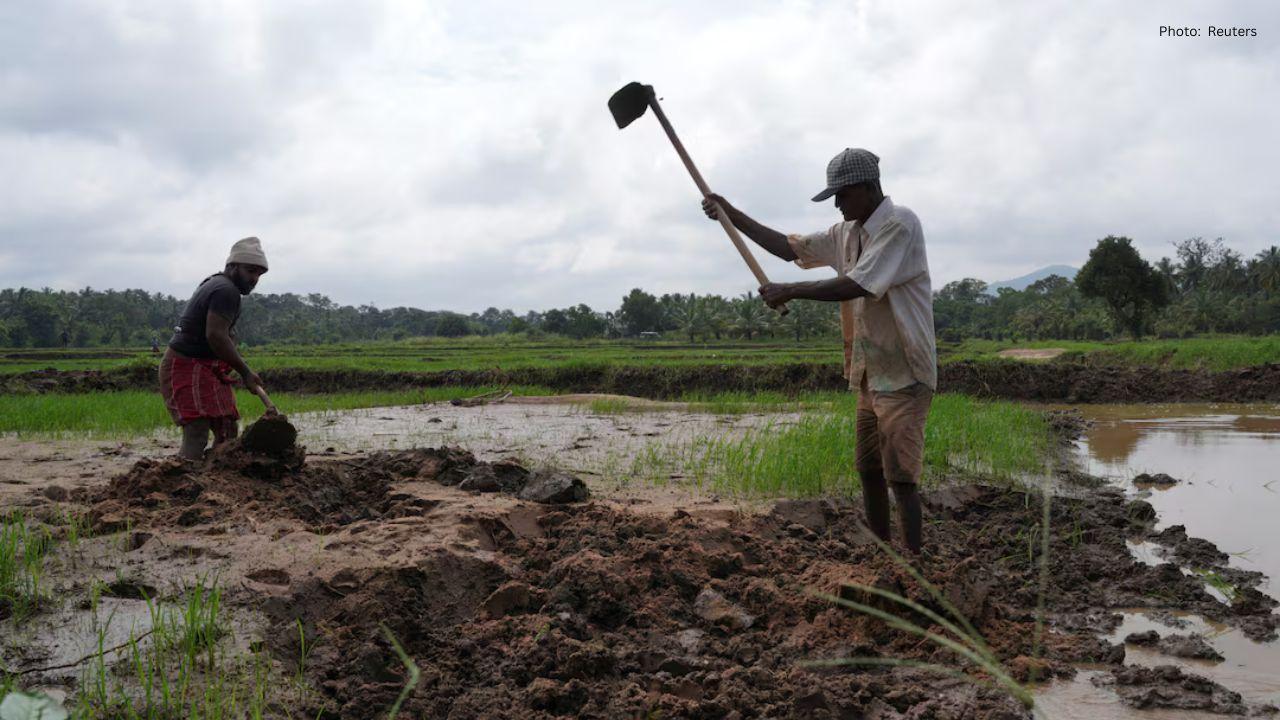
In central Sri Lanka’s farming villages, fields that once showed signs of a good harvest are now covered in thick mud and sand. Rice farmer Kalanchi Dewage Risman, 55, stands beside his two-acre field wondering how he will recover. Just days before the cyclone struck, young green rice plants had started to grow. Now, everything is gone.
Risman says he must first clear the mud, level the land again, and then replant the crop. This process will cost him more money, even though he is already in debt. Worse still, it is now mid-December. Rice planted this late usually produces a weak harvest, making it harder for farmers to earn enough to survive.
Cyclone Ditwah hit Sri Lanka in November, cutting through major farming areas that grow rice, vegetables, and maize. The storm killed at least 643 people and forced more than 70,000 into relief centres. Nearly 1.8 million farming families were affected across the island.
Government data shows that floods damaged crops on more than 535,000 hectares of land. Over 120,000 hectares were completely destroyed or buried under sand and mud. Rice fields, vegetable farms, and maize crops suffered severe losses, putting the country’s food supply at risk.
Just weeks before the cyclone, around 800,000 farmers had planted rice during the main growing season, which runs from November to February. This season is crucial for Sri Lanka’s food security. Now, large parts of that crop may be lost forever.
The damage was made worse by broken dams and irrigation canals. Torrential rain destroyed hundreds of dams and nearly 2,000 canals. Without quick repairs, water cannot reach the fields, making replanting even more difficult.
In some areas, farmers are working together to save whatever they can. Families are sharing tools and labour to clear fields and repair canals. But many say their resources are limited, and without strong government help, recovery will be slow.
The cyclone also destroyed homes and forced families to relocate. Niluka Yaparatne, 48, lost her house when a landslide killed seven of her neighbours. She and her family escaped in the middle of the night. Now, they are staying with relatives while searching for a place to rent. Rent prices have risen, adding to their stress. Her family still owes a large loan taken to build their home.
Her husband’s paddy field was also buried under mud and sand. Authorities have declared their area unsafe due to landslide risks, meaning they cannot return. For families like hers, the disaster has taken away both shelter and income.
Economists warn that food prices could rise sharply in the coming months. Food inflation, which was around 3% in November, could double. With rice and vegetable supplies damaged, Sri Lanka may struggle to meet local demand. Experts say farmers need strong state support, not just to replace lost crops, but also to pay for land repairs, seeds, and fertiliser.
The government has promised compensation of 150,000 rupees for farmers whose fields were fully destroyed. Officials say more than 15 billion rupees will begin to be distributed this week. Authorities are urging farmers to replant before the end of December and say much of the crop can still be saved if action is taken quickly.
However, many farmers fear the compensation will not be enough. For Risman alone, the cost of machinery, seeds, and fertiliser is estimated at 175,000 rupees. He is also struggling to repay a loan taken earlier in the season.
Government officials say rice production may still reach 3.5 million metric tons if recovery efforts succeed. But for farmers on the ground, such promises offer little comfort. Many are focused simply on surviving until the next planting season in May.
Cyclone Ditwah has shown how vulnerable Sri Lanka’s farmers are to extreme weather. Without faster support, better disaster planning, and long-term investment in agriculture, many fear that each storm will push rural families further into poverty.
For now, farmers like Risman look to the sky with worry, hoping the rains will stop and that help will arrive before it is too late.
#trending #latest #SriLankaCyclone #FarmersInCrisis #CycloneDitwah #AgricultureLoss #FoodSecurity #ClimateImpact #RuralStruggles #armustnews



Advances in Aerospace Technology and Commercial Aviation Recovery
Insights into breakthrough aerospace technologies and commercial aviation’s recovery amid 2025 chall

Defense Modernization and Strategic Spending Trends
Explore key trends in global defense modernization and strategic military spending shaping 2025 secu

Tens of Thousands Protest in Serbia on Anniversary of Deadly Roof Collapse
Tens of thousands in Novi Sad mark a year since a deadly station roof collapse that killed 16, prote

Canada PM Carney Apologizes to Trump Over Controversial Reagan Anti-Tariff Ad
Canadian PM Mark Carney apologized to President Trump over an Ontario anti-tariff ad quoting Reagan,

The ad that stirred a hornets nest, and made Canadian PM Carney say sorry to Trump
Canadian PM Mark Carney apologizes to US President Trump after a tariff-related ad causes diplomatic

Bengaluru-Mumbai Superfast Train Approved After 30-Year Wait
Railways approves new superfast train connecting Bengaluru and Mumbai, ending a 30-year demand, easi




