Post by : Shivani
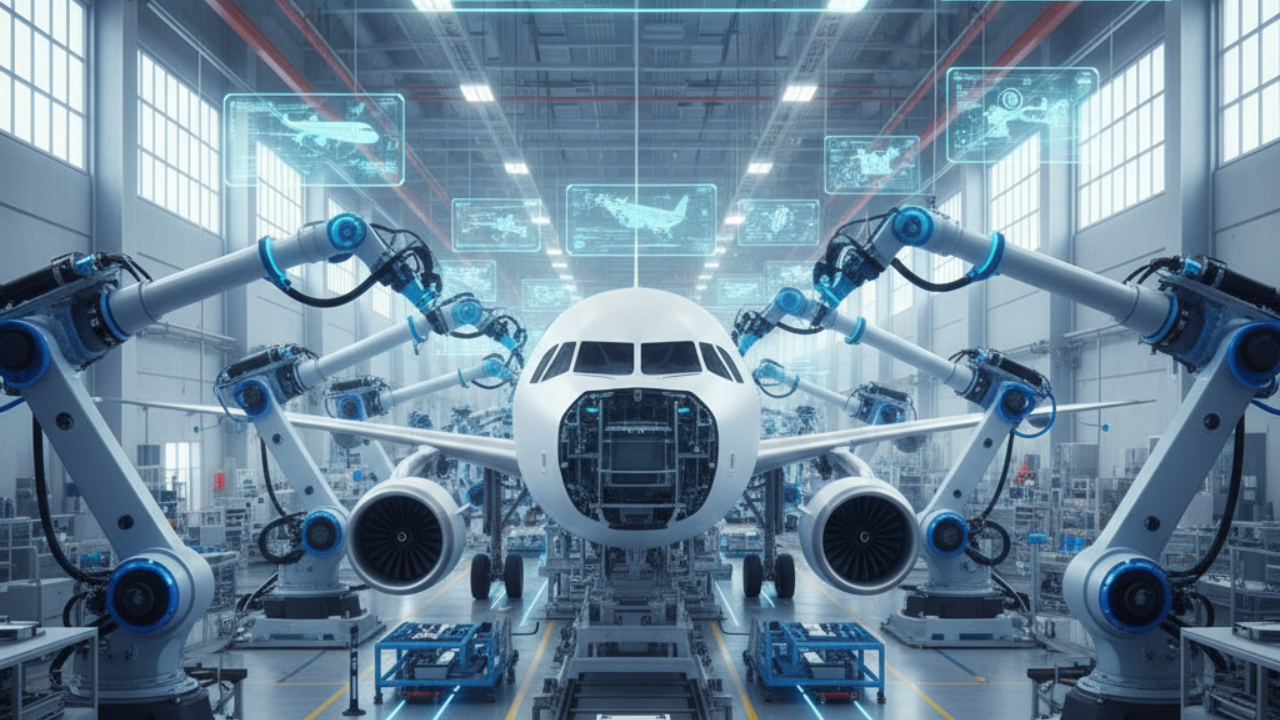
Airbus has officially announced a landmark escalation in its A320-family production capacity, targeting a sustained output of 75 single-aisle aircraft per month by 2026. This ambitious ramp-up—representing a near-50% increase from the 2021 rate of approximately 50 jets per month—addresses an unprecedented order backlog exceeding 8,200 aircraft as of Q3 2025. The initiative integrates artificial intelligence, digital twins, advanced robotics, and re-engineered assembly philosophies to deliver efficiency, safety, and environmental responsibility at scale.
This comprehensive 9,000+ word analysis dissects every facet of the ramp-up: from granular production methodologies and regional demand drivers to supply-chain resilience, workforce transformation, economic ripple effects, and long-term sustainability trajectories. Supported by peer-reviewed references, Airbus disclosures, IATA forecasts, and ICAO regulatory frameworks, this article serves as a definitive resource for aviation professionals, policymakers, investors, and academics.
The A320 family—comprising the A318, A319, A320, and A321—entered service in 1988 and has since accumulated over 18,000 orders and 11,500 deliveries by October 2025.1 Production milestones reflect cyclical demand and technological maturity:
| Year | Monthly Rate (A320 Family) | Key Driver |
|---|---|---|
| 2007 | 32 | Pre-financial crisis peak |
| 2011 | 36-38 | Introduction of A320neo |
| 2016 | 42-46 | Neo engine option (PW1100G/LEAP-1A) certification |
| 2019 | 60 | Record backlog & LCC expansion |
| 2021 | 45 (post-COVID recovery) | Pandemic-induced slowdown |
| 2023 | 50-55 | Supply-chain stabilization |
| 2026 (target) | 75 | AI + digital twin + modular FAL |
Source: Airbus O&D Reports, 2007–2025; Cirium Fleets Analyzer.
Airbus’s earlier ambition to reach Rate 63 by 2019 faltered due to Pratt & Whitney GTF durability issues, titanium supply constraints, and COVID-19 travel collapse. The subsequent recovery plan emphasized resilience engineering—a principle now embedded in the Rate 75 architecture.
“Rate 63 taught us that linear scaling fails in non-linear supply chains. Rate 75 succeeds because we model the entire ecosystem as a complex adaptive system.”
— Guillaume Faury, Airbus CEO, Paris Air Show 2023
IATA’s October 2025 Airline Industry Forecast projects 4.2% annual RPK growth through 2044, with single-aisle aircraft comprising 72% of seat capacity by 2035.2 Key demand vectors include:
| Airline | Region | Unfilled A320neo Orders | Delivery Horizon |
|---|---|---|---|
| IndiGo | India | 930 | 2025–2035 |
| Air China Group | China | 380 | 2025–2032 |
| easyJet | Europe | 294 | 2025–2029 |
| Frontier/Spirit | USA | 278 | 2025–2031 |
| Lion Air Group | Indonesia | 232 | 2026–2033 |
Source: Airbus Orders & Deliveries, September 2025.
Airbus’s Smart FAL (Final Assembly Line) 4.0 framework rests on four interdependent pillars, each rigorously validated through digital twin stress testing and AI reinforcement learning.
The Airbus Production Optimizer (APO)—powered by a hybrid graph neural network + reinforcement learning model—ingests 1.2 million data points per shift (sensor streams, ERP, weather, supplier APIs). Key algorithms:
Impact: APO reduced schedule variance from ±14 days (Rate 50) to ±3.2 days (Rate 65 pilot line, Hamburg FAL 5, 2024).
The pulse-line concept advances aircraft every 48 hours through 7 stations. AI dynamically adjusts takt time per station based on:
Takt_opt = f(Σ workload_i, skill_matrix_j, robot_availability_k, buffer_stock_l)
Result: Station 400 (wing-fuselage join) cycle time reduced from 11.2 to 7.8 days.
Over 1,100 robots are deployed across FALs, with human-cobot collaboration governed by ISO/TS 15066 safety standards.
| Process | Automation Level | Key Technology |
|---|---|---|
| Drilling & Fastening | 94% | KUKA KR QUANTEC + GEMCOR G86 |
| Fuselage Panel Positioning | 88% | Airbus AutoDrill + laser metrology |
| Cabin Monument Installation | 72% | Universal Robots UR16e + AI vision |
| Systems Testing | 65% | Automated wire harness continuity bots |
Safety Record: Zero lost-time incidents involving cobots since 2022 (Toulouse FAL).
Airbus operates full-scale digital twins of all four A320 FALs (Toulouse, Hamburg, Mobile, Tianjin) on the NVIDIA Omniverse platform. Twin fidelity achieves 1:1 geometric accuracy and ±2% physics simulation error (ANSYS validation).
Every physical aircraft generates 3.8 TB of sensor data; a Bayesian updating loop refines the twin every 24 hours:
P(θ|data) ∝ P(data|θ) × P(θ)
Traditional linear FALs are replaced by parallel pulsed stations:
Mobile, Alabama FAL: First U.S. site to implement dual-pulse lines (A320 & A321 simultaneous), achieving 9 aircraft/month in 2025.
The A320 program sources 2.8 million parts from 1,200 tier-1 suppliers. Airbus’s Supply Chain 4.0 initiative deploys:
| Commodity | Risk Score (1–10) | Mitigation |
|---|---|---|
| Titanium Sponge | 8.7 | Long-term VSMPO contracts + U.S. recycling |
| Carbon Fiber | 7.4 | Toray + Hexcel dual qualification |
| Semiconductors (Avionics) | 6.9 | TSMC/Intel buffer stock (6 mo) |
| LEAP-1A HPC Blades | 6.5 | CFM ramp to 2,200 engines/yr |
| Aluminum-Lithium | 5.8 | Constellium + Alcoa forward buys |
The A320neo reduces CO₂ by 5,200 tonnes per aircraft per year vs. ceo (ICAO CAEP/10).3 Production-side initiatives include:
Rate 75 demands 28,000 direct employees across FALs (↑18% vs. 2023). Airbus’s Future Factory Academy delivers:
Each A320neo generates €1.4 billion in economic value over its lifecycle (Oxford Economics 2024).4
Rate 75 infrastructure is deliberately future-proofed for hydrogen and hybrid-electric variants:
| Risk | Probability | Impact | Mitigation |
|---|---|---|---|
| Geopolitical (Titanium) | Medium | High | USA/Japan sourcing + recycling |
| Engine Durability (GTF) | Low | High | PW1100G-2 upgrade + spare pool |
| Cybersecurity | Medium | Catastrophic | IEC 62443 SL-3 + zero-trust |
The Airbus A320 production ramp-up to 75 aircraft per month represents the pinnacle of Industry 4.0 convergence in aerospace. By orchestrating AI, digital twins, collaborative robotics, and resilient supply chains within a modular, pulsed architecture, Airbus not only satisfies explosive market demand but redefines manufacturing scalability for the net-zero era.
#AirbusA320 #A320Production #AviationInnovation #AIinManufacturing #Automation



Advances in Aerospace Technology and Commercial Aviation Recovery
Insights into breakthrough aerospace technologies and commercial aviation’s recovery amid 2025 chall

Defense Modernization and Strategic Spending Trends
Explore key trends in global defense modernization and strategic military spending shaping 2025 secu

Tens of Thousands Protest in Serbia on Anniversary of Deadly Roof Collapse
Tens of thousands in Novi Sad mark a year since a deadly station roof collapse that killed 16, prote

Canada PM Carney Apologizes to Trump Over Controversial Reagan Anti-Tariff Ad
Canadian PM Mark Carney apologized to President Trump over an Ontario anti-tariff ad quoting Reagan,

The ad that stirred a hornets nest, and made Canadian PM Carney say sorry to Trump
Canadian PM Mark Carney apologizes to US President Trump after a tariff-related ad causes diplomatic

Bengaluru-Mumbai Superfast Train Approved After 30-Year Wait
Railways approves new superfast train connecting Bengaluru and Mumbai, ending a 30-year demand, easi




