Post by : Amit
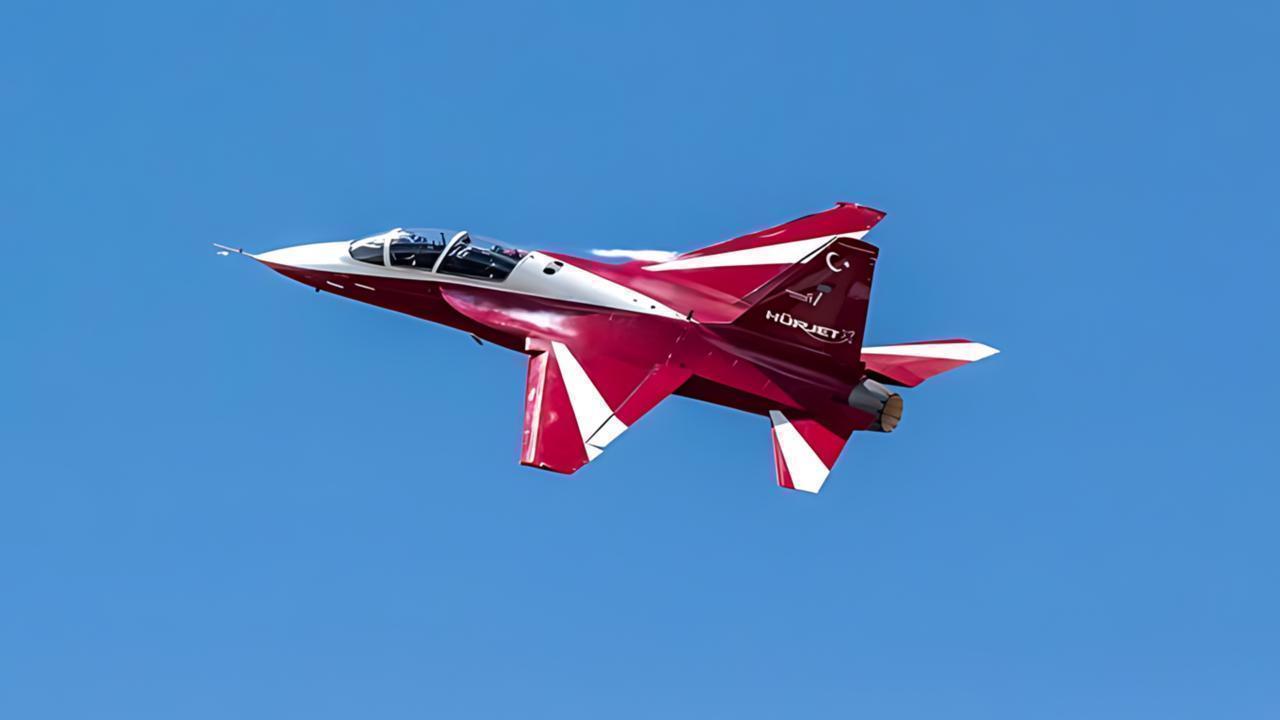
Photo : X / Turkish Aerospace
European-Turkish Collaboration Deepens in Defense Aerospace
In a move that may reshape the landscape of Europe’s tactical aircraft development, Airbus and Turkish Aerospace Industries (TAI) are advancing their cooperation to develop the Hurjet light attack and trainer jet — and they’re doing it on Spanish soil. The project, which has so far been a symbol of Turkey’s domestic aviation ambitions, is now entering a broader European phase with growing industrial and geopolitical implications.
From Ankara to Getafe: A Cross-Border Expansion
The spotlight this time is on Airbus’s Getafe facility near Madrid, where both companies recently signed an agreement to begin joint work on the Hurjet’s rear fuselage. This is not just an industrial arrangement; it marks the transformation of the Hurjet from a national platform into a potentially exportable European-Turkish aircraft.
The agreement, announced earlier this month, follows more than a year of collaboration discussions between Airbus and TAI. While Airbus has had experience with numerous international fighter programs including the Eurofighter Typhoon and FCAS (Future Combat Air System), this marks its first significant contribution to a Turkish-led aircraft platform.
The Getafe site is one of Airbus’s key aerospace facilities in Europe, previously involved in structural integration for military aircraft like the A400M and Eurofighter. Now, it becomes the staging ground for Turkey’s push into the light fighter market — one increasingly seen as vital amid evolving regional defense needs.
Hurjet: Not Just a Trainer Anymore
Initially unveiled by Turkish Aerospace as a next-generation trainer jet for Turkey’s Air Force, the Hurjet has evolved in scope. The aircraft, powered by a single General Electric F404 engine, is now being configured in dual roles — as an advanced jet trainer and a light attack platform. Its design offers versatility similar to the Korean KAI FA-50 or the Italian M-346FA — aircraft designed for both training and light combat missions.
The latest iteration includes combat avionics, weapons integration capabilities, and compatibility with NATO systems. This expanded potential is precisely what has caught Airbus’s attention.
Airbus Defense and Space officials have hinted that the Hurjet could serve niche defense requirements in countries that cannot afford high-end fighters like the F-35 or Eurofighter but need credible, affordable multi-role platforms.
Why Spain? Strategic, Political, and Industrial Reasons
The decision to move part of the development to Spain is strategic on multiple levels. Spain, a key Airbus manufacturing hub, also serves as an active member of both NATO and the EU. Its aerospace industry is integrated with major European defense programs, making it an ideal partner in expanding the Hurjet’s industrial base.
It’s not just about facilities — it’s also about access. Spain opens doors to European Union supply chains, potential future customers in Southern Europe, and perhaps even political goodwill that Turkey has been seeking amid rocky EU relations.
By building credibility within the EU through industrial cooperation, Ankara may be setting the stage for deeper integration of Turkish platforms into NATO and European defense ecosystems — a move that could be mutually beneficial in today’s turbulent geopolitical environment.
Airbus’s Quiet Expansion into Light Fighter Market
For Airbus, this collaboration represents more than just a manufacturing arrangement — it’s a quiet entry into the increasingly competitive segment of light fighter aircraft. While Airbus has historically focused on transport (like the A400M) and high-end fighter partnerships (like Eurofighter and FCAS), the Hurjet offers a foothold into a mid-tier market with strong export potential.
As several air forces across Africa, the Middle East, and Southeast Asia look to modernize aging trainer and light-attack fleets, platforms like the Hurjet — especially with European co-branding and quality assurance — could become highly attractive. Airbus, known for its rigorous aerospace standards, may help position the Hurjet as a more trusted offering compared to competitors from China or Russia.
This marks a potential strategic shift: from merely supporting existing fighter programs to quietly shaping new-generation platforms outside traditional European frameworks.
Turkey’s Broader Defense Industrial Strategy
The Hurjet’s development in Spain aligns with Turkey’s broader ambition to become a major global defense exporter. Already, Turkish drones (like Bayraktar TB2) have made international headlines and achieved combat validation in conflicts across Ukraine, Libya, and Azerbaijan.
The Hurjet, along with the more ambitious fifth-generation KAAN fighter (formerly TF-X), signals Ankara’s drive to diversify its defense portfolio — and more importantly, its customer base. By collaborating with Airbus, Turkey isn’t just buying industrial capacity — it’s buying legitimacy, reputation, and reach.
Moreover, with the U.S. maintaining restrictions on certain military technology transfers to Turkey, partnerships like this help Turkey circumvent chokepoints and ensure project continuity.
What the Agreement Covers — And What’s Next
The current agreement focuses on Airbus supporting the design and production of the Hurjet’s rear fuselage. This is a critical section of the aircraft, housing structural and control components that define the jet’s aerodynamic stability.
But industry insiders suggest this is just the first step. Talks are reportedly underway to explore deeper integration — possibly involving avionics collaboration, digital flight control systems, or even co-marketing the aircraft under a joint export banner.
Spanish engineers have already begun feasibility studies to align Hurjet production with Airbus’s existing tooling and digital simulation systems, ensuring compatibility with European aviation safety and manufacturing standards.
If successful, this could evolve into a broader Airbus–TAI strategic partnership, with potential spillover benefits for other Turkish aerospace projects.
European Defense and Turkey: A Warming Relationship?
This development comes at a time when Europe is rethinking its defense alliances. With the war in Ukraine reshaping security postures, and increasing U.S. retrenchment in some regions, European countries are investing in both legacy alliances and new capabilities.
Turkey, despite past frictions with NATO allies over defense acquisitions and political stances, remains a geographically and militarily critical partner. The Airbus-Hurjet partnership could serve as a low-risk, high-value way to rebuild confidence and show that collaboration is still possible — even essential.
Market: Light Jets on the Rise
The global market for light attack aircraft and trainer jets is projected to reach $12–15 billion over the next decade, with dozens of countries looking for cost-effective aircraft that can handle both pilot training and tactical strike missions.
Competitors like Korea’s FA-50, China’s L-15, and Italy’s M-346 have already secured export deals. If the Hurjet can enter that tier with European industrial backing, it could unlock new markets in Latin America, Africa, Central Asia, and the Balkans.
Spain’s role as a co-production site adds credibility, and Airbus’s involvement adds global visibility — both crucial ingredients in any successful defense export campaign.
Small Jet, Big Implications
At first glance, a rear fuselage production agreement might seem like a routine aerospace announcement. But for those watching European defense dynamics, the Hurjet’s leap to Getafe signals something deeper: the quiet construction of a new kind of partnership — one where industrial collaboration might pave the way for political realignment.
In an era where large-scale fifth-gen fighter programs are burdened with delays and complexity, agile, versatile aircraft like the Hurjet — and strategic alliances like Airbus–TAI — might just define the next chapter of global airpower.
Turkish Aerospace, Airbus, Hurjet, Spain



Advances in Aerospace Technology and Commercial Aviation Recovery
Insights into breakthrough aerospace technologies and commercial aviation’s recovery amid 2025 chall

Defense Modernization and Strategic Spending Trends
Explore key trends in global defense modernization and strategic military spending shaping 2025 secu

Tens of Thousands Protest in Serbia on Anniversary of Deadly Roof Collapse
Tens of thousands in Novi Sad mark a year since a deadly station roof collapse that killed 16, prote

Canada PM Carney Apologizes to Trump Over Controversial Reagan Anti-Tariff Ad
Canadian PM Mark Carney apologized to President Trump over an Ontario anti-tariff ad quoting Reagan,

The ad that stirred a hornets nest, and made Canadian PM Carney say sorry to Trump
Canadian PM Mark Carney apologizes to US President Trump after a tariff-related ad causes diplomatic

Bengaluru-Mumbai Superfast Train Approved After 30-Year Wait
Railways approves new superfast train connecting Bengaluru and Mumbai, ending a 30-year demand, easi




