Post by : Amit
Photo : X / CnEVPost
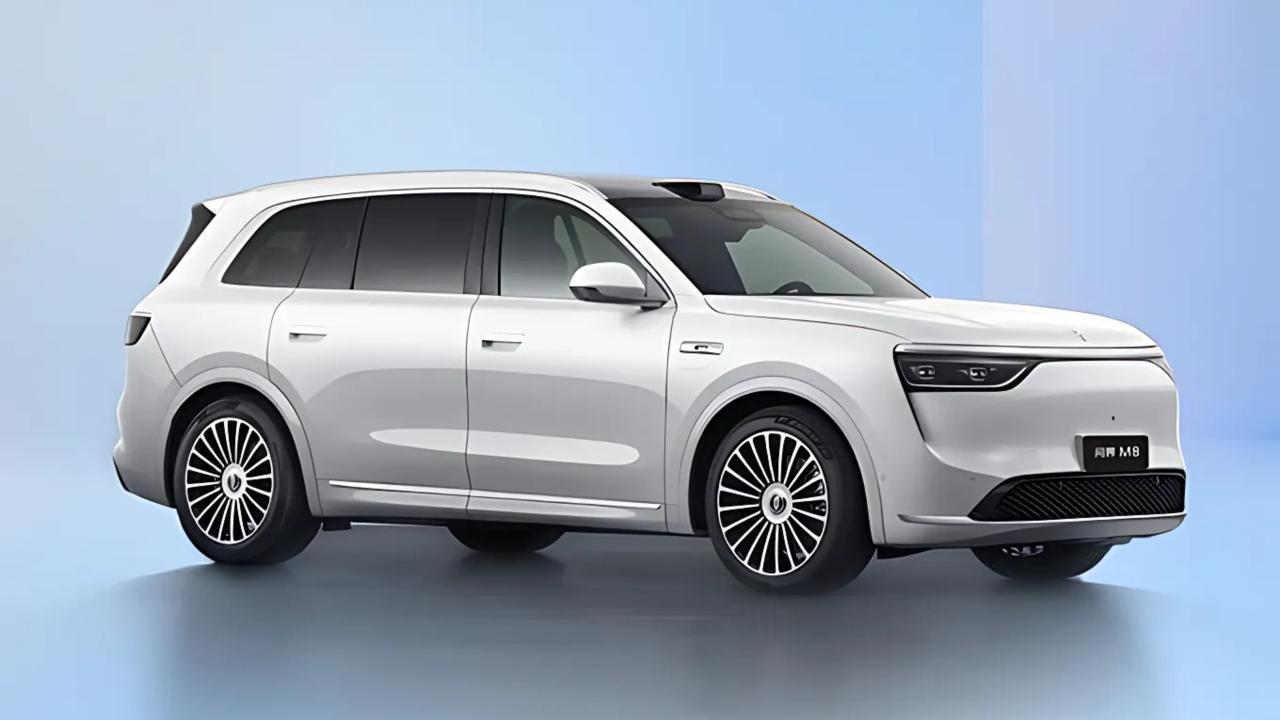
A New Electric Chapter for Huawei-Backed Aito: M8 BEV Launch Set for August
China’s electric vehicle battlefield is about to heat up once again—and this time, it’s Huawei’s EV partner Aito that’s taking center stage. In a strategic shift that could redefine its market presence, Aito has confirmed it will launch a battery electric version of its flagship M8 SUV this August. For a brand that has so far relied heavily on range-extended electric vehicles (REEVs), this move toward fully electric models signals a bold new direction, one that's primed to challenge rivals like Li Auto, Xpeng, and Nio in China’s premium EV SUV category.
What’s more, the upcoming M8 BEV isn't just another vehicle announcement. It’s a pivotal moment for Huawei’s broader smart mobility ambitions—where software, connectivity, and driving intelligence converge with electric propulsion to create what Aito and Huawei call the next evolution in urban premium transport.
From Range-Extended to Pure Electric: Why the M8 Matters
The original Aito M8 debuted in 2022 as a range-extended electric vehicle, blending the reliability of an internal combustion engine with the benefits of electric propulsion. It was a strategic hit. Chinese customers—especially in mid- to high-end markets—embraced its spacious cabin, smooth ride, three-row configuration, and most importantly, Huawei’s deeply integrated HarmonyOS smart cockpit.
But even strong-selling hybrids like the M8 are starting to feel the pressure in China’s rapidly evolving EV market. As cities tighten emission norms and public interest shifts toward zero-emission driving, BEVs (battery electric vehicles) are becoming a new baseline rather than an exception. With competitors already rolling out BEVs across multiple price points, Aito's reliance on REEVs increasingly looked like a limiting factor.
That’s what makes the BEV version of the M8 not just a natural evolution—but a strategic necessity.
Timing the Launch: Why August Could Be Perfect
Why now, and why August? According to insiders, this isn’t just a random launch date. The August debut gives Aito room to build excitement with teaser campaigns, media test drives, and exclusive previews for early adopters. It also provides a buffer ahead of the Beijing Auto Show in October, where rivals like Li Auto and Xpeng are expected to unleash their latest generation of battery tech and autonomous features.
More critically, the timing reflects Aito’s need to shift market momentum. With Li Auto already cornering the REEV space and BEV mindshare dominated by Tesla, this new M8 launch is a calculated move to pivot consumer perception—from a hybrid-adjacent brand to a full-scale BEV contender.
Design, Tech, and Under-the-Hood Innovation
While official technical specifications remain under wraps, multiple sources indicate that the M8 BEV will maintain the elegant, upscale design language of the REEV version. Inside, buyers can expect the same premium ambiance: a panoramic screen setup, leather finishes, ventilated seats, and voice-controlled smart systems powered by Huawei’s HarmonyOS.
Under the hood, things will be radically different. The range extender is gone, replaced by a fully electric drivetrain expected to come in two battery configurations—82 kWh and 100 kWh. Based on internal leaks, the CLTC-rated range should fall between 550 km and 700 km, making the M8 BEV competitive with the likes of the Nio ES8 and the Li Auto L9.
Fast charging is another area where the M8 BEV will shine. Leveraging Huawei’s proprietary thermal management and high-voltage charging control systems, the vehicle is expected to support rapid charging that replenishes 300+ km of range in under 20 minutes. That’s a key win for city dwellers who often rely on short bursts of charge rather than overnight parking access.
Smart Tech Edge: Huawei’s Role Behind the Wheel
Huawei’s growing influence on the EV space is impossible to ignore—and with the M8 BEV, that influence only deepens. The upcoming model is expected to come equipped with Huawei’s latest ADS 2.0 autonomous driving system. This means real-time city navigation, lane-level adaptive cruise control, automated parking, and improved safety AI—all updated over-the-air like a smartphone.
A new iteration of HarmonyOS will also debut in the M8 BEV. Seamlessly connected to Huawei smart devices, it will allow users to control smart home features, manage digital calendars, stream content, and even initiate remote vehicle diagnostics—all via voice, touch, or gesture.
In essence, Aito is positioning the M8 BEV not merely as an electric SUV, but as a rolling digital ecosystem. This positions it uniquely against Tesla, which—despite its software prowess—operates largely in a closed-loop system.
Competitive Pricing to Rattle Rivals
According to analysts, pricing will be critical in making or breaking the M8 BEV’s debut. The REEV M8 currently retails between ¥279,800 and ¥329,800 (~₹32.5–₹38.5 lakh). Sources suggest the all-electric variant will be priced between ¥299,800 and ¥349,800, depending on battery size and autonomous features.
If Aito can stay within this range while still offering more tech, more comfort, and more driving range than the competition, it could land a knockout punch in a market segment increasingly defined by tech-savvy buyers looking for value without compromise.
In fact, if the M8 BEV can undercut similar vehicles from Xpeng or Nio by even a small margin, it may rapidly scale up thanks to Aito’s already established REEV user base ready for an upgrade.
Distribution and Deliveries: Fast Out of the Gate
Aito has confirmed that the BEV version will enter mass production before the end of July, with deliveries to commence almost immediately after the official August launch. Initial distribution will focus on major urban centers such as Shanghai, Beijing, Chengdu, and Shenzhen—cities that already boast strong EV infrastructure and Huawei’s existing retail ecosystem.
To support the rollout, Aito will use both Huawei Experience Stores and dedicated Aito showrooms. This dual-channel strategy not only maximizes visibility but also blurs the line between consumer tech retail and automotive sales—a deliberate move to attract younger buyers accustomed to Apple-style shopping experiences.
A Launch with Strategic Stakes
This isn’t just about one car. The success of the M8 BEV will dictate Aito’s brand trajectory and Huawei’s future in automotive software. If the M8 BEV delivers on its promises, it could trigger a domino effect: faster BEV variants of other Aito models like the M5, broader software deployments, and even export strategies in emerging EV markets.
More importantly, this launch will answer whether Aito can truly hold its own in a BEV-dominated landscape—or if its strength will remain confined to range-extended compromises.
A Battle for the Premium EV Future
Aito's new M8 BEV enters a battleground that’s as unforgiving as it is lucrative. The premium EV segment in China has seen explosive growth, but also ruthless competition. Xpeng’s G9, Nio’s ES8, and Tesla’s refreshed Model X are all chasing the same demographic: upwardly mobile urbanites seeking style, intelligence, and environmental cred in their next SUV.
Unlike traditional automakers, Aito’s pitch is different—it’s not about horsepower or luxury for luxury’s sake. It’s about connectivity, software leadership, and lifestyle convergence. In many ways, the M8 BEV is not just Huawei’s experiment—it’s the prototype for what tomorrow’s vehicle might look and feel like.
A Litmus Test for Aito’s Electric Evolution
As August approaches, all eyes will be on Aito’s new flagship. The M8 BEV represents not only a technological upgrade but a philosophical shift—from hybrid convenience to all-electric confidence. With Huawei’s deep tech stack, aggressive pricing, and a refined urban utility aesthetic, the M8 BEV is poised to redefine expectations in China’s upscale electric SUV segment.
But success is not guaranteed. T he competition is formidable, consumer expectations are high, and the margin for error is razor-thin. Still, if Aito gets the formula right, this launch could be the catalyst that propels the brand—and Huawei’s smart mobility vision—into a commanding position in the global EV conversation.
Aito M8 BEV, Huawei, Electric SUV



Advances in Aerospace Technology and Commercial Aviation Recovery
Insights into breakthrough aerospace technologies and commercial aviation’s recovery amid 2025 chall

Defense Modernization and Strategic Spending Trends
Explore key trends in global defense modernization and strategic military spending shaping 2025 secu

Tens of Thousands Protest in Serbia on Anniversary of Deadly Roof Collapse
Tens of thousands in Novi Sad mark a year since a deadly station roof collapse that killed 16, prote

Canada PM Carney Apologizes to Trump Over Controversial Reagan Anti-Tariff Ad
Canadian PM Mark Carney apologized to President Trump over an Ontario anti-tariff ad quoting Reagan,

The ad that stirred a hornets nest, and made Canadian PM Carney say sorry to Trump
Canadian PM Mark Carney apologizes to US President Trump after a tariff-related ad causes diplomatic

Bengaluru-Mumbai Superfast Train Approved After 30-Year Wait
Railways approves new superfast train connecting Bengaluru and Mumbai, ending a 30-year demand, easi




