Post by : Meena Rani
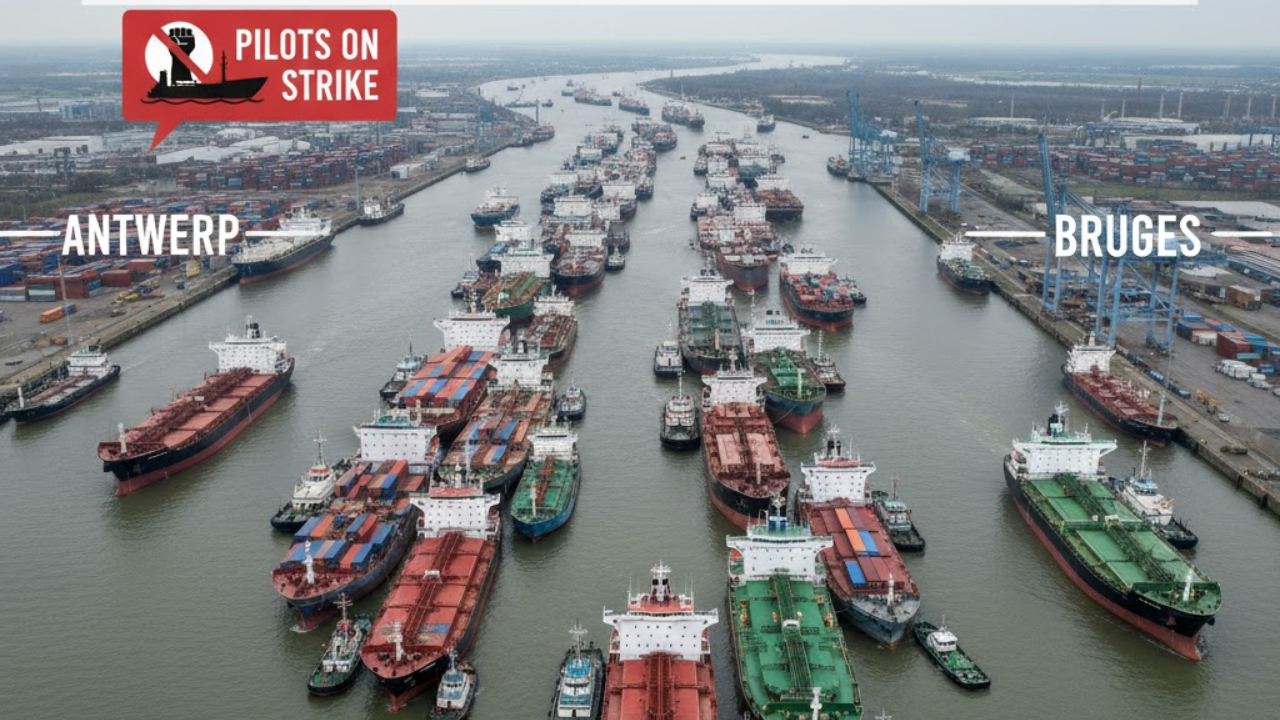
The Port of Antwerp-Bruges, one of Europe’s most critical maritime hubs, is facing severe congestion after a sustained strike by harbour pilots. The protest has caused hundreds of vessels to queue offshore, disrupted jet fuel and diesel deliveries, slowed bunkering operations, and triggered ripple effects across the European supply chain. The strike highlights the vulnerability of vital transport infrastructure when specialized labour is withdrawn and offers lessons for shipping lines, traders, and policymakers. This article takes a detailed look at the causes, mechanics, and consequences of this congestion and explores strategies to restore normalcy and strengthen future resilience.
Antwerp-Bruges is Europe’s second-largest port complex after Rotterdam and serves as a crucial node for oil, chemicals, automotive, and containerized cargo. The port’s deep integration with inland waterways, rail, and road networks makes it indispensable for Europe’s fuel supply and industrial production. Its refineries handle significant shares of the region’s jet fuel and diesel imports, while its terminals support exports of chemicals and containerized goods worldwide. A slowdown here is not merely a local issue—it affects refinery operations, airline fuel availability, and even factory production in landlocked European countries.
The congestion began when Flemish harbour pilots launched industrial action to protest proposed pension reforms. Initially, pilots engaged in a go-slow operation, adhering strictly to rules that limited the number of ships they could guide per shift. As the strike continued, pilot availability dropped sharply, and vessel scheduling became chaotic. Even after the strike was temporarily suspended, the backlog had ballooned, with reports indicating around 188 vessels waiting at anchor. Port throughput fell to roughly 70% of normal capacity, with critical services such as pilotage and towage struggling to keep up.
Though the pilots returned to partial work after negotiations resumed, clearing the accumulated backlog became a logistical challenge. Each missed tide window, each delayed berthing, and each rescheduled pilot assignment compounded the overall congestion, leaving the port operating below normal efficiency for several days.
For major European ports like Antwerp-Bruges, pilotage is mandatory for large vessels entering or leaving the harbour. These pilots possess intimate knowledge of local waterways, locks, currents, and tidal constraints. Without them, vessels cannot legally or safely transit the port’s complex approaches.
When pilots work to rule or restrict hours, the number of vessel movements drops dramatically. Since port logistics operate like a synchronized clock—where towage, locks, cranes, and cargo handling depend on scheduled arrivals—a pilot shortage brings the entire ecosystem to a crawl. Idle cranes, delayed bunkering barges, and overfilled storage tanks become visible symptoms of this hidden bottleneck.
The congestion at Antwerp-Bruges had several cascading effects:
Vessel queues surged: Dozens to hundreds of ships were delayed offshore, waiting for pilot assignments.
Bunkering delays: Fuel suppliers struggled to deliver marine fuel as berth access became unpredictable.
Product deliveries disrupted: Jet fuel and diesel shipments into Europe were delayed, tightening short-term supply.
Storage congestion: Onshore tank farms faced high utilization levels as outbound vessels couldn’t depart on schedule.
Crew and cost issues: Shipowners incurred higher demurrage and overtime costs as crew rotations and charters extended.
Even a few days of delay at a critical port like Antwerp-Bruges translates into millions of euros in cumulative cost for carriers and cargo owners.
Port congestion at Antwerp-Bruges impacts much more than maritime schedules. The port handles a significant portion of Europe’s refined oil imports, so even minor interruptions can ripple through the energy market. Airlines and transport companies dependent on steady jet fuel deliveries faced potential stock drawdowns. Manufacturers awaiting chemical feedstocks experienced production slowdowns.
Trucking and rail operators dependent on precise port handovers faced schedule disruptions. Logistics chains that depend on just-in-time delivery models were forced to activate contingency measures. The congestion also created temporary imbalances in container availability across Europe, with inland terminals reporting delays in receiving cargo.
Clearing a port backlog is a mathematical exercise in capacity restoration. With around 188 ships waiting, Antwerp-Bruges needed to increase vessel movement rates significantly. Assuming normal conditions handle about 100 pilotage movements daily, operating at 70% capacity would clear fewer than normal, causing backlog persistence.
Even after pilots returned, the port needed to operate above its standard throughput—possibly at 120–130% efficiency—to normalize within a week. Without such surge measures, the recovery could stretch over several weeks, depending on weather, tides, and labour cooperation at terminals.
Shipping lines quickly adjusted tactics to minimize the damage. Many carriers:
Rerouted ships to nearby ports such as Rotterdam or Zeebrugge.
Implemented slow-steaming to adjust estimated arrival times and reduce idle anchoring.
Cancelled optional Antwerp calls to maintain overall network punctuality.
Negotiated priority berthing windows for high-value cargoes.
Fuel traders and logistics companies responded by sourcing fuel from alternative ports, drawing on inland storage reserves, or paying premiums for fast-track berthing where available. While these measures eased the immediate crisis, they also added costs and complexity to European logistics.
The root of the problem lay in labour and politics. The harbour pilots’ strike was not about port policy but national pension reform. Yet, because pilots operate under government contracts and are essential for maritime safety, their industrial action directly paralyzes trade.
Labour unions representing pilots argued that reforms would unfairly erode retirement benefits for highly specialized professionals who face stressful, safety-critical work. The government, on the other hand, maintained fiscal reform was necessary to ensure pension sustainability. The standoff highlights the delicate balance between social policy and economic stability when critical infrastructure workers wield high leverage.
Antwerp-Bruges serves as a major bunkering hub in Europe. During the strike, bunker barge scheduling became erratic, leading to fuel delivery delays for transiting ships. Some vessels chose to bunker elsewhere, diverting business to rival ports.
The congestion also had implications for Europe’s downstream fuel security. With several refineries depending on Antwerp for product discharge, even short-term delays affected inventories of jet fuel and diesel in regional markets. Airports and fuel terminals dependent on Antwerp allocations began tapping contingency reserves. While no widespread shortages occurred, spot prices briefly reflected the supply strain.
For cargo owners, the Antwerp crisis was a test of contractual clarity. Delays triggered demurrage and detention claims, and “force majeure” clauses came under scrutiny. Terminal operators and shippers had to determine whether strike-related delays qualified as excusable under existing contracts.
Insurance companies and P&I clubs also evaluated claims arising from idle time, perishable cargo losses, and additional bunker consumption. The episode serves as a reminder for businesses to periodically review their charter-party and logistics contracts for explicit coverage of labour disruptions and port delays.
Fast Recovery Scenario: Pilots resume full duty; port authorities extend terminal hours; backlog cleared within 3–5 days. Impact minimal, minor fuel supply delays.
Gradual Normalization Scenario: Partial pilot availability continues; backlog clears in 7–14 days. Schedules remain unstable, minor rerouting persists.
Prolonged Disruption Scenario: Negotiations falter or new labour actions occur; congestion extends beyond two weeks. Shipping lines shift regular services away from Antwerp.
At present, analysts consider the gradual normalization scenario the most likely, but much depends on government-labour dialogue and port coordination efficiency.
Prioritize critical cargo such as fuels, perishables, and scheduled liner calls.
Extend working hours at terminals to run 24/7 operations temporarily.
Increase pilot throughput by incentivizing overtime or importing assistance from neighbouring pilotage districts.
Provide real-time transparency through digital dashboards showing vessel queue status.
Offer incentives for carriers willing to reschedule or defer non-essential cargo to balance flow.
By combining these operational and communication measures, ports can drastically shorten the duration of congestion and restore confidence among shipping lines.
Assess routing alternatives: Evaluate cost-benefit of using alternate ports until Antwerp fully normalizes.
Communicate proactively: Keep customers informed about ETAs and potential delays.
Manage fuel exposure: Build temporary stock buffers or source from alternative hubs.
Strengthen documentation: Maintain detailed records of delay causes to support potential claims.
Plan inland logistics adjustments: Reassign truck and rail slots dynamically to minimize idle capacity.
These actions protect customer relationships and reduce financial exposure during operational crises.
The Antwerp congestion has raised fundamental questions about Europe’s port resilience. Key lessons include:
Labour fragility: Even a small labour group can halt a large trade artery.
Need for redundancy: Ports must diversify critical services like pilotage.
Regional cooperation: Neighbouring ports should have contingency frameworks to handle overflow traffic.
Automation potential: Digital pilot scheduling and AI-based berth management can improve efficiency.
Policy reform: Governments may revisit rules allowing industrial action in critical infrastructure sectors.
The episode underscores that resilience is not just about physical infrastructure but also about governance and workforce relations.
Data visibility: Real-time tracking of vessel queues, pilot availability, and berth usage improves crisis response.
Contractual clarity: Update clauses to address strikes, port shutdowns, and demurrage risks explicitly.
Scenario training: Ports and shipping lines should run simulations of pilot shortages to stress-test response systems.
Diversification: Avoid dependency on single ports for critical imports or exports.
Dialogue frameworks: Institutionalize tripartite coordination between unions, port authorities, and government during disputes.
These steps can turn ad-hoc crisis management into systematic resilience.
Q1. How long will it take to clear the Antwerp backlog?
If full pilotage resumes, the backlog can be cleared in 5–7 days. Partial recovery could take longer.
Q2. Should shipping companies reroute vessels?
If delay costs exceed rerouting costs, shifting to alternate ports makes sense; otherwise, waiting may be cheaper.
Q3. Will fuel prices rise due to this disruption?
Short-term tightening in jet fuel and diesel markets is possible, but Europe’s diversified infrastructure should absorb most of the shock.
Q4. Are other ports affected?
Nearby ports like Rotterdam and Zeebrugge have experienced increased arrivals as carriers divert cargo.
Q5. What can the government do to prevent recurrence?
Governments can strengthen negotiation protocols with essential service unions, improve digital coordination tools, and ensure emergency pilotage coverage.
This article is for informational purposes only. The data and insights are based on reports and port statements available as of October 16, 2025. Readers should verify details from official sources before making business or financial decisions. The author assumes no liability for actions taken based on this content.
Antwerp, port congestion, pilots’ strike, shipping delays, bunkering, supply chain, port recovery, Europe logistics



Advances in Aerospace Technology and Commercial Aviation Recovery
Insights into breakthrough aerospace technologies and commercial aviation’s recovery amid 2025 chall

Defense Modernization and Strategic Spending Trends
Explore key trends in global defense modernization and strategic military spending shaping 2025 secu

Tens of Thousands Protest in Serbia on Anniversary of Deadly Roof Collapse
Tens of thousands in Novi Sad mark a year since a deadly station roof collapse that killed 16, prote

Canada PM Carney Apologizes to Trump Over Controversial Reagan Anti-Tariff Ad
Canadian PM Mark Carney apologized to President Trump over an Ontario anti-tariff ad quoting Reagan,

The ad that stirred a hornets nest, and made Canadian PM Carney say sorry to Trump
Canadian PM Mark Carney apologizes to US President Trump after a tariff-related ad causes diplomatic

Bengaluru-Mumbai Superfast Train Approved After 30-Year Wait
Railways approves new superfast train connecting Bengaluru and Mumbai, ending a 30-year demand, easi




