Post by : Saif
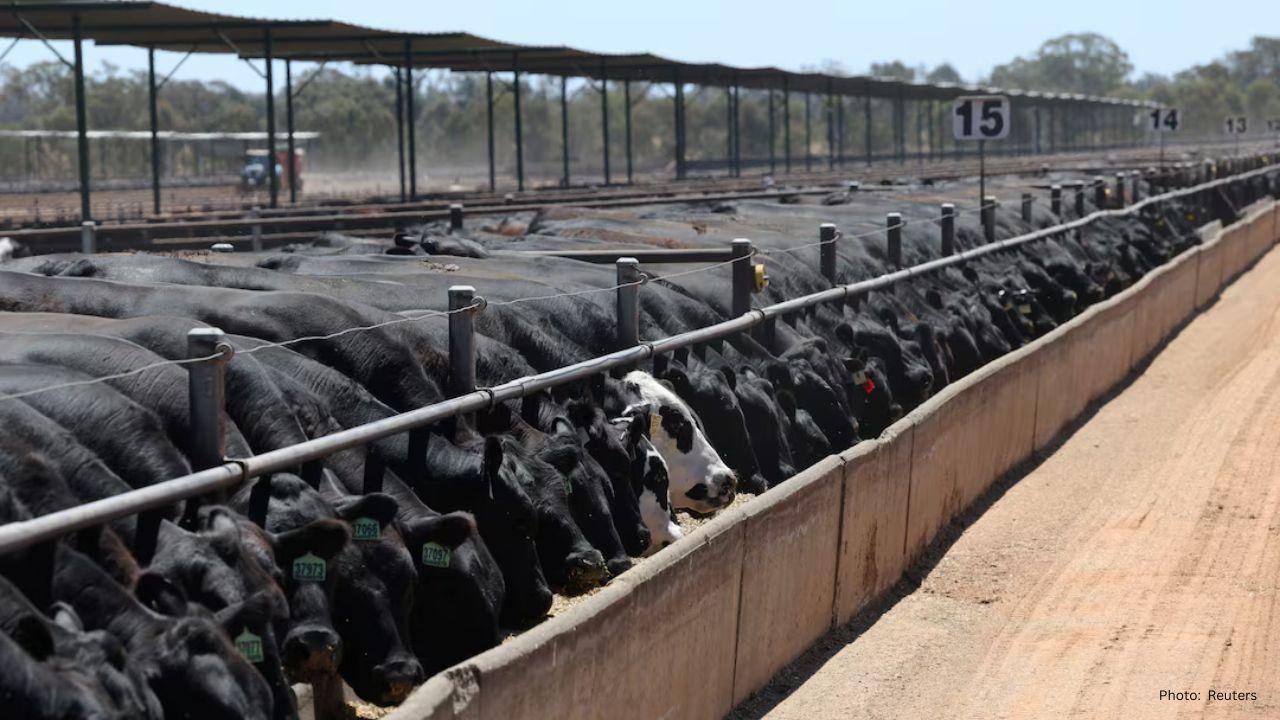
Australia is rapidly expanding its grain-fed beef industry as global demand rises and U.S. beef production weakens. At the Gundamain feedlot in New South Wales, around 6,000 Black Angus cattle are fed a rich mix of barley, silage, cottonseed and molasses. After 90 days in these shaded pens, the animals can gain up to 50% in weight, reaching nearly 600 kilograms. This system allows Australia to produce more consistent, high-quality beef for export, especially to Asian markets.
Australia has long been one of the world’s largest beef exporters thanks to its wide pasturelands and small population. But feedlots are now transforming the industry. They allow cattle to be fattened in a controlled environment rather than relying only on grass. This shift is helping Australia take advantage of rising global demand for grain-fed beef, a type prized for its marbling and tenderness.
Tess Herbert, whose family owns the Gundamain feedlot, said demand keeps growing. She explained that buyers are constantly requesting more beef, which has led the feedlot to plan an expansion from 6,000 to 12,000 cattle in the coming years. This growth is part of a much larger national trend.
Industry data shows that the number of cattle in Australian feedlots reached a record 1.6 million in June, up from 1 million five years ago. Analysts expect the number to climb to around 2 million by 2027. If that happens, about half of all cattle slaughtered in Australia will have spent time in feedlots, compared with around 40% today.
This rise comes at a time when the United States, the world’s biggest supplier of grain-fed beef, is facing a sharp decline. Severe drought has reduced U.S. cattle numbers to the lowest level since the 1950s, and American beef production is expected to fall this year and next year. On November 1, the United States had 11.7 million cows on feed, down 260,000 from the year before.
Grant Garey, president of the Australian Lot Feeders’ Association, said demand for grain-fed beef is growing quickly. He also noted that lower U.S. production is helping Australian beef gain ground in key markets such as Japan, South Korea and China. Australia’s grain-fed beef exports rose to more than 324,000 tons in the first nine months of this year, a sharp jump from 224,000 tons in the same period in 2020.
Feedlots give Australian producers more than just access to premium markets. They also help protect the industry from Australia’s extreme weather patterns. Drought often limits grass growth, but feedlots allow producers to continue finishing cattle even in dry years. Analysts say this stability is important for keeping exports consistent.
While drought can also affect grain supplies, Australia usually grows far more grain than feedlots require, ensuring steady access to cattle feed. Analysts like Simon Quilty expect feedlots to expand even further because operators are earning strong profits and seeing long-term opportunities.
Large feedlot owners include Mort & Co, JBS, NH Foods and Teys Australia, the last of which is partly owned by U.S. agribusiness giant Cargill. But despite the growth, experts say Australia is unlikely to copy the U.S. model completely. In the United States, more than 90% of cattle are fattened in feedlots. In Australia, the high cost of building new feedlots and the expected recovery of U.S. beef production in a few years could slow future investment.
There is also strong demand for grass-fed beef, which many consumers view as more natural or sustainable. This ensures that Australia will likely continue to support both grass-fed and grain-fed production styles.
As global markets shift and the United States struggles with low cattle numbers, Australia is stepping in to supply more of the beef that customers want. With feedlots expanding and demand rising, the country’s grain-fed beef industry is set to play an even bigger role in global food supplies in the years ahead.
#trending #latest #Australia #BeefIndustry #GrainFedBeef #USBeef #Agriculture #Livestock #Trade #armustnews



Advances in Aerospace Technology and Commercial Aviation Recovery
Insights into breakthrough aerospace technologies and commercial aviation’s recovery amid 2025 chall

Defense Modernization and Strategic Spending Trends
Explore key trends in global defense modernization and strategic military spending shaping 2025 secu

Tens of Thousands Protest in Serbia on Anniversary of Deadly Roof Collapse
Tens of thousands in Novi Sad mark a year since a deadly station roof collapse that killed 16, prote

Canada PM Carney Apologizes to Trump Over Controversial Reagan Anti-Tariff Ad
Canadian PM Mark Carney apologized to President Trump over an Ontario anti-tariff ad quoting Reagan,

The ad that stirred a hornets nest, and made Canadian PM Carney say sorry to Trump
Canadian PM Mark Carney apologizes to US President Trump after a tariff-related ad causes diplomatic

Bengaluru-Mumbai Superfast Train Approved After 30-Year Wait
Railways approves new superfast train connecting Bengaluru and Mumbai, ending a 30-year demand, easi




