Post by : Amit
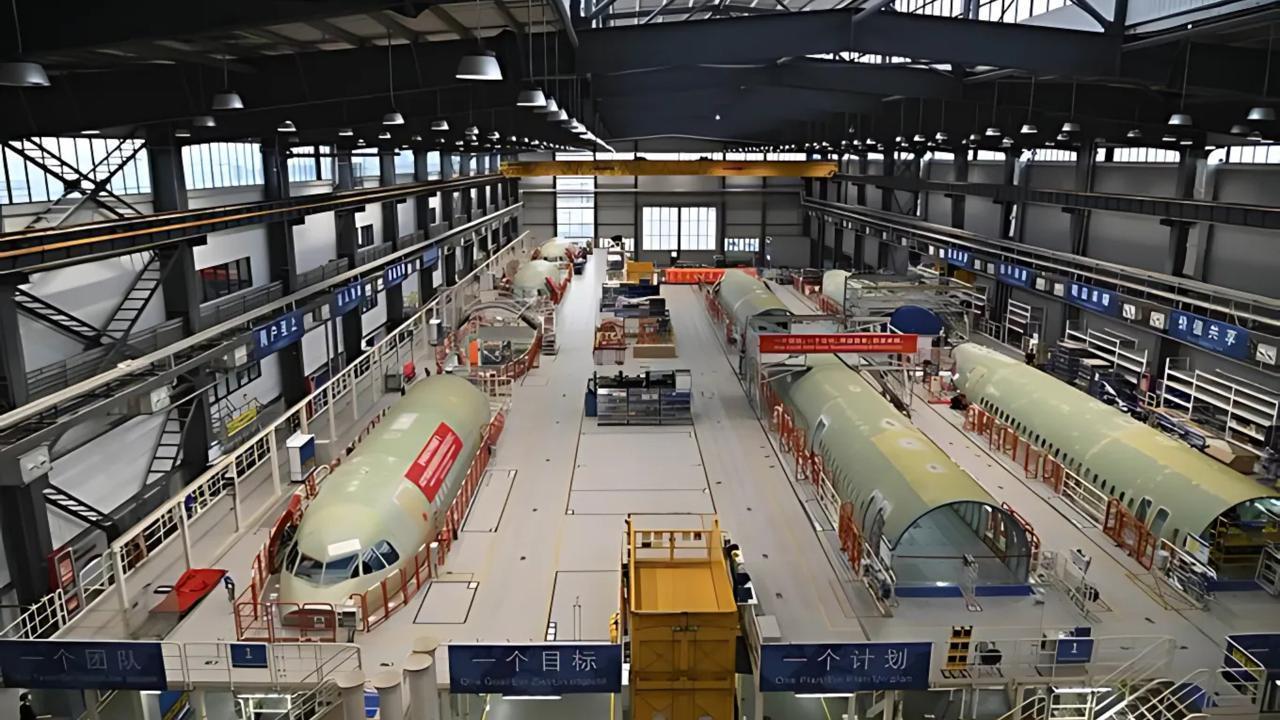
Photo : X / China Sciencea
AVIC Takes a Strategic Leap with A321 Fuselage Work in Tianjin
China’s AVIC (Aviation Industry Corporation of China) has launched its first A321 fuselage equipping operations at the Tianjin Airbus Final Assembly Line. The move marks a deeper integration between Airbus and Chinese aerospace manufacturing and highlights China’s ambition to ascend the value chain of international aircraft production.
The milestone was officially confirmed by Airbus and AVIC representatives during a joint press event at the Tianjin site, where the first A321 fuselage section—previously only assembled structurally—began undergoing internal systems installation, wiring, and cabin outfitting.
This development represents a major step beyond structural assembly. It now brings complex system integration tasks—long kept within Airbus’ European plants—into China’s domain.
From Structure to Systems: What Equipping Really Means
Until now, Tianjin’s Airbus assembly facility mainly handled structural tasks such as joining the forward, central, and aft fuselage sections of the A320 family, along with final aircraft assembly, painting, and delivery. The new initiative—called “fuselage equipping”—involves installing the essential operational systems inside the fuselage.
This includes hydraulic lines, avionics racks, air conditioning ducts, insulation panels, electrical wiring harnesses, and partial cabin elements like flooring or cable trays. The step-up in complexity requires higher-precision engineering, enhanced worker training, and tighter process controls.
Airbus China CEO George Xu emphasized the importance of this leap, stating: “This move represents a new level of trust and technical alignment between Airbus and our Chinese partners. It’s not just assembling planes anymore—it’s about building the systems that make them fly.”
A321 Demand Surges: Why Airbus Needs China’s Deeper Help
This move comes as Airbus continues to ramp up global production of the A321neo—the most popular variant in the A320neo family. With narrowbody orders piling up from airlines seeking fuel-efficient replacements and low-cost operators betting on high-capacity single-aisle aircraft, Airbus is under pressure to meet its ambitious production target of 75 aircraft per month by 2026.
The Tianjin plant, Airbus’ only final assembly line outside Europe and the U.S., plays a pivotal role in easing the bottleneck. As of 2023, it had already begun delivering A321neo aircraft in addition to the A320neo. Now, with equipping included, Tianjin’s scope is expanding beyond just final assembly to upstream work.
According to Airbus China’s production roadmap, Tianjin’s output is expected to double by 2026, with up to 8 aircraft completed per month—roughly 10% of the company’s global single-aisle output.
By shifting system installation tasks to China, Airbus is effectively replicating key segments of its Hamburg and Toulouse operations in Tianjin. This is both a strategic hedge and a response to growing airline backlogs.
AVIC’s Role Expands: From Parts Supplier to Integrated Partner
For AVIC, the development signals its evolution from a supplier of aircraft parts to a more integrated partner in global aircraft production chains. The state-owned aviation conglomerate, known mainly for producing military aircraft and components for COMAC, has long been seeking deeper integration into Western civil aviation programs.
The A321 fuselage equipping project is spearheaded by AVIC’s Xi’an Aircraft Industrial Corporation, which has already been supplying fuselage sections and center wing boxes for various Airbus programs for more than a decade. Now, with the new responsibilities in Tianjin, AVIC is taking on more value-added work—technically demanding and closely scrutinized by European quality regulators.
Airbus officials note that AVIC teams in Tianjin underwent 18 months of technical training and quality assurance programs co-developed with engineers from Hamburg and Saint-Nazaire.
“The A321 equipping line is not just another production hall. It’s a proving ground for how we integrate AVIC’s workforce and facilities into the Airbus global production standard,” said an Airbus production manager during the press conference.
Geopolitical Underpinnings: Hedging Supply Chains in an Uncertain World
Airbus’ decision to deepen its collaboration with China comes at a time of growing geopolitical uncertainty and industrial de-risking. While U.S.-China tensions continue to create a complicated landscape for Boeing, Airbus has managed to maintain strong ties with Chinese authorities and industry players.
Expanding operations in Tianjin is a signal of Airbus’ intent to remain a “trusted Western partner” within China’s aviation growth story. But it also gives Airbus greater geographic redundancy in case of production slowdowns or trade friction in Europe or North America.
Analysts suggest that Airbus is carefully threading the needle—expanding its reliance on China without fully exposing its IP or operational independence.
“Fuselage equipping is a complex but safe middle ground,” notes aerospace strategist Daniel Hemmert. “It doesn’t involve full avionics software, flight control law integration, or final aircraft testing—but it still signals high trust and a shared production culture.”
What This Means for China's Aviation Ambitions
From China’s perspective, the project reflects a quiet but persistent campaign to become a high-end aviation manufacturing hub. While state-backed COMAC continues to push its C919 program, Chinese leaders understand that deepening industrial ties with Airbus builds talent pipelines, enhances engineering standards, and aligns Chinese aerospace firms with global quality benchmarks.
The Tianjin equipping line is also a source of national pride. Local governments have already rolled out incentives to support the Airbus-AVIC ecosystem, including worker housing, logistics infrastructure, and vocational training centers specializing in aircraft interiors and systems wiring.
In a statement, China’s Ministry of Industry and Information Technology called the project a “landmark in international industrial cooperation with deep technological transfer and local capability enhancement.”
Talent, Training, and the Rise of a Skilled Aerospace Workforce
The fuselage equipping line is also sparking transformation in China’s technical labor force. Airbus has invested heavily in training local engineers, technicians, and quality inspectors. Many of the equipping staff are AVIC employees who have been retrained in European-standard procedures, using Airbus’ proprietary process documentation and software.
Joint training programs between Tianjin universities and AVIC now include specializations in aircraft systems installation, safety protocols, and non-destructive testing.
“In five years, we expect a pipeline of 2,000 Airbus-certified technicians to be available in Tianjin,” says Li Chen, director of HR at AVIC Tianjin. “This will not only serve Airbus but also boost our own aerospace programs.”
Economic and Strategic Ripple Effects
Beyond aerospace, the equipping line has knock-on effects on the local economy and supply base. At least 15 Chinese SMEs in adjacent zones have been certified to produce auxiliary components for the A321 project, ranging from wire clamps and insulation brackets to floor panels and air ducts.
The demand for high-reliability parts has lifted local industrial standards and created new export opportunities. AVIC and Airbus are also exploring whether similar equipping processes could be transferred to China’s domestic aircraft programs in the future, particularly for the C919 and CR929.
“This cooperation is not about today’s plane only,” said an AVIC vice chairman during the event. “It’s about building a long-term ecosystem of excellence.”
Will Airbus Expand Even Further in China?
Airbus has not ruled out further expansions in China. While final assembly and fuselage equipping are now well-established, other segments—such as engine nacelle integration, wing equipping, and systems testing—may eventually follow, depending on global demand and political alignment.
A key variable will be whether Airbus believes it can scale production in China without compromising its internal IP protections or its relationships with Western regulators and partners.
For now, the strategy seems to be working. Airbus gains a higher production ceiling; China builds capacity and reputation; AVIC climbs the value ladder; and airlines around the world benefit from shorter delivery times on one of the world’s most in-demand aircraft.
A New Chapter in Airbus-China Industrial Ties
With the launch of A321 fuselage equipping in Tianjin, Airbus and AVIC have entered a deeper phase of industrial collaboration—one that goes beyond the simple arithmetic of supply and demand.
It’s a story of trust, capability-building, and strategic hedging, but also of ambition. For Airbus, it’s about delivering more jets in less time. For China, it’s about proving it can build not just airplanes, but the sophisticated ecosystems behind them.
As the global aerospace industry navigates a world of backlogs, geopolitical recalibrations, and shifting centers of manufacturing gravity, the events in Tianjin today may well be remembered as a turning point.
A321 Fuselage, Tianjin



Advances in Aerospace Technology and Commercial Aviation Recovery
Insights into breakthrough aerospace technologies and commercial aviation’s recovery amid 2025 chall

Defense Modernization and Strategic Spending Trends
Explore key trends in global defense modernization and strategic military spending shaping 2025 secu

Tens of Thousands Protest in Serbia on Anniversary of Deadly Roof Collapse
Tens of thousands in Novi Sad mark a year since a deadly station roof collapse that killed 16, prote

Canada PM Carney Apologizes to Trump Over Controversial Reagan Anti-Tariff Ad
Canadian PM Mark Carney apologized to President Trump over an Ontario anti-tariff ad quoting Reagan,

The ad that stirred a hornets nest, and made Canadian PM Carney say sorry to Trump
Canadian PM Mark Carney apologizes to US President Trump after a tariff-related ad causes diplomatic

Bengaluru-Mumbai Superfast Train Approved After 30-Year Wait
Railways approves new superfast train connecting Bengaluru and Mumbai, ending a 30-year demand, easi




