Post by : Amit
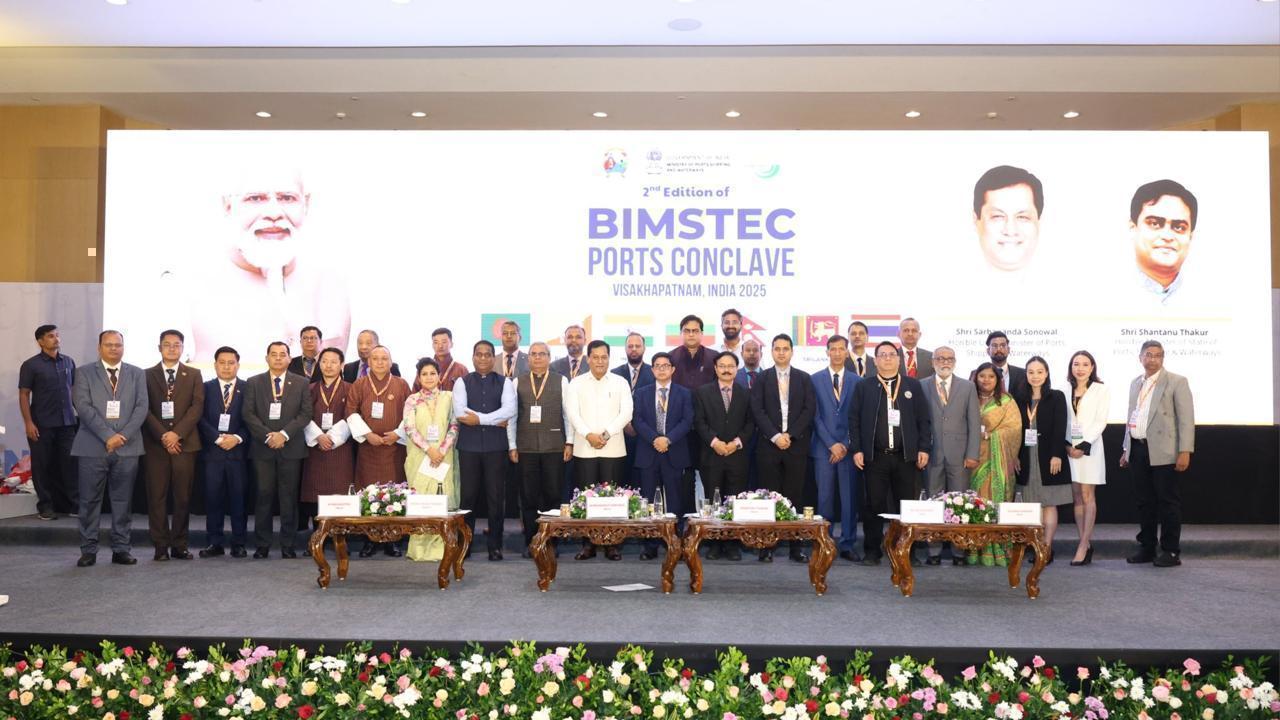
Photo : X / Sarbananda Sonowal
A Historic Step Towards Integrated Maritime Growth
In a landmark development poised to reshape maritime connectivity across Asia, the seven-member BIMSTEC (Bay of Bengal Initiative for Multi-Sectoral Technical and Economic Cooperation) bloc has formally signed a Maritime Transport Cooperation Agreement. The move, hailed as a historic milestone by Union Minister of Ports, Shipping and Waterways Sarbananda Sonowal, marks a decisive shift towards a more integrated and sustainable maritime economy in South and Southeast Asia.
This strategic pact, finalized at the BIMSTEC Ministerial Meet, reflects a shared vision to enhance port connectivity, foster cruise and coastal shipping networks, and unlock seamless cargo and passenger movement across regional waters. For India, it represents a bold new chapter in its Act East Policy, reaffirming its role as a maritime anchor in the Indo-Pacific.
Bay of Bengal at the Heart of Asia’s Future Supply Chains
Long considered a vital yet underutilized maritime corridor, the Bay of Bengal is now stepping into the limelight as the future artery of Asia’s trade and logistics. The new BIMSTEC maritime framework lays the groundwork for harmonized shipping standards, cross-border port coordination, and simplified customs procedures between India, Bangladesh, Sri Lanka, Myanmar, Thailand, Nepal, and Bhutan.
With a population base exceeding 1.7 billion and growing economic interdependence, the BIMSTEC bloc is uniquely positioned to catalyze intra-regional trade. Analysts believe the agreement could dramatically lower shipping costs, increase the frequency of vessel movements, and stimulate new opportunities for both cargo handling and cruise tourism at ports like Chennai, Chattogram, Colombo, and Yangon.
India, in particular, is keen on leveraging eastern ports such as Kolkata, Paradip, and Visakhapatnam to act as transit hubs and logistics anchors for smaller ports along the Bay of Bengal’s rim. These hubs will support cargo transshipment, inter-island ferry routes, and integrated cruise circuits.
Boosting Tourism Through Maritime Routes
One of the most compelling elements of the BIMSTEC pact is its focus on developing a robust and sustainable cruise tourism network. Minister Sonowal emphasized that the agreement enables member states to operate multi-country cruise itineraries, fostering regional travel and port-of-call tourism along scenic coastlines and culturally significant destinations.
From the pristine beaches of the Andaman and Nicobar Islands to the vibrant ports of Thailand and Myanmar, the agreement envisions the Bay of Bengal as Asia’s maritime Mediterranean—a zone where leisure, trade, and diplomacy converge through a network of joint cruise routes. This will bring not only economic benefits but also cultural exchange and soft power opportunities for participating nations.
Key to this plan is the creation of harmonized visa regimes, digitized immigration systems, and common maritime safety protocols to ensure smooth passenger travel. Eco-tourism and marine conservation are also integral to the initiative, ensuring that expansion does not come at the cost of environmental degradation.
A Platform for Sustainable Maritime Economy
Unlike traditional trade pacts focused solely on commerce, the BIMSTEC Maritime Agreement emphasizes ecological responsibility and green development. All seven nations have pledged to prioritize environmental stewardship in maritime activities, including pollution control, climate-resilient port design, and clean shipping technologies.
India is expected to lead by example through its flagship Sagarmala and PM Gati Shakti programs, which integrate sustainability into infrastructure planning. Planned investments include electric ferries, green hydrogen-powered vessels, solar-powered ports, and marine ecosystem monitoring systems.
Joint training programs, technology sharing, and disaster response coordination are part of the broader plan to build regional resilience. These steps aim to protect vulnerable coastal communities from rising sea levels, cyclones, and other climate-related disruptions while improving maritime governance.
Strategic Realignment in a Changing Global Order
The agreement comes at a time when the global maritime landscape is undergoing significant turbulence due to geopolitical disruptions in the South China Sea, Red Sea, and around Taiwan. For countries across South and Southeast Asia, the Bay of Bengal now emerges as a strategic alternative—one that offers economic promise without the political friction of contested waters.
India’s leadership in BIMSTEC also underscores its efforts to create regional alliances outside the China-centric RCEP. By establishing a rules-based maritime framework that emphasizes cooperation, transparency, and shared growth, the BIMSTEC pact enhances India’s influence in the Indo-Pacific and supports its ambition to be a net security provider in the region.
As traditional global shipping lanes become congested or unstable, the Bay of Bengal offers a compelling alternative: politically stable, economically viable, and geographically optimal.
India’s Role as the Maritime Architect
India has positioned itself at the helm of this transformative agreement, contributing not just diplomatic capital but also critical infrastructure, policy design, and technological expertise. The Ministry of Ports, Shipping and Waterways is already working closely with port authorities, cruise companies, and inland waterways agencies to accelerate the pact’s rollout.
Sarbananda Sonowal described India’s role as both connector and facilitator, ensuring that the Bay of Bengal becomes a conduit for prosperity, sustainability, and regional solidarity. His ministry is developing digital dashboards for tracking port connectivity, streamlining traffic management, and offering real-time analytics to operators across BIMSTEC.
India’s financial and logistical support will also extend to joint maritime safety initiatives, investment in shipbuilding clusters, and expanding maritime academies for regional crew training.
Operational Challenges and Policy Gaps
Despite the optimism, translating the agreement into functional reality will require resolving significant logistical and political hurdles. Infrastructure disparity across ports, varied levels of digital readiness, and differing legal frameworks could slow down integration efforts.
Industry experts have stressed the need for a permanent BIMSTEC maritime secretariat to manage implementation, oversee dispute resolution, and maintain coordination across national maritime administrations. Additionally, differences in language, visa regimes, and port security standards could present operational barriers unless harmonized through mutual agreements and regular policy dialogue.
Nonetheless, the inclusion of dedicated technical committees and performance benchmarks within the agreement provides a structured path forward.
Cruise Lines and Coastal Operators Gear Up
With the agreement now in place, cruise operators and coastal shipping firms are moving quickly to assess new opportunities. Indian companies like Cordelia Cruises are preparing to launch services connecting Kochi, Colombo, and Phuket, while international players explore collaborative ventures with local partners in Bangladesh and Myanmar.
Shipbuilders are already reporting a spike in inquiries for smaller passenger vessels and coastal cargo barges tailored to BIMSTEC routes. Regional maritime training institutes have begun updating certification programs to meet anticipated crew demand and safety compliance standards.
Simultaneously, port authorities are preparing to accommodate increased passenger and container flow through digital manifest processing, simplified berth allocation systems, and green corridor designations for low-emission vessels.
Paving the Way for a Blue Economic Corridor
If implemented efficiently, the BIMSTEC maritime pact could evolve into the backbone of a full-fledged Blue Economic Corridor—one that nurtures commerce, connectivity, and conservation in equal measure. With shared civilizational heritage, interconnected economies, and a growing appetite for growth, the Bay of Bengal could soon emerge as a maritime marketplace to rival the world’s most dynamic coastal trade zones.
Unlike the Indian Ocean’s western corridor, which often gets the lion’s share of global attention, the eastern seaboard is now showing signs of becoming the next powerhouse of growth. The transformation from a neglected coastline to a unified maritime ecosystem is no longer a dream—it is already underway.
As infrastructure upgrades begin, vessels chart new routes, and tourists board cruises to explore the Bay's scenic beauty, BIMSTEC's maritime pact stands out not merely as a diplomatic win, but as a bold declaration that the future of Asian trade will be built on cooperation, sustainability, and shared prosperity.
BIMSTEC, Bay of Bengal, Trade Routes



Advances in Aerospace Technology and Commercial Aviation Recovery
Insights into breakthrough aerospace technologies and commercial aviation’s recovery amid 2025 chall

Defense Modernization and Strategic Spending Trends
Explore key trends in global defense modernization and strategic military spending shaping 2025 secu

Tens of Thousands Protest in Serbia on Anniversary of Deadly Roof Collapse
Tens of thousands in Novi Sad mark a year since a deadly station roof collapse that killed 16, prote

Canada PM Carney Apologizes to Trump Over Controversial Reagan Anti-Tariff Ad
Canadian PM Mark Carney apologized to President Trump over an Ontario anti-tariff ad quoting Reagan,

The ad that stirred a hornets nest, and made Canadian PM Carney say sorry to Trump
Canadian PM Mark Carney apologizes to US President Trump after a tariff-related ad causes diplomatic

Bengaluru-Mumbai Superfast Train Approved After 30-Year Wait
Railways approves new superfast train connecting Bengaluru and Mumbai, ending a 30-year demand, easi




