Post by : Amit
Photo : X / My India Index
Strategic Rail Expansion in a Sensitive Zone
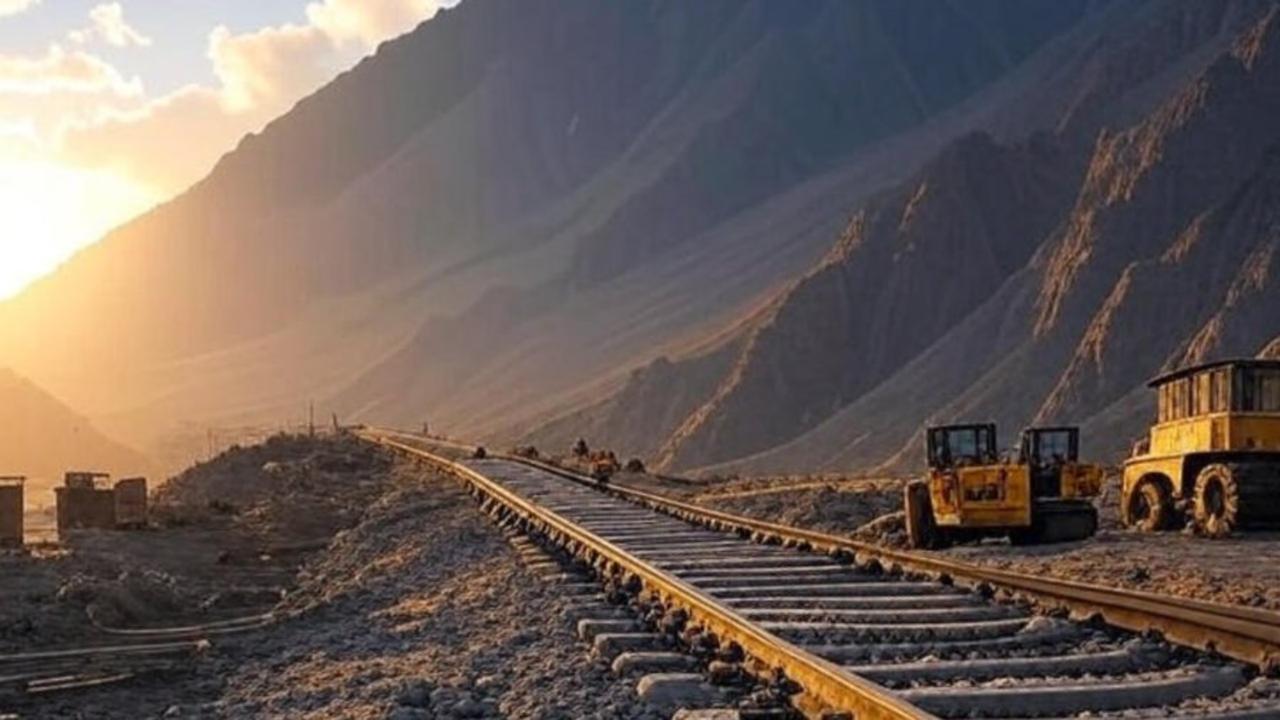
China has announced plans to construct a new railway line linking its Xinjiang and Tibet regions, running close to the disputed Line of Actual Control (LAC) with India. The move, reported by Chinese state media and international news outlets, is being viewed as a significant development with both economic and strategic implications.
The proposed route would connect key urban centers in Xinjiang with remote areas of western Tibet, creating an integrated transport corridor through one of the most militarily sensitive zones in Asia. While Chinese authorities have framed the project as an economic initiative to boost connectivity and development, analysts and defense experts are pointing out its potential to alter the security landscape along the Himalayan frontier.
A Strategic Corridor in the Making
According to preliminary details, the rail link will traverse areas near the western sector of the LAC, where India and China have had multiple standoffs in recent years, including the 2020 Galwan Valley clash. This corridor is expected to reduce travel time between Xinjiang and Tibet significantly, enhancing China’s ability to mobilize goods, resources, and—potentially—military assets across challenging mountainous terrain.
The railway would also integrate into China’s broader Belt and Road Initiative (BRI) framework, serving as an inland counterpart to its extensive coastal infrastructure projects. By connecting Xinjiang’s transport network directly with Tibet’s rail and road systems, Beijing aims to strengthen domestic cohesion while expanding logistical capabilities in a geopolitically tense region.
India’s Strategic Concerns
For New Delhi, the announcement is bound to raise red flags. The Indian defense establishment has long been wary of Chinese infrastructure projects in close proximity to the LAC, particularly those capable of supporting rapid troop and equipment movement. Railways in high-altitude regions can serve dual purposes—supporting civilian transport and commerce while also enabling swift military deployment.
Military analysts in India note that the new rail line could shorten China’s response time in border areas and provide a logistical advantage in the event of future tensions. It could also facilitate large-scale movement of construction materials and heavy machinery, enabling China to fortify its positions or build additional infrastructure along disputed stretches.
Chinese Rationale and Official Position
From Beijing’s perspective, the Xinjiang-Tibet rail project is part of a broader plan to enhance regional integration, improve living standards, and promote tourism in remote border areas. Chinese state media has emphasized economic development, claiming that better connectivity will uplift ethnic minority communities in both regions.
Officials have also highlighted the engineering challenges and achievements associated with high-altitude railway construction, portraying the project as a technological showcase for China’s railway sector. They insist the line will serve civilian purposes, much like the Qinghai-Tibet railway, which Beijing similarly framed as an economic development project when it opened in 2006.
Historical Context of Border Infrastructure
China’s push to expand transport infrastructure along its Himalayan frontier is not new. Over the past two decades, it has constructed highways, airstrips, and logistics hubs near the LAC. These projects have transformed China’s side of the border, allowing for faster troop rotations and supply delivery to high-altitude garrisons.
India, in turn, has accelerated its own border infrastructure program, upgrading roads, bridges, and airbases to counter China’s strategic advantage. The two countries have also been engaged in an ongoing effort to strengthen military presence in sensitive areas, resulting in a tense but largely stable standoff punctuated by occasional skirmishes.
Potential Economic Benefits and Civilian Uses
While security concerns dominate headlines, the railway also carries potential economic benefits for China’s domestic agenda. Xinjiang and Tibet are among the least economically developed regions in China, with limited industrial bases and low population densities. Improved transport links could make it easier to move goods and attract investment in sectors such as mining, tourism, and renewable energy.
The line could also encourage cultural exchange and domestic tourism, enabling more Chinese citizens to visit remote regions and strengthening Beijing’s administrative grip over these areas. Such integration efforts are in line with China’s long-standing policy of promoting Han migration and economic activity in border regions to consolidate national unity.
Engineering Feats in Extreme Conditions
Constructing a railway in this region will be a formidable engineering challenge. The terrain is characterized by steep gradients, fragile geology, and extreme weather conditions, including sub-zero temperatures for much of the year.
Chinese engineers are expected to deploy advanced tunneling techniques, permafrost stabilization systems, and high-altitude safety measures to overcome these obstacles. The experience gained from building the Qinghai-Tibet railway, which traverses similar conditions, will likely be applied here—albeit with additional complexity due to the route’s proximity to militarized zones.
Environmental and Social Impacts
Environmentalists have voiced concerns that large-scale construction in Tibet’s fragile ecosystem could lead to soil erosion, wildlife disruption, and water pollution. The high-altitude plateau, often called the “Roof of the World,” is a critical source of Asia’s major rivers and home to unique biodiversity.
Local communities—many of them Tibetan or Uyghur minorities—may also face social and cultural changes as outside workers and tourists enter the region in greater numbers. Critics argue that development projects often prioritize state control and resource extraction over the needs and wishes of indigenous populations.
India’s Response and Strategic Options
While India has not yet issued an official statement on the railway plan, defense experts expect the issue to feature prominently in diplomatic and military dialogues with China. New Delhi could intensify its own border infrastructure development, fast-track railway and road projects in Ladakh and Arunachal Pradesh, and enhance surveillance of Chinese activities near the LAC.
India is also likely to leverage its partnerships with countries such as the United States, Japan, and Australia—members of the Quad security grouping—to strengthen its strategic posture in the Indo-Pacific. While these partnerships are not directly focused on the Himalayan border, they contribute to India’s overall deterrence capabilities against Chinese assertiveness.
Geopolitical Ramifications Beyond India
The Xinjiang-Tibet rail project could also have implications for other neighboring countries and the broader geopolitical landscape. Enhanced Chinese infrastructure in the Himalayas may enable Beijing to project influence into South Asia more effectively, potentially affecting Nepal and Bhutan.
In the context of the Belt and Road Initiative, this project reinforces China’s strategy of creating multiple overland transport corridors that bypass maritime chokepoints. By developing robust inland connectivity, China can safeguard trade and resource flows even in the face of maritime disruptions.
A Pattern of Strategic Infrastructure Projects
The railway plan fits into a broader pattern of Chinese strategic infrastructure development in contested or sensitive areas. Similar projects include rail and road construction in the South China Sea’s disputed islands and in regions bordering Russia and Central Asia. In each case, Beijing combines economic justifications with potential military utility, blurring the line between civilian and defense infrastructure.
This dual-use approach complicates the responses of rival nations, which must weigh the diplomatic costs of protesting economic development projects that may have hidden strategic functions.
Timelines and Uncertainties
Details about the project’s construction schedule remain scarce, and given the engineering difficulties, it could take several years to complete. Funding sources, environmental assessments, and precise routing have yet to be disclosed publicly.
However, China’s track record in executing large-scale infrastructure projects—often ahead of schedule—suggests that once construction begins, progress could be rapid. The strategic location ensures that the project will be closely monitored by India and other interested parties.
Balancing Development and Security
For China, the Xinjiang-Tibet railway represents both an economic investment and a strategic asset. For India, it is a reminder that infrastructure development in disputed regions is never purely about economics. The challenge for policymakers will be to address security risks without unnecessarily escalating tensions, especially at a time when bilateral relations remain fragile.
The coming years will reveal whether this project becomes a symbol of regional integration—or another flashpoint in the long, complex relationship between Asia’s two largest nations.
China’s decision to push forward with a rail link between Xinjiang and Tibet near the LAC is more than just an infrastructure story. It is a development with the potential to reshape the strategic balance in the Himalayas, influence regional geopolitics, and spark fresh debates about the intersection of economic development and national security. For both India and China, it underscores the reality that in the high Himalayas, every road, bridge, or rail line carries significance far beyond its immediate utility.
Xinjiang-Tibet rail link, China rail project near LAC



Advances in Aerospace Technology and Commercial Aviation Recovery
Insights into breakthrough aerospace technologies and commercial aviation’s recovery amid 2025 chall

Defense Modernization and Strategic Spending Trends
Explore key trends in global defense modernization and strategic military spending shaping 2025 secu

Tens of Thousands Protest in Serbia on Anniversary of Deadly Roof Collapse
Tens of thousands in Novi Sad mark a year since a deadly station roof collapse that killed 16, prote

Canada PM Carney Apologizes to Trump Over Controversial Reagan Anti-Tariff Ad
Canadian PM Mark Carney apologized to President Trump over an Ontario anti-tariff ad quoting Reagan,

The ad that stirred a hornets nest, and made Canadian PM Carney say sorry to Trump
Canadian PM Mark Carney apologizes to US President Trump after a tariff-related ad causes diplomatic

Bengaluru-Mumbai Superfast Train Approved After 30-Year Wait
Railways approves new superfast train connecting Bengaluru and Mumbai, ending a 30-year demand, easi




