Post by : Amit
Photo : X / HON David Murotake OCDS PhD
A Vision from the Past Reborn to Dominate the Skies
Imagine merging the daring experimental designs of the 1970s with today’s AI-powered aerospace engineering to propel aircraft into speeds beyond Mach 5. That’s exactly what Chinese aerospace researchers are doing. By reviving NASA's long-dormant oblique rotating wing—or “scissor wing”—the project aims to create a futuristic, unmanned hypersonic drone carrier. This vessel could cruise near space at Mach 5, releasing swarms of autonomous drones to strike radar or communications infrastructure deep behind enemy lines. If pulled off successfully, this mothership concept could redefine the very nature of aerial warfare.
What Is the Oblique “Scissor Wing” All About?
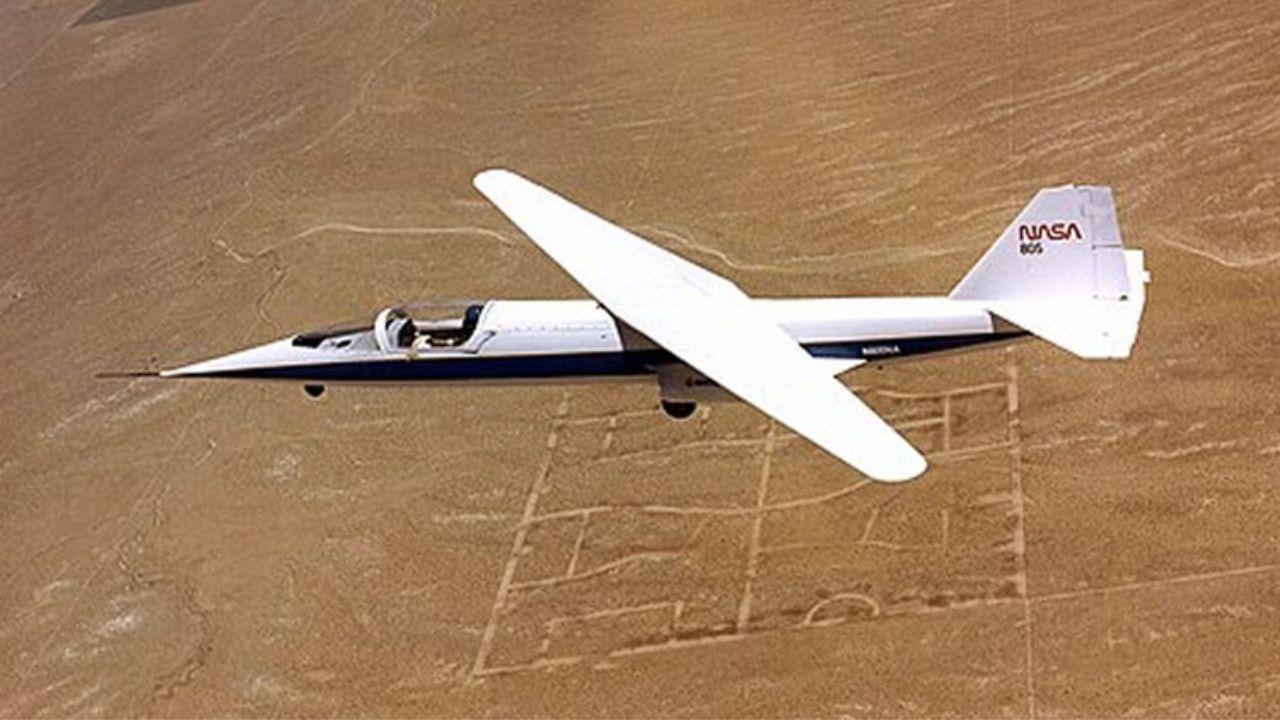
The oblique wing concept first appeared in NASA’s experimental AD-1 aircraft of the 1970s. Rather than using symmetric swing wings, this design featured a single wing that pivoted diagonally across the fuselage—across its centerline—in a scissor-like motion. At low speeds, the wing remained perpendicular to generate lift; as velocities increased to transonic and hypersonic ranges, it rotated up to 90 degrees, aligning with the fuselage to minimize drag while still providing lift.
China's new iteration updates this idea with modern tools—supercomputer CFD simulations, AI modeling, smart materials, and active control surfaces. The result is a design that could efficiently perform at vastly different speed regimes, from subsonic takeoff to Mach 5 cruise, without compromising stability or control.
From Lab Concept to Drone Mothership
Beyond aerodynamic novelty, this oblique-wing aircraft is designed with military utility in mind. It could serve as a high-speed drone carrier capable of carrying 16 to 18 compact autonomous drones inside its fuselage. Deployed at altitudes near 30 km, the craft could release these drones mid-flight—dropping them behind enemy defenses while the main body returns unscathed. This tactic offers speed, surprise, and strategic depth, with launch and return all conducted autonomously.
The Aviation Challenges That Come with Hypersonic Flight
However, reviving such a complex wing architecture is no small feat. At Mach 5, airframe surfaces exceed temperatures of 1,000°C, while critical components like the pivot shaft must remain cooler to avoid destruction. The design must manage thermal expansion, lubrication breakdown, and fatigue stress cycles. To mitigate these, researchers plan microsecond-level diagnostics, real-time strain sensors, redundant mechanics, and fail-safe locks—without which the entire project risks catastrophic failure midflight.
The Strategic Implications of a Functional Mothership
If operationalized, this hypersonic mothership would initiate a new era in aerial combat. Capable of rapid drone deployment and high-speed ingress/egress, the system could overwhelm enemy defenses with speed and distributed threats. It's not just about stealth—it’s about reach and the ability to stay just outside intercept envelopes while sending threats deep behind contested lines.
Where China Stands Among Global Aerospace Rivals
China's revival of the scissor-wing design comes amid a broader global race for hypersonic technology. The U.S., Russia, and India all invest heavily in scramjet and glide vehicles. But China’s push to combine extreme speed, adaptive wing configuration, and drone swarming could leapfrog current standards. Coupled with innovations like high-speed satellite comms and AI-controlled drones, China may be laying the groundwork for asymmetric advantage in rapid-strike aerospace operations.
A Future Powered by AI and Aerospace
The project exemplifies a fusion of AI and aerospace that could redefine aircraft design. By running live airflow models, training sensors to adapt to shifting thermal loads, and employing smart materials, designers rethink aircraft as living systems. This intelligent wing architecture embodies the future of adaptive flight, where airframes learn, sense, and react dynamically—almost like pilot-in-the-loop intuition, but faster and more precise.
Scissors Carve the Path Forward
Reviving the scissor wing for modern hypersonic systems is more than a technical marvel—it’s an act of strategic reinvention. It blurs the line between historical experimentation and tomorrow’s battlefield tools, offering speed, range, and autonomy in unprecedented combination. Whether AI, smart materials, or drone swarms, the project is racing toward a vision where aircraft are no longer bound by the limitations of rigid design or single-use missions.
In revitalizing this old NASA concept, Chinese engineers are not just redesigning wing mechanics—they’re slicing open the future of aerospace strategy.
Scissor wing hypersonic drone, China oblique wing revival, Hypersonic drone carrier



Advances in Aerospace Technology and Commercial Aviation Recovery
Insights into breakthrough aerospace technologies and commercial aviation’s recovery amid 2025 chall

Defense Modernization and Strategic Spending Trends
Explore key trends in global defense modernization and strategic military spending shaping 2025 secu

Tens of Thousands Protest in Serbia on Anniversary of Deadly Roof Collapse
Tens of thousands in Novi Sad mark a year since a deadly station roof collapse that killed 16, prote

Canada PM Carney Apologizes to Trump Over Controversial Reagan Anti-Tariff Ad
Canadian PM Mark Carney apologized to President Trump over an Ontario anti-tariff ad quoting Reagan,

The ad that stirred a hornets nest, and made Canadian PM Carney say sorry to Trump
Canadian PM Mark Carney apologizes to US President Trump after a tariff-related ad causes diplomatic

Bengaluru-Mumbai Superfast Train Approved After 30-Year Wait
Railways approves new superfast train connecting Bengaluru and Mumbai, ending a 30-year demand, easi




