Post by : Amit
Photo : X / Carlos
A New Era of Ultra-High-Speed Ground Travel Begins in China
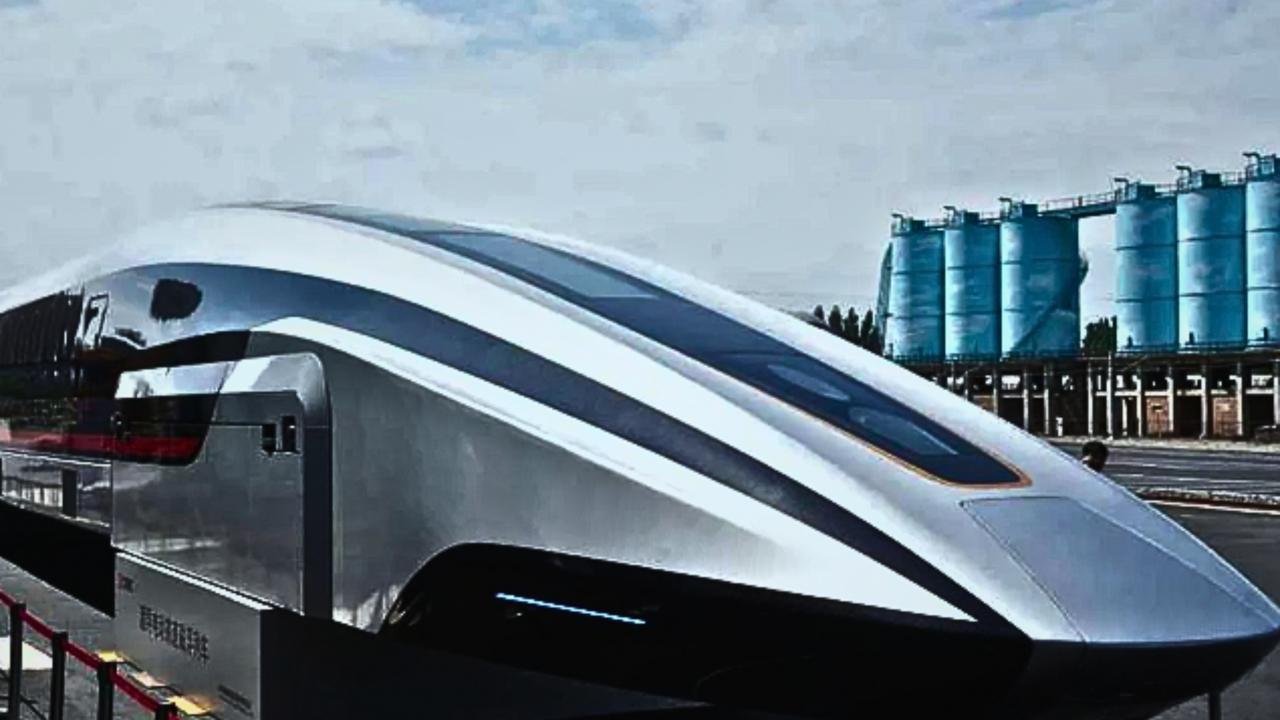
China has taken a dramatic leap forward in transportation technology with the public unveiling of its newest maglev train prototype, capable of reaching a top speed of 600 kilometres per hour (373 mph). Developed by a team of engineers and scientists in Qingdao, the train is being touted as the fastest ground vehicle in the world and marks a significant advancement in magnetic levitation (maglev) technology—a field in which China has become a global leader.
The sleek prototype, revealed in recent days and showcased by major state media outlets, uses electromagnetic force to lift and propel the train above the track, virtually eliminating friction. This allows the train to travel at speeds that drastically reduce travel times between major cities, potentially slashing Beijing-to-Shanghai journey durations to just 2.5 to 3 hours, rivaling air travel in both time and convenience.
Engineering Excellence Behind the Design
The new maglev model was developed by China Railway Rolling Stock Corporation (CRRC), in collaboration with leading research universities and magnetics labs. It reflects over five years of R&D, incorporating breakthroughs in lightweight materials, aerodynamic shaping, superconducting magnetics, and autonomous train control systems.
The vehicle features a carbon-fibre composite body for weight reduction and minimal air resistance, along with precision-guided levitation rails that allow it to maintain high-speed stability even on curved paths. Its passenger compartments are pressurized and soundproofed, offering a flight-like experience with low vibration and almost no engine noise.
The Technology: How Maglev Reaches Such Speeds
Unlike conventional trains that rely on wheel-to-rail friction, maglev trains use magnetic attraction and repulsion to hover a few centimeters above the track. Propulsion is achieved through linear synchronous motors (LSMs), which push and pull the train along the guideway using rapidly changing magnetic fields.
This design allows for near-silent operation, lower maintenance costs, and unmatched acceleration and deceleration. With no physical contact between the train and the track, wear and tear are drastically reduced, enhancing system longevity and performance consistency.
Competing with Air Travel in the Domestic Market
The high-speed maglev aims to fill the critical gap between high-speed rail (350 km/h) and domestic air travel. According to China’s Ministry of Transport, maglev systems offer a superior choice for intercity travel over distances of 600–1,500 kilometres—routes that are too long for traditional rail to be efficient, but too short for aviation to be cost-effective or environmentally friendly.
If widely deployed, this maglev could link urban megaregions like the Yangtze River Delta, Pearl River Delta, and Jing-Jin-Ji (Beijing-Tianjin-Hebei) with seamless, ultra-fast mobility, driving down carbon emissions while boosting regional productivity.
Testing and Deployment Timeline
The train has already completed extensive low-speed tests on a 1.5-kilometre track at a facility in Qingdao, with full-speed trials planned on a longer 35-km test track currently under construction. Experts involved with the program say that, barring any major delays, commercial rollout could begin by 2030, depending on how quickly dedicated maglev corridors can be built.
Unlike China’s existing maglev in Shanghai—which runs between Pudong Airport and Longyang Road at speeds up to 430 km/h—the new model is entirely indigenously developed and marks a significant step toward homegrown technological self-reliance.
Strategic Importance and Global Significance
This maglev project is not just about speed—it’s about showcasing China's growing dominance in transportation innovation. As countries around the world struggle to decarbonize transport, China's investment in advanced rail technologies positions it as a global exporter of high-speed systems, particularly to regions like Southeast Asia, the Middle East, and Africa.
It also plays into China’s Belt and Road Initiative (BRI), where the export of maglev systems could become a soft power tool, promoting infrastructure diplomacy and technological leadership.
Economic and Environmental Benefits
Beyond strategic prestige, the high-speed maglev promises strong economic and environmental dividends. Operating at higher efficiency than planes and with lower energy use per passenger-kilometre, maglev trains offer a green alternative to short-haul flights.
CRRC officials say the train's carbon footprint is roughly one-third of an airplane’s on equivalent routes, and with China's growing grid integration of renewables, the train could run entirely on clean electricity within a decade.
From an economic perspective, the train supports jobs across manufacturing, R&D, infrastructure, and engineering sectors, forming a complete industrial ecosystem that also boosts innovation in adjacent fields like power electronics, software, and materials science.
Challenges Remain: Infrastructure and Cost
Despite its promise, widespread maglev adoption faces challenges. Building dedicated maglev lines requires high initial capital investment, complex land acquisition, and urban integration. The cost of laying maglev tracks is significantly higher than conventional rail, and the technology demands rigorous maintenance and power grid stability.
Still, experts argue that long-term benefits such as lower operating costs, reduced travel congestion, and pollution offset the upfront investment—especially in countries like China that have the scale and political will to execute mega projects.
Public Reaction and National Pride
Reactions to the unveiling have been overwhelmingly positive across Chinese social media platforms. Netizens have expressed pride in the country's engineering advancements and welcomed the possibility of faster, cleaner, and more comfortable travel experiences.
For many, the maglev represents not just a transport innovation, but a symbol of national progress, engineering excellence, and a future-forward outlook that matches China's broader ambitions of technological leadership by mid-century.
Racing into the Future
As China continues to redefine what’s possible in rail mobility, this 600 km/h maglev train is more than just a prototype—it’s a bold vision of what the future of transportation could look like. Combining speed, sustainability, and homegrown ingenuity, it sets a new benchmark in global high-speed travel.
If successful, this breakthrough could fundamentally reshape intercity mobility, redefine urban planning, and cement China’s place at the forefront of next-generation transport technology.
China, High Speed Rail



Advances in Aerospace Technology and Commercial Aviation Recovery
Insights into breakthrough aerospace technologies and commercial aviation’s recovery amid 2025 chall

Defense Modernization and Strategic Spending Trends
Explore key trends in global defense modernization and strategic military spending shaping 2025 secu

Tens of Thousands Protest in Serbia on Anniversary of Deadly Roof Collapse
Tens of thousands in Novi Sad mark a year since a deadly station roof collapse that killed 16, prote

Canada PM Carney Apologizes to Trump Over Controversial Reagan Anti-Tariff Ad
Canadian PM Mark Carney apologized to President Trump over an Ontario anti-tariff ad quoting Reagan,

The ad that stirred a hornets nest, and made Canadian PM Carney say sorry to Trump
Canadian PM Mark Carney apologizes to US President Trump after a tariff-related ad causes diplomatic

Bengaluru-Mumbai Superfast Train Approved After 30-Year Wait
Railways approves new superfast train connecting Bengaluru and Mumbai, ending a 30-year demand, easi




