Post by : Amit
China’s Transport Boom Accelerates Under 14th Five-Year Plan
As China enters the final stretch of its 14th Five-Year Plan (2021–2025), the country’s transport sector is experiencing one of the most aggressive modernization pushes in its history. Driven by a policy mix of infrastructure expansion, digital upgrades, and carbon-conscious mobility, China is now poised to become a global transport powerhouse—both in scale and in strategy.
According to the Ministry of Transport, the cumulative investment in China's transport infrastructure over the past five years has reached a staggering 17.5 trillion yuan (approximately $2.41 trillion). From sprawling high-speed rail (HSR) networks to digital ports and autonomous highways, this massive push underlines the critical role mobility plays in China’s national growth narrative.
A High-Speed Rail Network That Redefines Distances
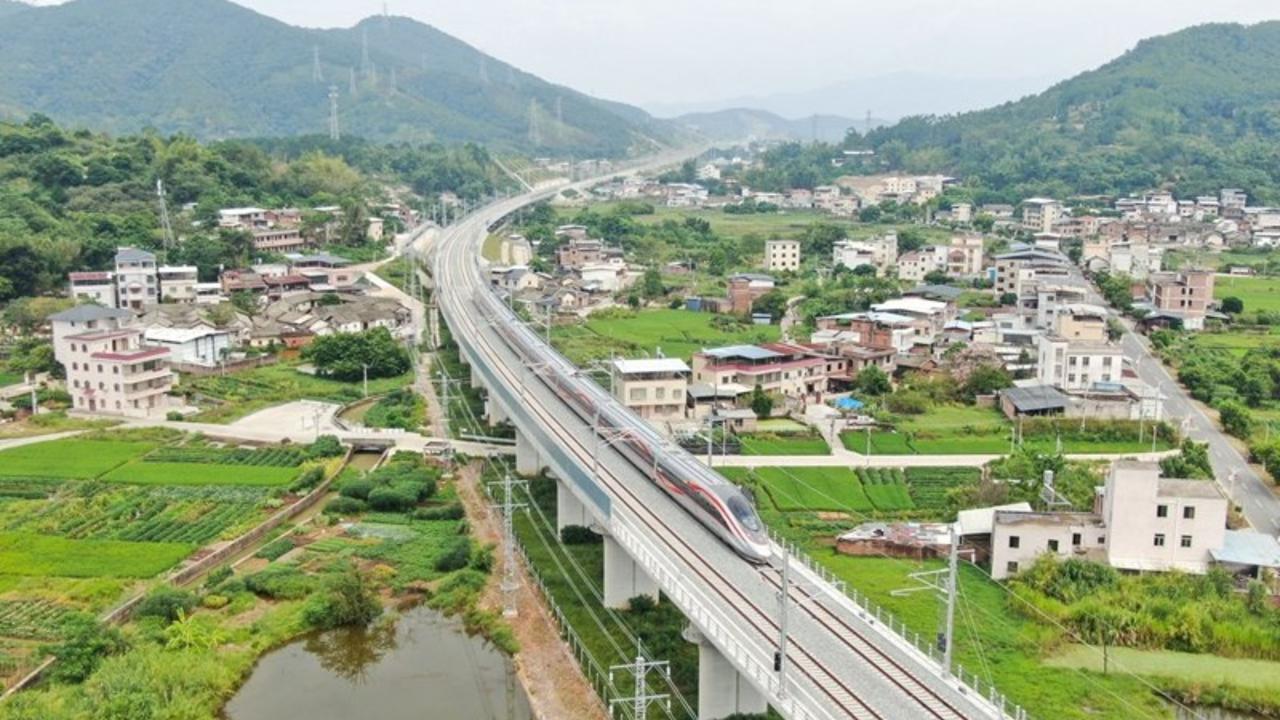
One of the centerpieces of this transport revolution is China's high-speed rail network, now the largest and fastest-growing in the world. By the end of June 2025, China’s operational HSR network exceeded 45,000 kilometers, covering over 95% of cities with populations above 500,000.
This includes new lines in traditionally underserved regions such as western Gansu, Inner Mongolia, and parts of Xinjiang, where high-speed connections are now transforming regional economies and tourism flows. According to officials, HSR is no longer just a prestige project but a socio-economic equalizer.
What sets China’s HSR apart is its integration into broader regional development schemes like the Chengdu-Chongqing Economic Circle and the Yangtze River Economic Belt. These megaregions are seeing reduced travel times from 12 hours to under four, thanks to trains traveling at up to 350 km/h.
Urban Transit Expansion: Subways, Monorails, and BRT Systems
Urban transportation has also seen accelerated growth, especially in second- and third-tier cities. Over the past four years, subway mileage has increased by more than 40%, and nearly 70 cities now operate some form of urban rail.
Notably, smaller cities like Luoyang and Hohhot have successfully launched their first metro lines under the Plan. These developments are part of China’s push to create 30-minute commute zones, wherein residents can access key urban amenities via efficient and green mass transit.
Bus Rapid Transit (BRT) networks are also gaining traction, especially in lower-density cities. Paired with real-time scheduling systems and low-emission fleets, these services are providing faster, cheaper alternatives to car travel.
Smart Highways and Connected Freight Corridors
China’s push for digitally intelligent highways is another hallmark of the 14th Plan. The Ministry of Transport confirmed that over 12,000 km of national expressways are now equipped with Vehicle-to-Infrastructure (V2I) sensors, enabling autonomous truck trials, lane optimization, and predictive maintenance.
In eastern provinces such as Jiangsu and Zhejiang, these roads serve as testbeds for Level 4 self-driving trucks, operated by companies like Baidu’s Apollo Go and JD Logistics. The integration of AI-driven road monitoring has already reduced accident rates and congestion by over 15% in some pilot zones.
Freight logistics are also becoming more efficient thanks to the national multimodal transport system, which links rail, road, and inland waterway terminals into a single digital platform. This is central to China’s “three-network integration” policy—physical networks, digital infrastructure, and energy systems—launched under the Plan.
Digital Ports and Maritime Belt Connectivity
China’s maritime expansion continues in parallel with land-based efforts. Shanghai, Ningbo-Zhoushan, and Guangzhou now operate fully automated container terminals, with 5G-enabled cranes and AI-assisted berth management. These smart ports have cut ship turnaround times by nearly 30% since 2021.
China is also increasing port capacity along the Belt and Road Initiative (BRI), with investments in Gwadar (Pakistan), Piraeus (Greece), and Hambantota (Sri Lanka). The aim is not just trade facilitation but logistical influence over Eurasian and African maritime corridors.
Under the Five-Year Plan, the country has added 38 new berths capable of handling ultra-large container ships, supporting its goal to become a hub in the global just-in-time supply chain.
Green Transport: Leading the Way in Decarbonization
Perhaps the most transformative shift under the 14th Plan is the pivot to green mobility. China’s goal is for 75% of new public vehicles to be electric or hydrogen-powered by 2025. Already, more than 70% of urban buses are electric, and hydrogen fuel-cell buses are in trial operation in Beijing and Zhangjiakou.
Long-distance electric trucks—some with solid-state batteries—are now operating on intercity routes, thanks to a growing network of ultra-fast charging depots. These e-truck corridors are part of China’s carbon peaking roadmap, targeting transport emissions stabilization by 2030.
The plan has also accelerated the rollout of electric aviation pilots, including cargo drones and eVTOL air taxis. Urban air mobility zones have been launched in Shenzhen and Chengdu for last-mile logistics, with broader certification expected by 2027.
Rural Transport Gets a Modern Upgrade
While megacities often grab headlines, the Plan places special emphasis on rural connectivity. Over the past five years, 230,000 km of rural roads have been upgraded, and over 99% of villages are now connected by paved roads.
This has allowed better access to schools, clinics, and markets, reducing transport inequality and boosting agricultural exports. The “four good rural roads” program (good planning, construction, maintenance, and operation) is cited as a global model by the World Bank.
In some areas, drones and low-altitude logistics aircraft are being used for cold-chain delivery of fresh produce and medicine, especially in mountainous provinces like Yunnan and Guizhou.
Transport and National Security: Strategic Integration
Another less-publicized but crucial element of the transport surge is its alignment with national defense strategies. The expansion of dual-use airports, modular rail spurs near border zones, and coastal logistics centers supports the civil-military integration principle at the core of national planning.
In western provinces such as Tibet and Xinjiang, multi-lane roads and railways have strategic value beyond economic development, enhancing rapid response capabilities during emergencies or geopolitical tensions.
China’s Civil Aviation Authority has also built over 70 new regional airports, many of which double as logistics hubs for disaster relief and medical emergencies, further reinforcing state resilience.
International Implications: China as a Transport Trendsetter
China’s scale of investment and speed of execution are already influencing transport policy globally. Countries in Africa, Southeast Asia, and Central Europe are adapting elements of China’s approach—particularly in high-speed rail procurement and digital port management.
However, some critics argue that this pace raises concerns about sustainability, debt-financed expansion, and long-term asset utilization. Environmentalists are also pushing for clearer guidelines on biodiversity impact, especially with mega-infrastructure slicing through ecologically sensitive zones.
Nevertheless, global observers—including the UN and World Economic Forum—have acknowledged that China’s 14th Five-Year Plan presents “the largest living lab for 21st-century transport transformation.”
The 15th Plan and Emerging Frontiers
With the 14th Plan nearing its conclusion, planning for the 15th Five-Year Cycle (2026–2030) is already underway. Insiders suggest it will further emphasize decarbonization, digital twin transport systems, and international rail expansion, including faster China-Europe freight corridors.
Chinese policymakers are expected to double down on AI-based traffic orchestration, predictive maintenance using big data, and next-gen aerospace logistics. Cross-border projects with Central Asia, Russia, and Southeast Asia will also continue under the broader Belt and Road umbrella.
Transport as the Heart of a Rising China
China’s transport surge is more than a showcase of engineering—it is a cornerstone of its socio-economic strategy, global influence, and climate roadmap. From bullet trains to AI-managed ports, from green buses to borderland roads, the 14th Five-Year Plan has redefined what is possible at national scale.
As 2025 concludes, the world is watching not just how fast China builds, but how smart, inclusive, and sustainable its transport future truly becomes.
China, Transport



Advances in Aerospace Technology and Commercial Aviation Recovery
Insights into breakthrough aerospace technologies and commercial aviation’s recovery amid 2025 chall

Defense Modernization and Strategic Spending Trends
Explore key trends in global defense modernization and strategic military spending shaping 2025 secu

Tens of Thousands Protest in Serbia on Anniversary of Deadly Roof Collapse
Tens of thousands in Novi Sad mark a year since a deadly station roof collapse that killed 16, prote

Canada PM Carney Apologizes to Trump Over Controversial Reagan Anti-Tariff Ad
Canadian PM Mark Carney apologized to President Trump over an Ontario anti-tariff ad quoting Reagan,

The ad that stirred a hornets nest, and made Canadian PM Carney say sorry to Trump
Canadian PM Mark Carney apologizes to US President Trump after a tariff-related ad causes diplomatic

Bengaluru-Mumbai Superfast Train Approved After 30-Year Wait
Railways approves new superfast train connecting Bengaluru and Mumbai, ending a 30-year demand, easi




