Post by : Saif
New military moves by China near Japan have created serious concern across East Asia. A Chinese aircraft carrier led large air drills close to Japanese waters, while both nations exchanged strong diplomatic protests. This incident shows how fragile peace has become in a region already filled with political and military pressure.
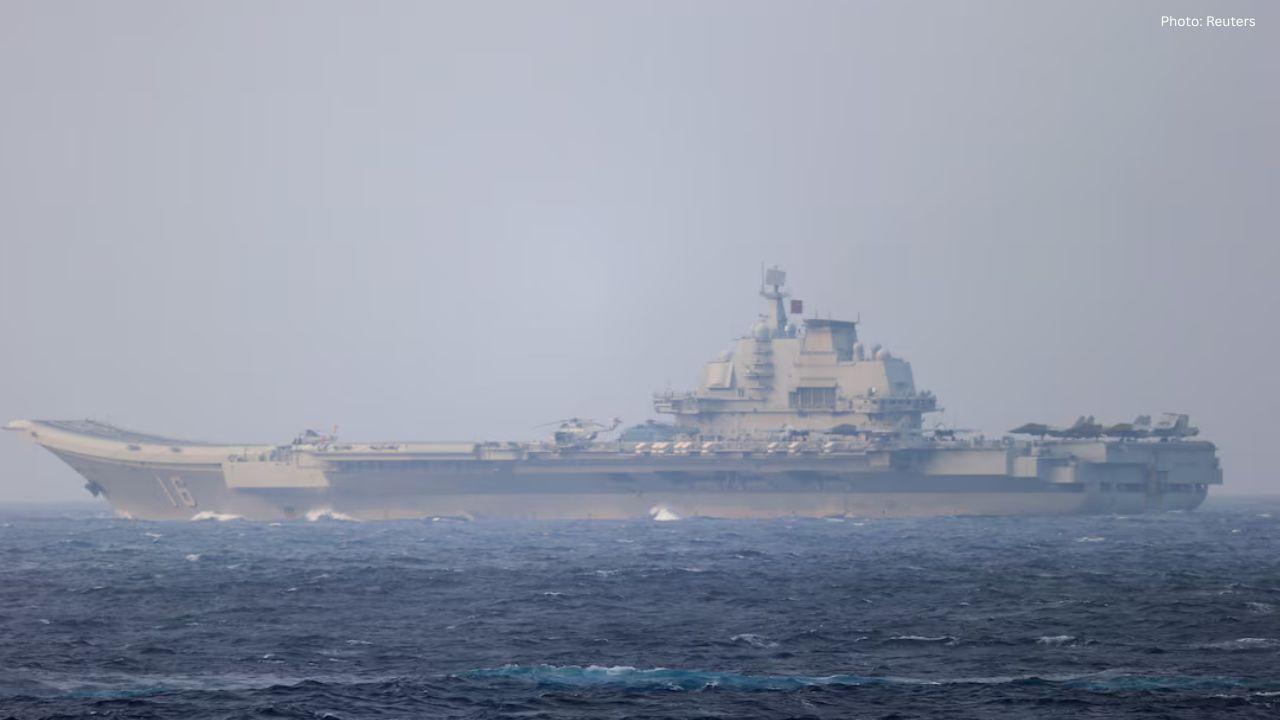
Over the weekend, China’s aircraft carrier, the Liaoning, carried out nearly 100 aircraft take-offs and landings. It sailed past Japan’s Okinawa island chain and into the Pacific Ocean. According to Japan’s Self-Defense Forces, these drills were unusually intense and took place very close to Japanese air and sea space.
Japan reacted strongly to these actions. The Japanese government summoned China’s ambassador, Wu Jianghao, and officially protested what it called dangerous behavior. Japanese officials said Chinese fighter jets used radar to “lock on” to Japanese aircraft that were monitoring the carrier group. When a radar beam locks onto a plane, it is often seen as a warning sign of a possible attack. This can force pilots to take sudden, dangerous manoeuvres to protect themselves.
China rejected Japan’s version of events. The Chinese embassy said Japanese planes had flown too close to the carrier group and had put Chinese training operations at risk. China demanded that Japan stop what it called “smearing and slandering” and control its frontline military actions.
The Japanese government stood firm in its response. Chief Cabinet Secretary Minoru Kihara said Japan would remain calm but firm. He added that Japan would continue to closely watch Chinese military movements to protect its airspace and territorial waters.
This incident is not happening in isolation. It comes at a time of rising tension over Taiwan. Taiwan is a self-governed island that China claims as its own territory. Japan has warned that any Chinese attack on Taiwan that also threatens Japan’s security could lead to a response from Tokyo. Taiwan is only about 110 kilometers from Japan’s southwestern islands, making the issue very close to Japan’s borders.
Relations between China and Japan have already been strained in recent months. After Japan released treated water from the damaged Fukushima nuclear power plant, China suspended seafood imports from Japan. Beijing also advised its citizens not to travel to Japan after strong political statements from Japanese leaders.
The role of the United States also adds to the tension. Japan hosts large numbers of U.S. military forces, especially in Okinawa. The U.S. ambassador to Japan has openly supported Japan’s position in this dispute. However, the U.S. President has remained silent, possibly due to upcoming trade talks planned with China.
This growing military activity and harsh language from both sides increase the risk of a dangerous miscalculation. When warships and fighter jets operate so close to each other, even a small mistake can turn into a serious conflict. No country in the region would benefit from such a situation.
Both China and Japan have strong economies and long histories. They should use dialogue instead of displays of force. Military drills may show strength, but they also build fear and mistrust. Peaceful communication is the only real way to prevent accidents and misjudgments.
The people of both countries deserve safety, stability, and a future free from the fear of war. Leaders must act wisely and avoid turning tension into tragedy.
#trending #latest #ChinaJapan #EastAsiaTensions #NavalDrills #PeaceAndStability #WorldPolitics #TaiwanIssue



Advances in Aerospace Technology and Commercial Aviation Recovery
Insights into breakthrough aerospace technologies and commercial aviation’s recovery amid 2025 chall

Defense Modernization and Strategic Spending Trends
Explore key trends in global defense modernization and strategic military spending shaping 2025 secu

Tens of Thousands Protest in Serbia on Anniversary of Deadly Roof Collapse
Tens of thousands in Novi Sad mark a year since a deadly station roof collapse that killed 16, prote

Canada PM Carney Apologizes to Trump Over Controversial Reagan Anti-Tariff Ad
Canadian PM Mark Carney apologized to President Trump over an Ontario anti-tariff ad quoting Reagan,

The ad that stirred a hornets nest, and made Canadian PM Carney say sorry to Trump
Canadian PM Mark Carney apologizes to US President Trump after a tariff-related ad causes diplomatic

Bengaluru-Mumbai Superfast Train Approved After 30-Year Wait
Railways approves new superfast train connecting Bengaluru and Mumbai, ending a 30-year demand, easi




