Post by : Amit
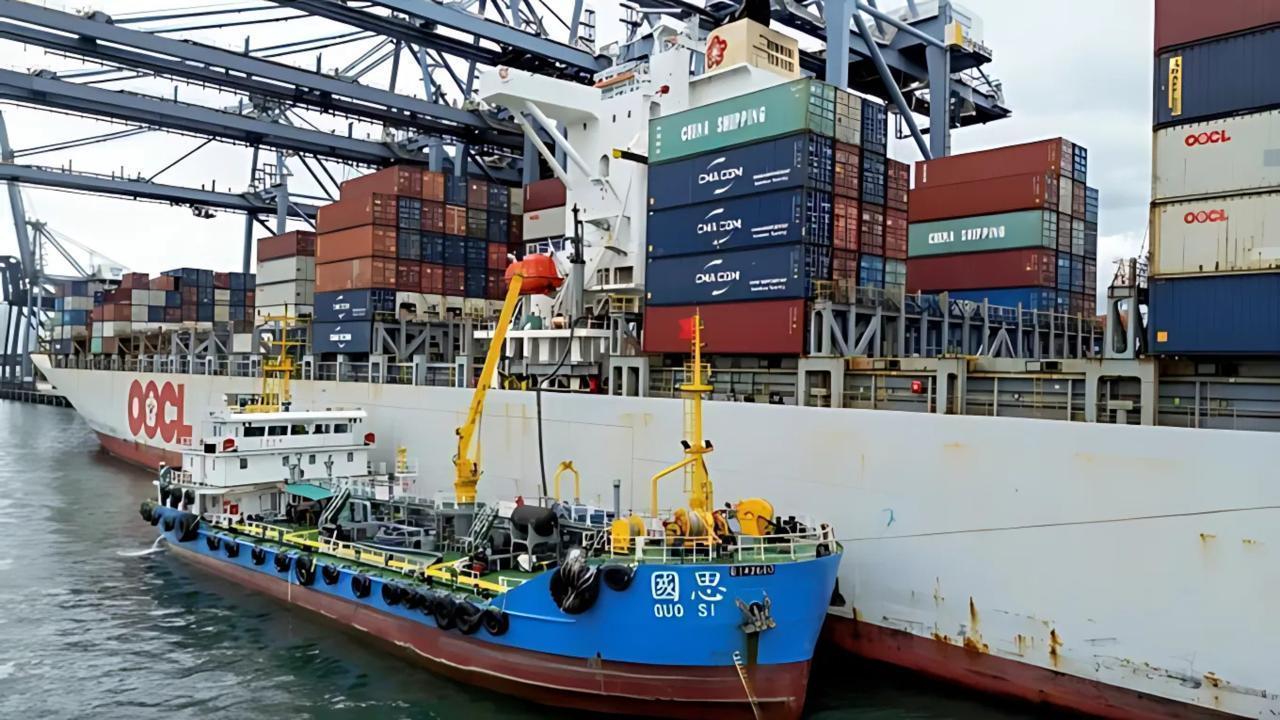
Photo : X / Green Marine
A Bold Step for China’s Clean Fuel Ambitions
China’s maritime industry is taking another decisive leap toward cleaner seas, as two of its leading shipbuilders have joined forces to design and develop a 20,000 cubic meter LNG bunkering vessel. This ship, conceived to meet the rising demand for liquefied natural gas as a marine fuel, will be among the largest and most advanced of its kind in the world. It reflects both China’s commitment to sustainable shipping and its ambition to dominate the rapidly expanding LNG refueling sector.
The move comes at a pivotal moment. Global shipping is under increasing pressure to reduce its environmental footprint, with the International Maritime Organization (IMO) introducing tighter caps on sulfur emissions and long-term carbon reduction targets. LNG bunkering capacity—especially at a high scale—is in short supply relative to projected demand. This vessel will be capable of refueling large ocean-going ships quickly, efficiently, and safely, while meeting the strictest international environmental standards.
Strategic Partnership for a Specialized Mission
The partnership pairs two of China’s strongest shipbuilding players, each contributing specialized expertise. One has a track record of producing large-scale LNG carriers and optimized hull designs for fuel efficiency. The other brings state-of-the-art cryogenic storage technology and advanced fuel transfer systems.
By pooling their resources, the companies are targeting a design that will combine high cargo capacity with maneuverability. The 20,000 CBM size is significant—large enough to service ultra-large container vessels, LNG-powered cruise ships, and high-capacity car carriers, yet nimble enough to call at smaller ports without extensive harbor modifications. This versatility will make the vessel competitive across a variety of operating environments, from established LNG hubs to emerging bunkering markets.
Meeting the Surge in LNG Demand
The LNG bunkering market has been expanding rapidly over the last five years. In Europe, ports such as Rotterdam, Zeebrugge, and Barcelona are now regular LNG refueling stops for major shipping lines. Asia is catching up fast—Singapore, Japan, South Korea, and China have invested heavily in LNG infrastructure to accommodate the surge in LNG-powered vessels.
China’s domestic demand is also rising sharply. Container carriers, ferries, and coastal bulk ships are shifting toward LNG to meet both regulatory requirements and customer-driven sustainability commitments. With more LNG-powered newbuilds entering service, reliable and high-volume bunkering capacity will be critical to avoiding supply bottlenecks.
Advanced Technology for Efficient Operations
The planned vessel will feature a dual-fuel propulsion system, capable of operating on both LNG and conventional marine fuels. This provides operational flexibility, allowing the ship to operate even in ports where LNG supply infrastructure is not yet established.
Its bunkering system will be engineered for rapid, safe, and flexible transfers, supporting both ship-to-ship and shore-to-ship operations. The inclusion of advanced boil-off gas management systems will capture and use natural gas that evaporates during storage, significantly reducing waste and methane slip.
The hull will be optimized for hydrodynamic performance, incorporating energy-efficient propellers and waste heat recovery systems to further reduce greenhouse gas emissions during voyages.
Environmental Impact and Regulatory Compliance
This vessel will contribute indirectly to global emission reduction targets by making LNG more accessible to the shipping fleet. When used as a marine fuel, LNG can eliminate nearly 100% of sulfur oxide emissions, reduce nitrogen oxide emissions by up to 85%, and cut carbon dioxide emissions by about 20% compared to traditional heavy fuel oil.
The design will fully comply with the IMO’s International Code of Safety for Ships using Gases or other Low-flashpoint Fuels (IGF Code), as well as classification society requirements. These rules govern fuel storage, handling, and safety measures, ensuring that operations meet both domestic Chinese and global safety standards.
Boosting China’s Shipbuilding and Maritime Influence
China’s shipbuilding industry has already secured a significant share of the LNG carrier and bunkering vessel market. The launch of this project reinforces the country’s reputation as a competitive producer of high-value, technologically advanced ships, positioning it against established leaders in South Korea and Japan.
The vessel could also become a model for export sales to other regions experiencing a surge in LNG demand, particularly in Southeast Asia, Africa, and Latin America. By developing homegrown expertise in LNG bunkering technology, China strengthens both its shipbuilding capabilities and its strategic influence over future global fuel supply chains.
Market Ripple Effects
Introducing a 20,000 CBM bunkering vessel to China’s LNG supply network will have several knock-on effects. First, it will improve the economics of LNG delivery by enabling larger volumes to be transferred in a single voyage, reducing the per-ton cost of fuel delivery. Second, it could help stabilize regional LNG bunkering prices by increasing supply capacity and reducing competition for limited bunkering slots.
For ports, hosting such a vessel will make them more attractive to international shipping lines, potentially increasing port calls, cargo throughput, and related economic activity.
Anticipated Construction and Delivery
Although the delivery schedule has not been confirmed, industry insiders suggest that the design phase will be completed within 12 months. Construction is expected to begin soon after, with an estimated build time of two to three years due to the complexity of LNG systems. This means the vessel could be operational by the late 2020s.
Modular construction methods are expected to be used, allowing the vessel to be upgraded or retrofitted in the future. This ensures that as LNG technology evolves—or as new alternative fuels become viable—the ship can adapt without requiring a complete rebuild.
A Catalyst for Future Green Marine Fuels
While LNG is a lower-carbon fuel compared to traditional options, it is widely viewed as a transitional step toward zero-emission shipping. Experts believe that investments in LNG bunkering vessels and infrastructure will also pave the way for other clean fuels such as green ammonia, hydrogen, or methanol.
The design of this 20,000 CBM vessel will include considerations for future fuel flexibility. Potential retrofits could allow it to handle cryogenic fuels other than LNG, making it a long-term asset in the evolving alternative fuel landscape.
Challenges and Opportunities Ahead
Despite LNG’s advantages, some challenges remain. Methane slip—the unburned methane that can escape during LNG production, storage, and combustion—still poses a climate concern. Technological advances in engine efficiency and gas capture systems will be key to maximizing LNG’s environmental benefits.
Additionally, while LNG infrastructure is growing, global availability is uneven. This is why the dual-fuel propulsion system on the new vessel is crucial, ensuring it can continue to operate efficiently even in ports where LNG supply is limited or absent.
Shaping the Future of Maritime Fuel Supply
The announcement of this 20,000 CBM LNG bunkering vessel is more than just an expansion of China’s fleet—it’s a signal of intent. By combining engineering expertise, environmental awareness, and commercial strategy, the two Chinese shipbuilders involved are positioning themselves not only as suppliers of ships, but as key enablers of the maritime industry’s decarbonization journey.
As more LNG-powered vessels join the global fleet, the importance of high-capacity, efficient bunkering solutions will grow. This vessel could become a blueprint for future designs, setting a benchmark for capacity, safety, and operational flexibility.
In the coming decade, the maritime fuel market will be shaped by the availability and efficiency of bunkering infrastructure. By moving early, China is ensuring it will not only meet its domestic needs but also compete for international market share. The 20,000 CBM bunkering vessel is a critical part of that strategy—and a clear step toward greener global shipping.
Chinese, LNG Bunker Ship



Advances in Aerospace Technology and Commercial Aviation Recovery
Insights into breakthrough aerospace technologies and commercial aviation’s recovery amid 2025 chall

Defense Modernization and Strategic Spending Trends
Explore key trends in global defense modernization and strategic military spending shaping 2025 secu

Tens of Thousands Protest in Serbia on Anniversary of Deadly Roof Collapse
Tens of thousands in Novi Sad mark a year since a deadly station roof collapse that killed 16, prote

Canada PM Carney Apologizes to Trump Over Controversial Reagan Anti-Tariff Ad
Canadian PM Mark Carney apologized to President Trump over an Ontario anti-tariff ad quoting Reagan,

The ad that stirred a hornets nest, and made Canadian PM Carney say sorry to Trump
Canadian PM Mark Carney apologizes to US President Trump after a tariff-related ad causes diplomatic

Bengaluru-Mumbai Superfast Train Approved After 30-Year Wait
Railways approves new superfast train connecting Bengaluru and Mumbai, ending a 30-year demand, easi




