Post by : Amit
Photo : X / Muthi-ur-Rahman Siddiqui
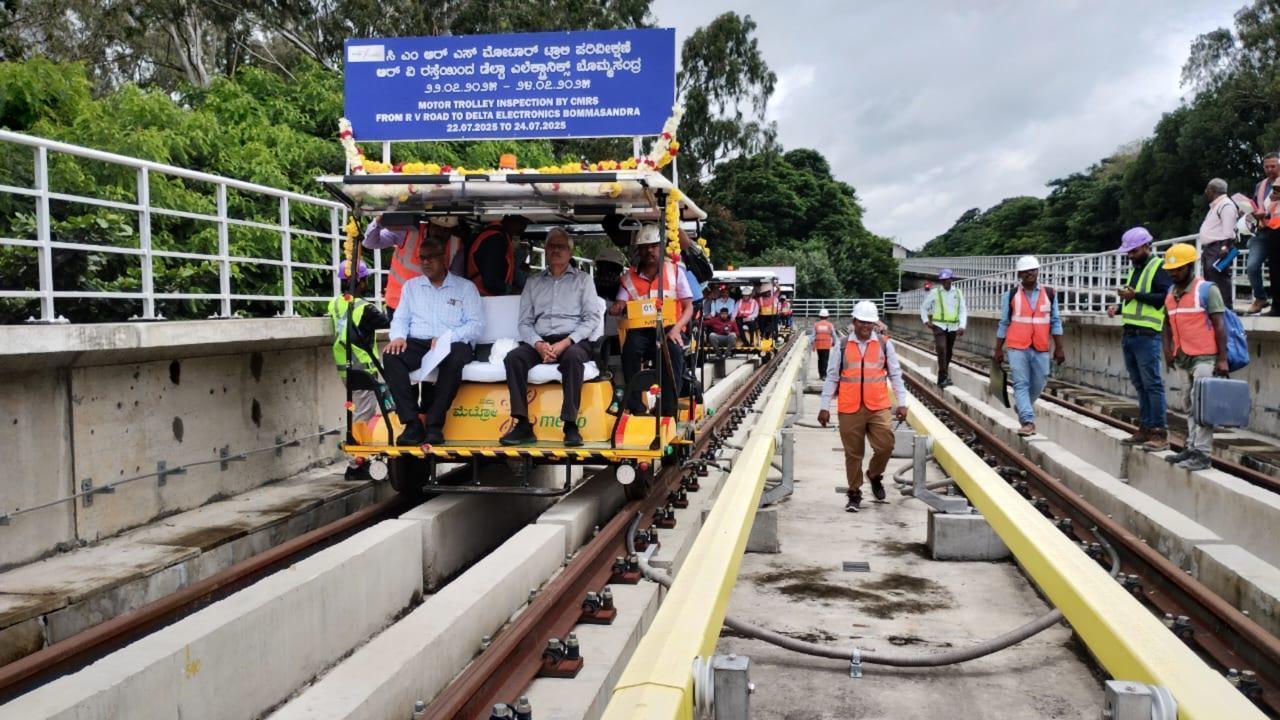
Final Safety Push: CMRS Inspects Bangalore Metro Yellow Line
Bengaluru— The long-anticipated Yellow Line of Bangalore Metro has taken a giant step toward commercial launch. The Commissioner of Metro Rail Safety (CMRS), the statutory authority for ensuring safety on all metro systems in India, has officially carried out the critical inspection process for this newly built corridor. The event marks a turning point in Phase 2 of Bangalore Metro’s expansion, potentially transforming east-west connectivity in India’s Silicon Valley.
For months, commuters and transit planners alike have watched the Yellow Line project closely, aware of the immense relief it promises to the city’s choked arterial roads. As the CMRS team inspected stations, signaling systems, and operational control rooms over multiple days this week, hopes soared that the 19.5-km corridor connecting R.V. Road to Bommasandra could soon become a functional lifeline.
What the Inspection Covers and Why It Matters
The CMRS inspection is more than just a technical formality—it’s a mandatory regulatory milestone that any metro line must clear before commercial operations can begin. Led by a specialized team, the inspection includes scrutiny of various safety systems, including:
A clean sheet from the CMRS gives the green light to commence passenger service. However, any major deficiency observed during the inspection would require rework and re-evaluation—potentially delaying public access. According to sources within Bangalore Metro Rail Corporation Limited (BMRCL), initial feedback from the CMRS team appears positive, with only a few minor adjustments requested.
The Yellow Line: A Corridor of Transformation
The Yellow Line (Reach-5) is part of Bangalore Metro’s Phase 2 development and stretches from R.V. Road in the south to Bommasandra in the industrial southeast. Spanning 16 stations, this line is being developed as a strategic connector between key residential clusters, IT hubs, and industrial belts.
Some stations along the corridor include:
This corridor is expected to cut travel time between Bommasandra and R.V. Road from 90 minutes by road to just 35 minutes by metro, drastically improving commute quality for lakhs of daily travelers.
A Gamechanger for East-West Connectivity
Currently, most of Bengaluru’s public transit lines run in a north-south orientation or serve localized regions. The Yellow Line, however, for the first time connects the southeastern industrial zone with central Bangalore, creating direct, reliable access to:
Urban transport analysts note that once the Yellow Line becomes operational, it could relieve pressure on overburdened bus networks and drastically reduce daily vehicle congestion along Hosur Road and Outer Ring Road.
Intermodal Integration with Silk Board Interchange
One of the most ambitious features of the Yellow Line is the multi-level interchange hub at Central Silk Board. Designed as a future-ready infrastructure node, this interchange will eventually link the Yellow Line with:
According to BMRCL officials, the Silk Board station is designed to accommodate more than 100,000 daily transfers, easing commuter movement between the city’s dense south-eastern suburbs and the IT corridor of Whitefield and beyond.
Role of BMRCL and L&T: Engineering Excellence
The construction and systems integration work for the Yellow Line has been spearheaded by Larsen & Toubro (L&T), under the management of Bangalore Metro Rail Corporation Limited (BMRCL). Despite facing delays due to the COVID-19 pandemic, land acquisition challenges, and supply chain bottlenecks, the project has picked up momentum in the last year.
BMRCL has also been proactive in adopting digital project monitoring dashboards, AI-enabled construction quality audits, and accelerated station finishing techniques to reduce delays. Insiders suggest the track installation, electrification, and depot integration at Hebbagodi were completed ahead of schedule, helping pave the way for CMRS inspection.
CMRS Timeline and Expected Opening Date
According to BMRCL sources, the CMRS began its inspection on July 22 and concluded the process within three days, covering all technical and safety systems. A report is expected within two weeks. If the report flags no major issues, the Yellow Line may be cleared for commercial operations as early as mid-August 2025.
BMRCL Managing Director Anjum Parwez recently stated, “We are in the final stretch. Once the CMRS gives its nod, we will move swiftly to prepare for public launch, including running mock drills and station readiness evaluations.”
Safety First: How the Yellow Line Is Built for Resilience
One of the most striking features of this line is its attention to comprehensive safety protocols, including:
Additionally, the entire line is fitted with platform screen doors at interchange stations, an added safety layer that prevents accidental falls or crowding near tracks—critical in high-density locations like Jayadeva and Silk Board.
Public Response and Economic Expectations
The Yellow Line has generated intense public interest, especially among employees of tech firms, industrial units, and medical institutions along the route. According to a survey conducted by Citizen Matters, over 63% of respondents said they would shift from private vehicles to the metro once the line becomes operational.
Economists estimate the line will contribute to:
This data-driven outlook has already spurred commercial leasing around the corridor, with commercial real estate developers reporting renewed interest in office spaces near Electronic City and Bommasandra.
Broader Implications for Namma Metro’s Phase 2
The Yellow Line is the second major corridor expected to be operational under Phase 2 of Namma Metro, which aims to expand the network from 69 km to 175 km. Alongside the Pink Line (Kalena Agrahara–Nagawara), Blue Line (Silk Board–KR Puram–Hebbal), and Purple Line extensions, this expansion is critical for Bengaluru’s transformation into a multi-nodal transit city.
With funding from the Asian Development Bank (ADB), Japan International Cooperation Agency (JICA), and European Investment Bank (EIB), the metro is also becoming a testbed for future AI-based train operations, driverless metros, and smart station platforms.
Expert Opinions
Dr. Sudha Narayanan, an urban mobility expert at Indian Institute for Human Settlements (IIHS), noted:
“This is a defining moment for Namma Metro. The Yellow Line could become a model for how to integrate industrial and residential corridors with high-capacity, affordable transport.”
Meanwhile, Rajeev Krishnan, CEO of a manufacturing firm in Bommasandra, said:
“Our workforce has struggled with commuting. This metro line is not just a transport project; it’s a socio-economic enabler.”
Remaining Hurdles: What's Next?
Despite positive momentum, some challenges remain. These include:
BMRCL has indicated that most of these steps are already underway and will be completed within two weeks of CMRS approval.
A New Era for Bengaluru Commutes
With CMRS inspection successfully underway, Bengaluru is closer than ever to unlocking a transformative new metro corridor. The Yellow Line’s pending launch will not only alleviate traffic congestion but also redefine how India’s fastest-growing metro city moves.
It’s a project that promises more than convenience—it promises urban dignity, cleaner air, shorter commutes, and an inclusive transport future. If all goes as planned, the Yellow Line will soon become a benchmark in India’s evolving metro rail story.
CMRS, Bangalore, Metro Yellow Line



Advances in Aerospace Technology and Commercial Aviation Recovery
Insights into breakthrough aerospace technologies and commercial aviation’s recovery amid 2025 chall

Defense Modernization and Strategic Spending Trends
Explore key trends in global defense modernization and strategic military spending shaping 2025 secu

Tens of Thousands Protest in Serbia on Anniversary of Deadly Roof Collapse
Tens of thousands in Novi Sad mark a year since a deadly station roof collapse that killed 16, prote

Canada PM Carney Apologizes to Trump Over Controversial Reagan Anti-Tariff Ad
Canadian PM Mark Carney apologized to President Trump over an Ontario anti-tariff ad quoting Reagan,

The ad that stirred a hornets nest, and made Canadian PM Carney say sorry to Trump
Canadian PM Mark Carney apologizes to US President Trump after a tariff-related ad causes diplomatic

Bengaluru-Mumbai Superfast Train Approved After 30-Year Wait
Railways approves new superfast train connecting Bengaluru and Mumbai, ending a 30-year demand, easi




