Post by : Amit
The global electric vehicle (EV) battery market will exceed $750 billion by 2030, driven not just by electrification demand—but by AI-powered energy optimization, next-gen chemistries, and regional policy alignment. The explosive forecast represents one of the most significant technology transformations of the decade, with sweeping implications for automakers, energy providers, and mineral supply chains.
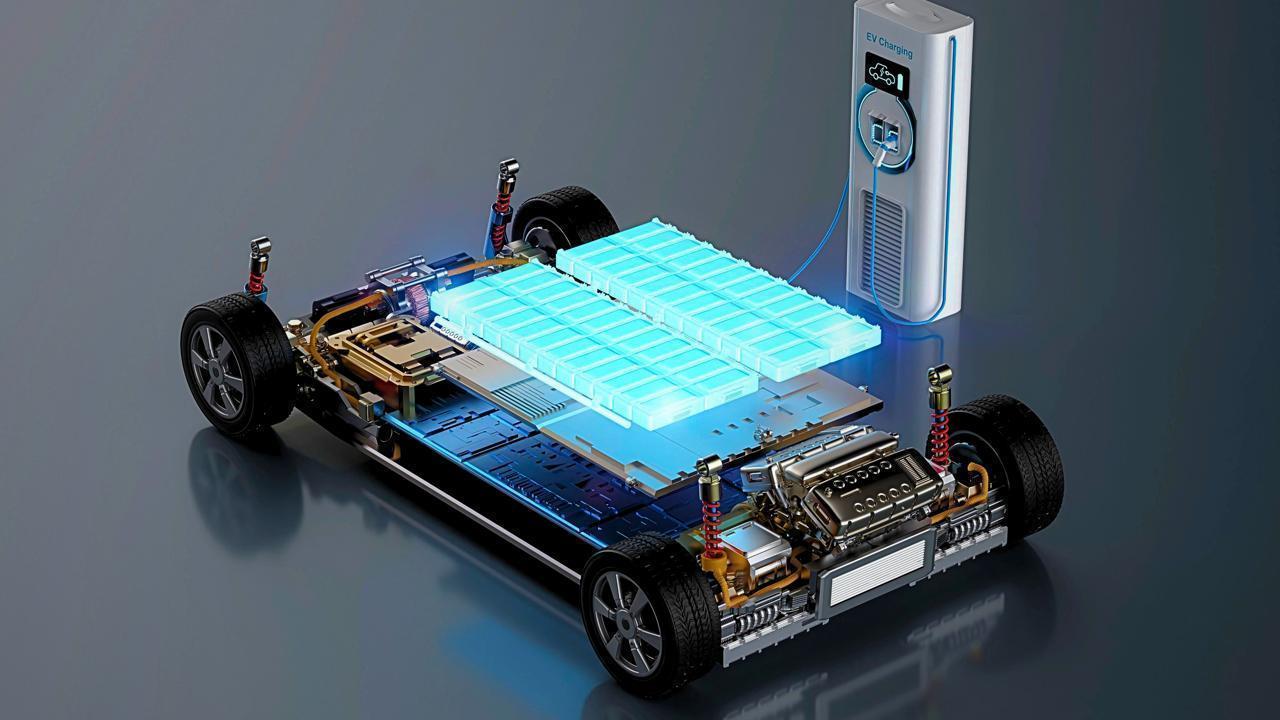
According to the report, AI-enhanced battery management systems (BMS) are expected to become the global standard by 2027, enabling smarter range control, real-time thermal regulation, and predictive lifespan optimization. These technologies will dramatically reduce range anxiety while accelerating adoption of lithium alternatives such as sodium-ion and solid-state batteries.
The traditional lithium-ion pack is evolving. With artificial intelligence now embedded deep within the BMS architecture, EV batteries are becoming living, learning systems that adapt in real-time to driving patterns, weather, terrain, and powertrain loads. These intelligent systems not only enhance safety and energy efficiency but also prolong battery life by 20% or more, according to early industry pilots.
McKinsey’s analysis indicates that AI-powered battery systems will be pivotal in making sodium-ion and solid-state batteries viable alternatives. While lithium-ion still dominates, sodium-ion’s appeal lies in its cost advantage and mineral accessibility, especially in regions like India and Africa. Meanwhile, solid-state technology offers higher energy density and faster charging—two holy grails of EV adoption.
AI helps bridge the limitations of these emerging technologies by enabling real-time power distribution, temperature balancing, and degradation prediction, smoothing their path to commercial viability.
China continues to lead the global battery race by volume and vertical integration. Its state-supported gigafactories, rapid scaling of sodium-ion pilots, and strong domestic AI ecosystem have created a fortress of innovation and scale. CATL and BYD are now jointly testing AI-assisted solid-state packs for next-gen EV platforms launching in 2026.
The European Union, meanwhile, is focusing on sustainability and energy sovereignty. Backed by the Green Deal and the Battery Passport framework, Europe’s battery boom is now tied to supply transparency, lifecycle tracking, and AI-led recyclability. Swedish-based Northvolt and Germany’s BASF are spearheading intelligent closed-loop systems that give Europe a competitive edge in ethical battery production.
India, newly emerged as a battery manufacturing hub, is positioning itself as a low-cost, AI-integrated supply chain leader. Government-backed PLI schemes, rising EV demand, and strong software expertise are pushing Indian firms to pioneer AI-BMS solutions for both domestic and export markets.
The report warns that battery technology—once viewed as hardware—must now be understood as a software-defined ecosystem. Startups specializing in battery AI, second-life analytics, and charging intelligence are attracting record funding, as OEMs and governments look to leapfrog legacy inefficiencies.
McKinsey forecasts that by 2030, 70% of all new EVs sold globally will feature AI-augmented battery systems, and more than 50% of those will use either hybrid chemistries or post-lithium alternatives. Energy storage companies are also preparing for massive grid-scale deployment of smart batteries that can shift load in milliseconds and stabilize renewables.
The convergence of AI and energy is no longer hypothetical—it is defining who wins the EV era.
“This market is no longer just about batteries,” said senior McKinsey partner Hans Keller. “It’s about intelligent energy. And the countries that lead in AI-powered storage will shape the electric century.”
Electric Vehicle



Advances in Aerospace Technology and Commercial Aviation Recovery
Insights into breakthrough aerospace technologies and commercial aviation’s recovery amid 2025 chall

Defense Modernization and Strategic Spending Trends
Explore key trends in global defense modernization and strategic military spending shaping 2025 secu

Tens of Thousands Protest in Serbia on Anniversary of Deadly Roof Collapse
Tens of thousands in Novi Sad mark a year since a deadly station roof collapse that killed 16, prote

Canada PM Carney Apologizes to Trump Over Controversial Reagan Anti-Tariff Ad
Canadian PM Mark Carney apologized to President Trump over an Ontario anti-tariff ad quoting Reagan,

The ad that stirred a hornets nest, and made Canadian PM Carney say sorry to Trump
Canadian PM Mark Carney apologizes to US President Trump after a tariff-related ad causes diplomatic

Bengaluru-Mumbai Superfast Train Approved After 30-Year Wait
Railways approves new superfast train connecting Bengaluru and Mumbai, ending a 30-year demand, easi




