Post by : Amit
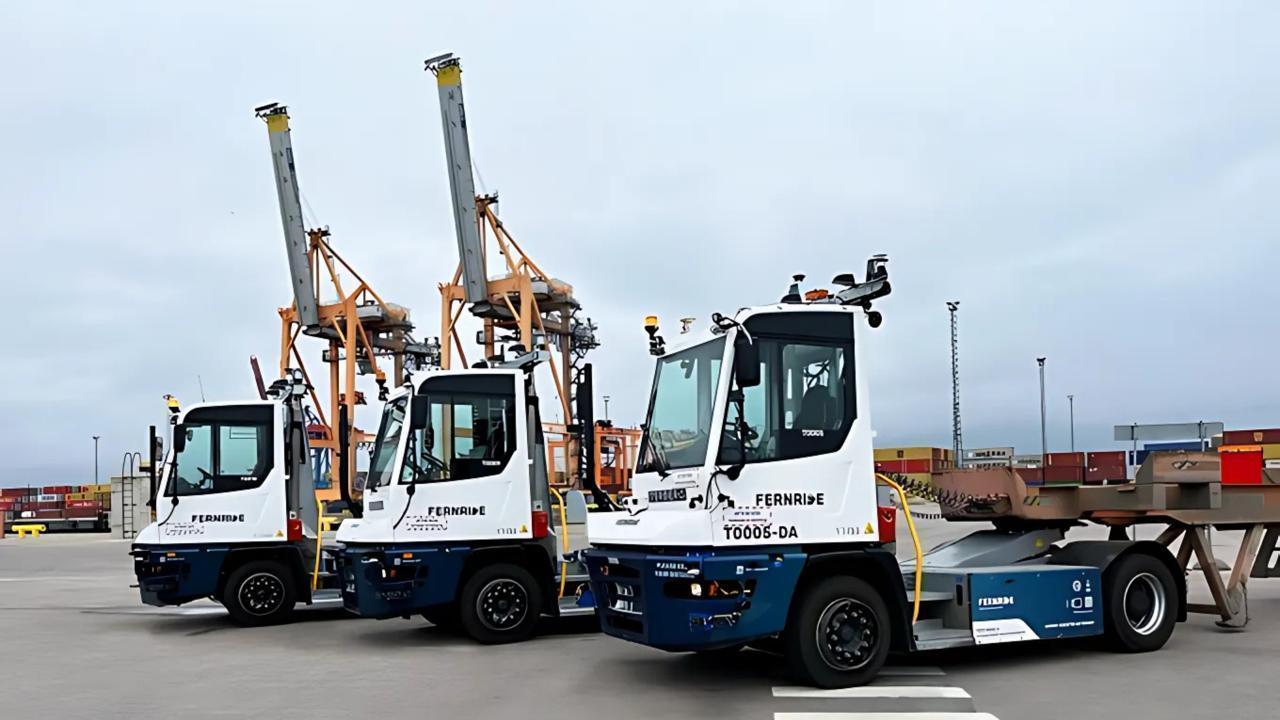
Photo : X / Port Strategy
Fernride’s Autonomous Trucking Project in Estonia Reaches Driverless Milestone, Signaling Smart Logistics Future
In a groundbreaking leap for autonomous freight movement, Fernride, the German pioneer in teleoperated and autonomous logistics, has officially entered the driverless phase of its operations in Estonia. This development, taking place at a major logistics terminal, marks a significant milestone not only for Fernride but for the broader evolution of smart logistics and autonomous transportation in Europe’s fast-growing port and terminal sector.
A Pioneering Step in Autonomous Logistics
The project, located at Estonia’s HHLA TK Estonia terminal, involves the deployment of Fernride’s autonomous yard trucks—specially designed electric vehicles capable of operating without a human behind the wheel. Following successful teleoperated trials, the company has now begun operating the trucks in fully driverless mode for specific logistical tasks within the terminal’s controlled environment.
Fernride’s achievement underscores the growing maturity of autonomous vehicle technology in industrial settings. By combining advanced sensors, AI-driven decision-making, and teleoperation capabilities, these driverless trucks promise to revolutionize how cargo moves within ports and logistics hubs.
Transforming Port Operations with Driverless Vehicles
Port terminals, with their complex choreography of containers, cranes, and vehicles, are ideal environments for early deployment of autonomous solutions. Fernride’s autonomous trucks handle the essential task of moving containers between different points within the terminal—an operation that traditionally relies on manual driving.
With the introduction of driverless operations, the terminal is poised to benefit from greater efficiency, reduced labor dependency, enhanced safety, and lower operational costs. Automation not only streamlines cargo flow but also minimizes the risk of human error in high-density industrial zones.
Environmental Gains: Electrification Meets Automation
A standout feature of Fernride’s autonomous solution is its reliance on electric vehicles. By integrating electrification with automation, the company is addressing two of the logistics industry’s most pressing challenges: decarbonization and efficiency.
The driverless yard trucks produce zero tailpipe emissions, contributing to the broader goals of green ports and sustainable shipping supply chains. This aligns with the European Union’s ambitious environmental targets and the global shipping industry’s push to cut emissions under the International Maritime Organization’s decarbonization framework.
The Role of Teleoperation in Autonomous Transition
What sets Fernride apart in the crowded field of autonomous logistics is its unique teleoperation model. Rather than jumping straight to full autonomy, Fernride combines real-time remote human supervision with AI navigation. During the initial phases of deployment, trained operators remotely controlled the vehicles from safe, centralized hubs.
This hybrid model not only ensures safety and operational reliability during the transition to full autonomy but also helps gain regulatory approvals and build stakeholder confidence. Now, with the move to driverless operations, Fernride demonstrates the robustness of its technology and its readiness for more widespread adoption.
Estonia: A Strategic Testing Ground for Innovation
Estonia has earned a global reputation as a digital innovator and tech-forward economy. With advanced infrastructure, favorable regulatory frameworks, and a supportive innovation ecosystem, the country serves as a strategic location for testing and deploying cutting-edge logistics technologies.
HHLA TK Estonia, one of the region’s key logistics players, has been an active supporter of the Fernride project, facilitating trials, providing operational insights, and offering the ideal setting for driverless freight operations. This collaboration highlights Estonia’s ambition to lead in next-generation logistics solutions.
Meeting the Growing Demand for Smart Port Solutions
The Fernride driverless initiative comes at a time when global ports and logistics hubs are increasingly turning to automation to address critical challenges including labor shortages, rising costs, and the need for round-the-clock operations.
Smart ports are leveraging AI, robotics, Internet of Things (IoT) systems, and autonomous vehicles to create more agile, efficient, and resilient supply chains. Fernride’s project is a tangible example of how these technologies are not just theoretical concepts but real-world solutions with immediate applicability.
Safety, Regulations, and Industry Impact
Safety remains paramount in any deployment of autonomous vehicles, especially in busy port environments. Fernride’s system incorporates multiple layers of redundancy, including obstacle detection, AI decision algorithms, and real-time monitoring, to ensure safe operations.
The success of the Estonian project could pave the way for wider regulatory acceptance of autonomous trucking within closed logistics environments and, eventually, on public roads. It could also spark increased investment from global port operators seeking to future-proof their operations.
Human Jobs in an Automated Era
One of the biggest societal concerns around automation is its impact on human employment. Fernride’s approach offers a balanced perspective. By using teleoperation as a transitional step, the company creates new kinds of remote jobs even as it reduces reliance on traditional manual driving roles.
Furthermore, the operational data collected from these deployments can help train AI models, providing opportunities for skilled data analysts, system supervisors, and maintenance specialists—creating a new wave of digital port jobs.
Scaling Up Automation in Logistics
The move to driverless operations at the HHLA TK Estonia terminal is just the beginning for Fernride. The company plans to expand its presence across Europe, targeting logistics hubs, distribution centers, and intermodal terminals where autonomous freight movement can deliver measurable value.
Scaling up will involve further technical refinements, regulatory engagement, and partnerships with major logistics players. As autonomous vehicle technology continues to mature, Fernride’s success in Estonia could serve as a blueprint for ports worldwide eager to embrace smarter, greener freight solutions.
A Glimpse of the Future: Autonomous Supply Chains
The Fernride project represents more than just a technological milestone—it offers a glimpse into the future of supply chain management where goods move seamlessly, efficiently, and with minimal environmental impact.
In a world where speed, reliability, and sustainability are paramount, autonomous solutions like Fernride’s driverless trucks could become the backbone of the next-generation logistics ecosystem. Estonia’s bold embrace of this technology positions it at the forefront of this global transformation.
Fernride Charts a New Path for Smart Ports
With the successful deployment of driverless yard trucks in Estonia, Fernride is not only advancing its own technological journey but is also reshaping how the world envisions port operations, supply chains, and sustainable logistics. As the company continues to scale, its Estonia project will remain a defining case study in the evolution of smart ports and the inexorable rise of automation in global freight.
Fernride, Port, Logistic Hub



Advances in Aerospace Technology and Commercial Aviation Recovery
Insights into breakthrough aerospace technologies and commercial aviation’s recovery amid 2025 chall

Defense Modernization and Strategic Spending Trends
Explore key trends in global defense modernization and strategic military spending shaping 2025 secu

Tens of Thousands Protest in Serbia on Anniversary of Deadly Roof Collapse
Tens of thousands in Novi Sad mark a year since a deadly station roof collapse that killed 16, prote

Canada PM Carney Apologizes to Trump Over Controversial Reagan Anti-Tariff Ad
Canadian PM Mark Carney apologized to President Trump over an Ontario anti-tariff ad quoting Reagan,

The ad that stirred a hornets nest, and made Canadian PM Carney say sorry to Trump
Canadian PM Mark Carney apologizes to US President Trump after a tariff-related ad causes diplomatic

Bengaluru-Mumbai Superfast Train Approved After 30-Year Wait
Railways approves new superfast train connecting Bengaluru and Mumbai, ending a 30-year demand, easi




