Post by : Saif
Ford Motor Company announced a major shift in its electric vehicle (EV) strategy on Monday, taking a $19.5 billion writedown and cancelling multiple EV projects. The move highlights how U.S. policies under former President Donald Trump and falling consumer demand are reshaping the auto industry.
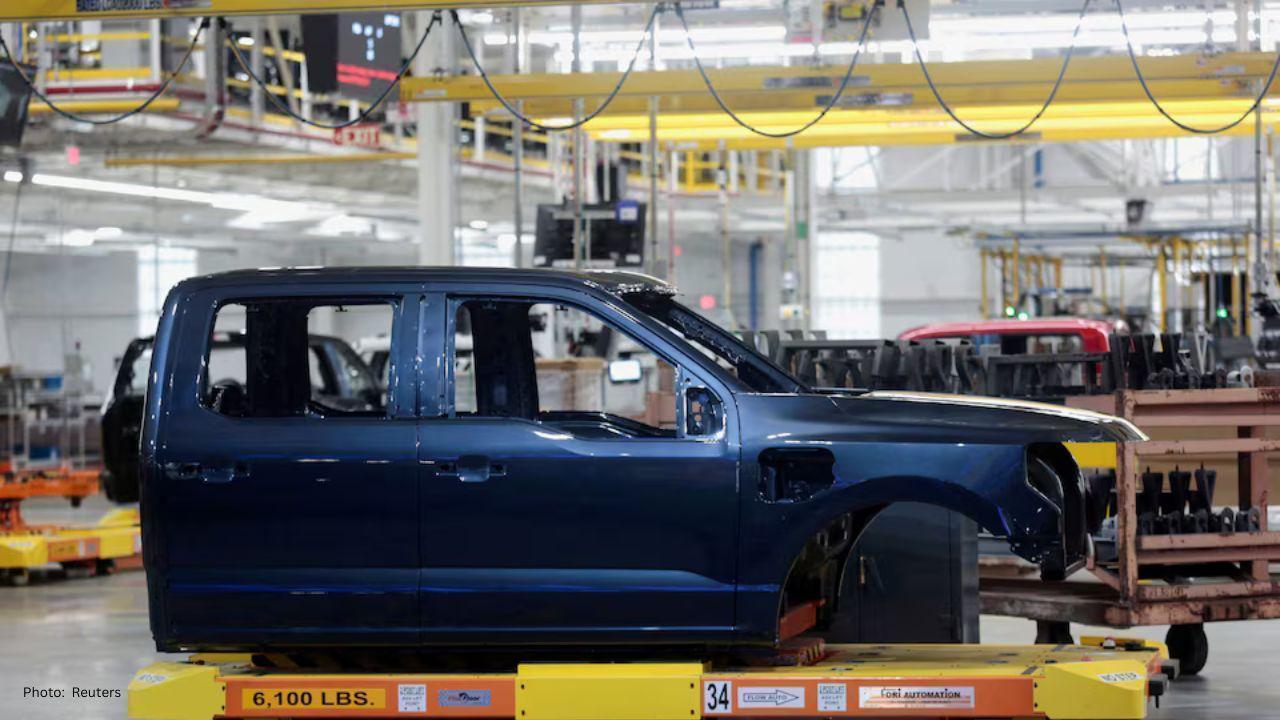
The company will replace its fully electric F-150 Lightning pickup with a new extended-range EV that uses a gas engine to recharge its battery. Ford is also scrapping a next-generation electric truck, codenamed the T3, and several planned electric commercial vans.
“When the market really changed over the last couple of months, that was the reason we made the decision,” Ford CEO Jim Farley said. The company will focus more on gas-powered and hybrid vehicles, even as it plans to hire thousands of workers in the long term. However, some layoffs are expected at a Kentucky battery plant in the near term.
Ford aims to increase its mix of hybrids, extended-range EVs, and pure EVs to 50% of its total lineup by 2030, up from just 17% today. The $19.5 billion writedown will be spread over the next few years. About $8.5 billion comes from cancelled EV models, $6 billion from ending a battery joint venture with South Korea’s SK On, and $5 billion from other program-related costs. Despite the losses, Ford raised its 2025 guidance for adjusted earnings before interest and taxes to around $7 billion.
The shift reflects broader industry trends. U.S. EV sales dropped about 40% in November after a $7,500 consumer tax credit expired. Trump-era policies, including easing emissions rules and reducing federal EV support, have encouraged automakers to sell more gas-powered vehicles.
The F-150 Lightning, launched in 2022, initially received strong demand with 200,000 orders, but sales have lagged, with only 25,583 units sold through November—a 10% drop from the previous year. The successor T3 truck was to be produced at a new Tennessee facility, but Ford will now focus on gas-powered trucks there from 2029.
Ford plans to develop more affordable EVs through a special California “skunkworks” team. The first model, priced around $30,000, is expected to go on sale in 2027.
Other automakers are also scaling back EV plans. General Motors took a $1.6 billion charge earlier this year and warned of more potential losses, while Stellantis cancelled an electric Ram pickup and is focusing more on hybrids. Toyota, which has long emphasized hybrid technology, continues to lead in that space.
The breakup with SK On will allow Ford to independently operate its Kentucky battery plants, while SK On will manage a Tennessee plant. Ford plans to use these facilities to produce batteries for energy storage systems and its upcoming $30,000 midsize EV truck.
Analysts say Ford’s retreat shows the challenges of competing in the EV market as government incentives, regulations, and consumer demand fluctuate. By focusing on hybrids and smaller, affordable EVs, Ford hopes to balance profitability with a transition to greener vehicles.
#trending #latest #FordEV #ElectricVehicles #AutomotiveNews #EVMarket #HybridCars #F150Lightning #FordNews #CarIndustry #TrumpPolicies #SustainableMobility



Advances in Aerospace Technology and Commercial Aviation Recovery
Insights into breakthrough aerospace technologies and commercial aviation’s recovery amid 2025 chall

Defense Modernization and Strategic Spending Trends
Explore key trends in global defense modernization and strategic military spending shaping 2025 secu

Tens of Thousands Protest in Serbia on Anniversary of Deadly Roof Collapse
Tens of thousands in Novi Sad mark a year since a deadly station roof collapse that killed 16, prote

Canada PM Carney Apologizes to Trump Over Controversial Reagan Anti-Tariff Ad
Canadian PM Mark Carney apologized to President Trump over an Ontario anti-tariff ad quoting Reagan,

The ad that stirred a hornets nest, and made Canadian PM Carney say sorry to Trump
Canadian PM Mark Carney apologizes to US President Trump after a tariff-related ad causes diplomatic

Bengaluru-Mumbai Superfast Train Approved After 30-Year Wait
Railways approves new superfast train connecting Bengaluru and Mumbai, ending a 30-year demand, easi




