Post by : Amit
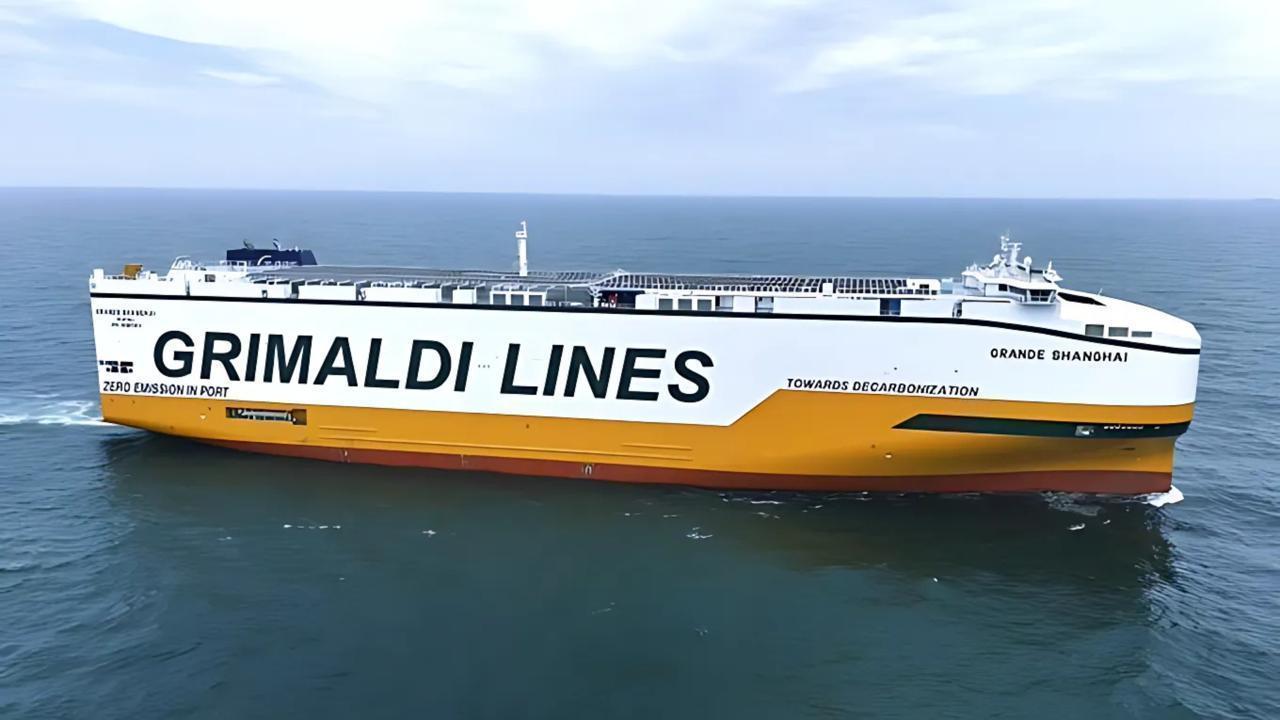
Photo : X / Green Marine
Grimaldi Group Launches First Ammonia-Ready Car Carrier, Setting New Green Benchmark in Maritime Logistics
In a decisive move towards maritime decarbonization, Italy’s Grimaldi Group has officially named and launched the Grande Torino, the first of ten colossal ammonia-ready Pure Car and Truck Carriers (PCTCs). Built by China’s Yangfan Shipyard, this 18,600 CEU (Car Equivalent Units) behemoth not only reflects the future of low-emission ocean transport but also heralds a new era of scalable, sustainable shipping logistics for the global automotive industry.
With the shipping industry under increasing pressure to align with the International Maritime Organization’s (IMO) decarbonization goals, Grimaldi’s latest fleet addition is more than just a vessel—it’s a signal. A signal that green transformation is no longer optional; it's already underway.
Europe’s Largest Car Carrier: A New Marine Milestone
The Grande Torino is one of the largest car carriers ever constructed for European operation, both in terms of capacity and technological readiness for alternative fuels. It is designed to accommodate future retrofitting with ammonia-fueled propulsion systems once regulatory frameworks and bunkering infrastructure mature.
The vessel is the first of a ten-ship order placed by Grimaldi with China Merchants Heavy Industries, representing a significant investment in sustainable shipping. The vessels were commissioned under Grimaldi’s GG5G-class (Grimaldi Green 5th Generation) strategy, with advanced hybrid propulsion systems, shore power compatibility, and massive lithium battery packs that allow full zero-emission operations while docked.
At nearly 230 meters in length and with a beam of 34 meters, the Grande Torino dwarfs most of its predecessors, reinforcing Grimaldi’s position at the forefront of global automotive shipping. Its onboard systems and cargo handling automation are designed to serve OEMs across Europe, the US, and North Africa.
Built in China, Operated for the World
The vessel was constructed at Yangfan Shipyard in Zhoushan, China, known for building sophisticated LNG and alternative fuel-ready ships. While its basic fuel system is designed around low-sulfur marine gas oil (LSMGO), the ship is "ammonia-ready"—a classification that means its internal systems, tank spaces, fuel lines, and safety redundancies are future-proofed for a full conversion to ammonia, widely regarded as one of the most promising zero-carbon fuels for deep-sea shipping.
The vessels come pre-equipped with shaft generators, optimized hull design, and high-efficiency propellers that minimize resistance and maximize fuel efficiency. Onboard emissions reduction tech includes scrubbers, selective catalytic reduction (SCR) units, and particulate matter filtration to meet and exceed IMO Tier III regulations.
Grimaldi’s Push Toward Alternative Fuels
While many shipping lines are still testing or trialing alternative fuel strategies, Grimaldi is already commissioning vessels that anticipate the next generation of fuel transitions. Ammonia, in particular, has gained interest due to its zero CO₂ emissions at the point of combustion, high energy density, and global production footprint.
The IMO's target of net-zero emissions by 2050 has forced shipowners to begin investing in vessels that won’t become obsolete as environmental regulations tighten. Grimaldi’s approach—combining short-term hybrid operations with long-term alternative fuel preparedness—strikes a pragmatic balance between operational viability and environmental responsibility.
As the first of its class, Grande Torino also sets a precedent for retrofittable maritime engineering. Once green ammonia supply chains become widely available (especially across Europe and East Asia), the ship can undergo conversion at significantly lower cost and lead time compared to a non-prepared vessel.
Cargo Capacity Designed for the Automotive Surge
The Grande Torino is built with 13 cargo decks and six hoistable decks, allowing maximum flexibility to accommodate high and heavy cargo such as trucks, tractors, and construction machinery, in addition to standard passenger vehicles. This is particularly crucial as electric vehicle (EV) exports from Asia to Europe are surging, requiring enhanced handling infrastructure on board for temperature control, fire safety, and fast charging where applicable.
With a ramp capacity of up to 350 tons, the ship also supports roll-on/roll-off (RoRo) cargo types, offering carmakers a logistics backbone that is both future-ready and scalable. Grimaldi’s decision to invest in such massive cargo capacity stems from a clear reading of global trends—OEMs are expanding overseas rapidly, and shipping must catch up.
Maritime Green Corridor Integration
The Grande Torino and its sister ships are expected to serve key green corridors linking Northern Europe with the Mediterranean, as well as transatlantic routes to the United States and Mexico. These corridors have become central to the maritime energy transition, as ports and carriers jointly adopt emission-reduction technologies, shore-side power, and alternative fuel refueling systems.
Several European ports—Antwerp, Zeebrugge, Hamburg, and Valencia—are already collaborating on ammonia bunkering feasibility, while Scandinavian countries are pioneering green hydrogen-ammonia production clusters. Grimaldi’s vessels will be among the first commercial beneficiaries of this evolving infrastructure.
The ship’s hybrid propulsion system also includes mega lithium-ion battery banks capable of powering all onboard services during port stays, ensuring zero-emission dockside operations. This is especially critical for port cities struggling with air pollution and pushing for shore power mandates by 2030.
The Broader Impact: Decarbonization Meets Demand Growth
Grimaldi’s bet on mega car carriers comes at a time when the global automotive logistics market is booming. Post-pandemic demand for vehicles, especially electric and hybrid models, has stretched shipping capacity to its limits. Simultaneously, the environmental footprint of maritime logistics has come under scrutiny.
This is the paradox that shipowners like Grimaldi are trying to solve—how to move more vehicles across oceans while reducing their carbon, nitrogen, and sulfur emissions. The company’s answer: scale up vessels, decarbonize propulsion, digitize navigation, and modularize cargo handling.
Through investments like the Grande Torino, Grimaldi is aligning with EU Fit for 55, IMO 2023, and national clean transport strategies—all of which require industry players to transition quickly from intent to execution.
Future-Ready, Regulation-Ready
What sets the Grande Torino apart is its double readiness: it’s not only engineered to comply with current rules but also designed to thrive under future ones. That includes:
Grimaldi has also prioritized crew safety and operational flexibility, incorporating fireproofing for lithium battery cargo, emergency ammonia leak mitigation systems, and digital cargo load balancing algorithms.
A Sign of Things to Come
As the first of ten ships in this class, the Grande Torino is just the beginning of Grimaldi’s broader vision to revolutionize maritime automotive logistics. Each subsequent vessel in the series will incorporate learnings from its predecessor, with potential upgrades in battery chemistry, AI-assisted navigation, and alternative propulsion integrations.
Moreover, this strategy is resonating beyond Europe. Latin American and African ports are showing interest in hosting future-ready ships. In turn, this could stimulate a global standardization of ammonia-ready infrastructure, starting from shipyards to refueling stations.
Grimaldi’s leadership also sends a strong message to regulators and competitors: decarbonization is not a speculative future—it’s already being welded into the hulls of the next generation of global workhorses.
Setting Sail Toward a Cleaner Future
The Grande Torino is more than a vessel—it’s a floating commitment to change. In an industry long dominated by fossil fuel inertia, Grimaldi has chosen a bold path forward, one that blends engineering foresight with environmental accountability.
By launching the first ammonia-ready, hybrid mega car carrier, the company has not only future-proofed its fleet but has also catalyzed a ripple effect across shipbuilders, fuel innovators, and port authorities.
In a decade, we may look back at this launch not just as a milestone for Grimaldi, but as a tipping point for global maritime logistics.
Grimaldi, Ammonia Mega Car Carrier



Advances in Aerospace Technology and Commercial Aviation Recovery
Insights into breakthrough aerospace technologies and commercial aviation’s recovery amid 2025 chall

Defense Modernization and Strategic Spending Trends
Explore key trends in global defense modernization and strategic military spending shaping 2025 secu

Tens of Thousands Protest in Serbia on Anniversary of Deadly Roof Collapse
Tens of thousands in Novi Sad mark a year since a deadly station roof collapse that killed 16, prote

Canada PM Carney Apologizes to Trump Over Controversial Reagan Anti-Tariff Ad
Canadian PM Mark Carney apologized to President Trump over an Ontario anti-tariff ad quoting Reagan,

The ad that stirred a hornets nest, and made Canadian PM Carney say sorry to Trump
Canadian PM Mark Carney apologizes to US President Trump after a tariff-related ad causes diplomatic

Bengaluru-Mumbai Superfast Train Approved After 30-Year Wait
Railways approves new superfast train connecting Bengaluru and Mumbai, ending a 30-year demand, easi




