Post by : Saif
The war in Ukraine has brought a deep and lasting change to Europe’s defence sector. Since Russia launched its full-scale invasion in February 2022, European governments have become more focused on military strength, security planning, and defence readiness. Nearly four years into the conflict, defence is no longer seen as a background issue. It has moved to the center of political decisions, budget planning, and industrial growth across the continent.
As global tensions continue to rise in many regions, including the Middle East and Latin America, European countries feel a stronger need to protect themselves and their allies. This has led to a major increase in defence spending and long-term military planning. Investors have also taken notice, pushing defence company shares to record highs. Europe’s aerospace and defence stock index has risen by around 55% over the past year, showing strong confidence in the sector’s future.
European Union member states spent about 343 billion euros on defence in 2024. This figure is expected to increase to around 381 billion euros in 2025. Defence spending as a share of GDP has also gone up, rising from around 1.9% in 2024 to a likely 2.1% in 2025. These numbers reflect Europe’s effort to meet NATO’s defence target of spending at least 2% of GDP on military needs.
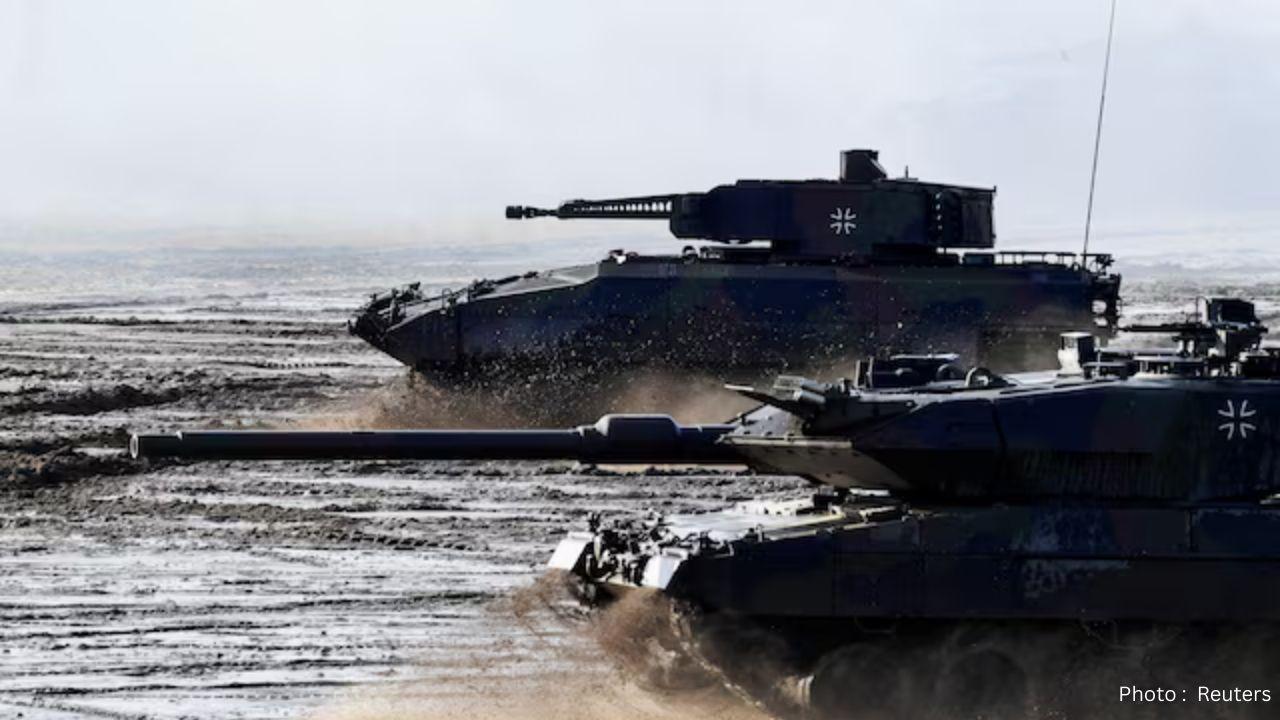
Investment in defence equipment has grown even faster. In 2024, defence investment reached a record 106 billion euros. In 2025, it is expected to climb close to 130 billion euros. This money is being used to buy tanks, fighter jets, air defence systems, ammunition, naval vessels, and advanced digital technologies. Many countries are also rebuilding stockpiles that had been reduced over years of lower military spending.
NATO has added further pressure on its members to increase spending. In June, alliance leaders agreed on a new long-term goal equivalent to 5% of GDP by 2035. This includes 3.5% for core defence activities such as armed forces and weapons, and 1.5% for broader security areas like cyber defence, infrastructure protection, and crisis response. This decision has made it clear that defence spending will remain high for many years.
Germany has taken some of the most important steps in this direction. The country created a special 100 billion-euro fund to speed up military purchases and modernize its armed forces. Lawmakers also approved changes allowing defence spending above 1% of GDP to bypass strict constitutional debt limits. These moves marked a major shift for a country that had long been cautious about military expansion.
Poland has gone even further. It became NATO’s top defence spender by share of GDP, spending around 4.1% of its economic output in 2024. The country plans to raise this to about 4.7% in 2025. Poland is investing heavily in tanks, air defence systems, missiles, and troop expansion, driven by its location near the conflict zone.
Other European nations are following similar paths. France, Italy, and Nordic countries have increased spending on air defence, ammunition production, cyber security, and naval forces. Many governments now accept that modern warfare depends not only on soldiers and weapons but also on technology, information, and rapid response systems.
This wave of spending has boosted Europe’s defence companies. Large and well-known firms have seen strong growth. Airbus, which also operates a major defence and space business, benefits from demand for military aircraft, satellites, and secure communications. Britain’s BAE Systems continues to gain from orders for warships, armored vehicles, and advanced defence systems. Germany’s Rheinmetall has become a key supplier of tanks and ammunition, while Italy’s Leonardo has expanded its role in helicopters, electronics, and defence technology.
Smaller and more specialized companies are also gaining attention. Germany’s Hensoldt, known for radar and electronic warfare systems, has seen rising demand as countries try to fix weaknesses in air surveillance and missile defence. Sweden’s Saab, which produces Gripen fighter jets, submarines, and electronic warfare equipment, has benefited from its flexible and modern designs. French companies Safran and Thales play an important role by supplying engines, navigation tools, radar systems, and cyber defence technology.
Investor interest in defence is growing as well. The planned stock market listing of Czech arms maker Czechoslovak Group, one of Europe’s largest private defence firms, shows that capital markets are becoming more open to defence-related businesses. This reflects a wider change in how defence is viewed, not only as a security necessity but also as a long-term industrial sector.
The transformation of Europe’s defence industry is not temporary. Governments now see military strength and security readiness as permanent priorities. The war in Ukraine has served as a strong reminder that peace cannot be taken for granted. Combined with growing global uncertainty, it has reshaped how Europe plans its future.
Europe’s defence sector has entered a new phase, defined by higher spending, stronger industry growth, and deeper cooperation between governments and manufacturers. This shift will continue to influence politics, economies, and security decisions across the continent for many years to come.
#trending #latest #EuropeDefense #UkraineWar #DefenseIndustry #NATOSpending #MilitaryNews #EuropeanSecurity #AerospaceAndDefense #GlobalPolitics



Advances in Aerospace Technology and Commercial Aviation Recovery
Insights into breakthrough aerospace technologies and commercial aviation’s recovery amid 2025 chall

Defense Modernization and Strategic Spending Trends
Explore key trends in global defense modernization and strategic military spending shaping 2025 secu

Tens of Thousands Protest in Serbia on Anniversary of Deadly Roof Collapse
Tens of thousands in Novi Sad mark a year since a deadly station roof collapse that killed 16, prote

Canada PM Carney Apologizes to Trump Over Controversial Reagan Anti-Tariff Ad
Canadian PM Mark Carney apologized to President Trump over an Ontario anti-tariff ad quoting Reagan,

The ad that stirred a hornets nest, and made Canadian PM Carney say sorry to Trump
Canadian PM Mark Carney apologizes to US President Trump after a tariff-related ad causes diplomatic

Bengaluru-Mumbai Superfast Train Approved After 30-Year Wait
Railways approves new superfast train connecting Bengaluru and Mumbai, ending a 30-year demand, easi




