Post by : Amit
Photo : X / News IADN
Final Airbus C-295 from Spain Delivered to India: Domestic Assembly Set to Accelerate
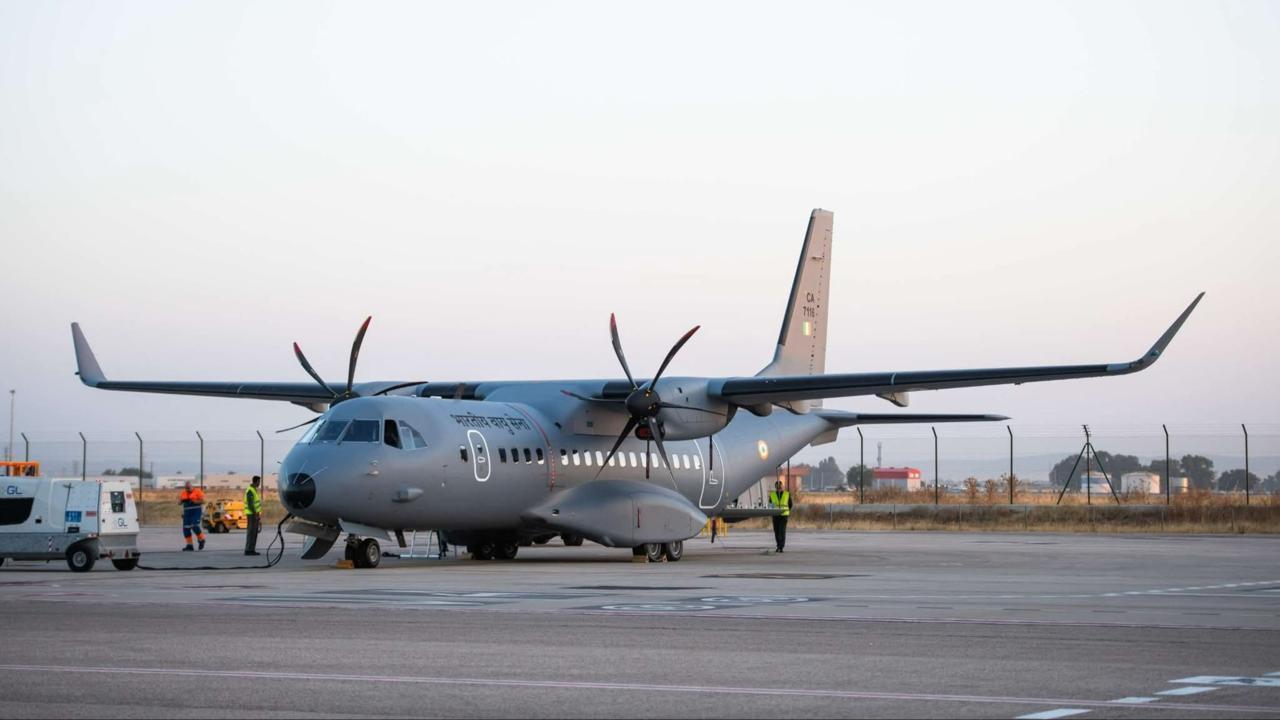
The Indian Air Force (IAF) has officially taken delivery of the 16th and final C-295 military transport aircraft from Airbus Defence and Space at the Seville production facility in Spain. This delivery marks the completion of the first phase of India’s ambitious Rs 21,935 crore procurement deal, and sets the stage for the next, far more transformative phase—the indigenous assembly of 40 additional C-295 aircraft in India.
Under a groundbreaking partnership between Airbus and India’s Tata Advanced Systems Limited (TASL), this is the first time a full production line for a military aircraft is being set up in India by a private consortium. It not only promises to significantly boost the country’s tactical airlift capabilities but also represents a strategic leap in India's journey toward self-reliance in aerospace manufacturing.
The Deal That Reshaped India’s Tactical Airlift Future
The contract for 56 C-295MW aircraft was signed in September 2021. The first 16 aircraft were to be manufactured at Airbus’s final assembly line in Seville, Spain, and delivered in ‘flyaway’ condition. These deliveries began in September 2023 and have now concluded with the handover of the final aircraft, as scheduled, in July 2025.
The remaining 40 aircraft will be manufactured and assembled in India at the newly built C-295 Final Assembly Line (FAL) in Vadodara, Gujarat, by Tata Advanced Systems. This transition from foreign production to indigenous manufacturing forms the bedrock of a new industrial ecosystem in the Indian private aerospace sector.
Air Chief Marshal V.R. Chaudhari, who previously received the first aircraft in Seville in 2023, had called the deal a “watershed moment” for Indian defence aviation. The C-295 is expected to replace the aging fleet of Avro-748 aircraft, many of which have been in service since the 1960s.
The Aircraft: A Tactical Asset with Multi-Mission Capabilities
The C-295MW is a new-generation tactical transport aircraft known for its versatility, short takeoff and landing (STOL) capabilities, and rugged performance in austere environments. It can carry up to 71 troops or 50 paratroopers, or five tonnes of cargo. Equipped with a rear ramp, it supports rapid loading and deployment of personnel, supplies, and small vehicles.
Crucially, the aircraft is suited for operations in forward and mountainous regions, including airstrips in Ladakh, Arunachal Pradesh, and other border zones. It is also compatible with aerial delivery and casualty evacuation operations, and can be modified for maritime patrol, signals intelligence, and electronic warfare.
With India’s growing emphasis on mobility and responsiveness—especially along its northern and western borders—the C-295 is expected to play a vital role in the Air Force’s tactical lift doctrine, bridging the gap between helicopters and the larger C-17 Globemaster or IL-76 heavy lifters.
India’s Aerospace Landscape Gets a Manufacturing Hub
The Vadodara facility, jointly operated by Airbus and Tata, is at the heart of India’s Make in India initiative in the defence aerospace domain. It is the first time a military aircraft assembly line is being set up by a private entity, not by a public sector enterprise like Hindustan Aeronautics Ltd (HAL). This diversification marks a tectonic shift in India’s defence production strategy.
The facility will handle complete aircraft assembly—from structural manufacturing, final assembly, avionics integration, and testing, to painting and delivery. It is designed not just to build the 40 aircraft for the IAF but to serve as a global production hub for Airbus in the long term.
Airbus has already committed to transfer of technology, supply chain development, and skilled workforce training. Indian suppliers are producing major components including aero-structures, doors, control surfaces, and landing gear parts. Over 13,000 parts, components, and tools will be indigenously manufactured, creating thousands of jobs and stimulating Tier 2 and Tier 3 supplier networks across the country.
Strategic Implications Beyond the Indian Air Force
While the current contract is focused on the IAF, the implications of the C-295 project go far beyond the Air Force or even defence services. Multiple agencies including the Indian Coast Guard, Border Security Force (BSF), National Disaster Response Force (NDRF), and Home Ministry have shown interest in procuring variants of the C-295 for logistics and surveillance roles.
Moreover, the aircraft opens up new export opportunities. The Vadodara plant, once stabilized, is expected to cater to regional and global markets, allowing India to emerge as a serious player in the light transport aircraft segment.
Industry analysts see this as a strategic capability build-up that can evolve into broader aircraft development platforms in future, including for medium airlift aircraft, maritime patrol aircraft, or even UAVs.
Timely Delivery and Project Execution Lauded
Despite global supply chain disruptions and a pandemic-induced slowdown, Airbus has kept to its committed delivery timeline—a point acknowledged by both Indian and Spanish officials. The on-time handover of all 16 aircraft within 22 months is being seen as a model of execution efficiency, particularly in contrast with delays that have marred several major defence acquisitions in the past.
Defence Ministry sources noted that this performance has boosted confidence in future foreign partnerships involving technology transfer and local production—especially as India pursues deeper indigenization targets under its Defence Acquisition Procedure (DAP) 2020.
Operational Deployment and Early Results
The 16 C-295 aircraft already delivered to India have been inducted progressively across IAF commands, including those tasked with high-altitude and forward operations. Air Force officials report that initial sorties have validated the aircraft’s performance across multiple mission profiles.
In addition to troop and cargo movement, the aircraft has been used for medical evacuation and aerial supply drops in the Northeast and Ladakh sectors. Its ability to land on unprepared or semi-prepared strips has been especially valuable during joint exercises and emergency response operations.
The IAF has also begun pilot and technician training programs centered around the C-295, with a focus on transition from legacy platforms. Full operational clearance for integrated fleet deployment is expected by the end of 2025.
Driving a New Aerospace Industrial Ecosystem
The Airbus-Tata C-295 program is being widely regarded as a template for future defence manufacturing projects under the Make in India banner. By involving the private sector, ensuring technology transfer, and developing local supply chains, the project is aligned with the broader goal of reducing India’s reliance on imports.
Tata has already partnered with global OEMs for aero-structures, avionics, and tooling development. The project is catalyzing the emergence of new MSMEs in cities like Hyderabad, Nagpur, Bengaluru, and Pune, fostering what experts call “aeroclusters” capable of supporting future aviation programs.
In a rare acknowledgment of cross-sector cooperation, both civil aviation regulators and defence certification agencies have been brought into the loop to standardize approvals, quality audits, and documentation processes. This harmonization is expected to yield long-term dividends for India's dual-use aerospace capacity.
Future Path: Variants, Upgrades, and Expansion
The C-295 project could spawn multiple variants, including maritime surveillance, SIGINT (signals intelligence), ELINT (electronic intelligence), and AEW&C (airborne early warning and control) versions. Indian firms are also exploring retrofitting capabilities to modify the platform for specific missions under the supervision of DRDO and BEL.
Moreover, industry sources suggest Airbus is considering the export of C-295s manufactured in India to South American and Southeast Asian countries. If this materializes, it will make India an exporter of full military aircraft, a feat achieved by very few countries outside the traditional Western aerospace powers.
A Stepping Stone to Aviation Self-Reliance
With the final C-295 from Spain now in Indian hands, the transition to domestic production marks the start of a new journey—not just for the Indian Air Force but for the entire Indian defence manufacturing ecosystem. The success of this program could define the trajectory of several other "Make in India" aerospace ventures in the years ahead.
India’s long-held dream of becoming a design-to-delivery defence aerospace power is still unfolding, but for the first time in decades, it appears to have found a viable runway.
The C-295 isn’t just an aircraft; it’s a symbol of what strategic vision, international collaboration, and industrial discipline can achieve together. The final delivery from Spain may have closed one chapter—but for Indian aerospace, the next chapter may well be the most exciting yet.
India, C-295 Aircraft,Spain



Advances in Aerospace Technology and Commercial Aviation Recovery
Insights into breakthrough aerospace technologies and commercial aviation’s recovery amid 2025 chall

Defense Modernization and Strategic Spending Trends
Explore key trends in global defense modernization and strategic military spending shaping 2025 secu

Tens of Thousands Protest in Serbia on Anniversary of Deadly Roof Collapse
Tens of thousands in Novi Sad mark a year since a deadly station roof collapse that killed 16, prote

Canada PM Carney Apologizes to Trump Over Controversial Reagan Anti-Tariff Ad
Canadian PM Mark Carney apologized to President Trump over an Ontario anti-tariff ad quoting Reagan,

The ad that stirred a hornets nest, and made Canadian PM Carney say sorry to Trump
Canadian PM Mark Carney apologizes to US President Trump after a tariff-related ad causes diplomatic

Bengaluru-Mumbai Superfast Train Approved After 30-Year Wait
Railways approves new superfast train connecting Bengaluru and Mumbai, ending a 30-year demand, easi




