Post by : Amit
A New Era of Lethal Air Power Begins
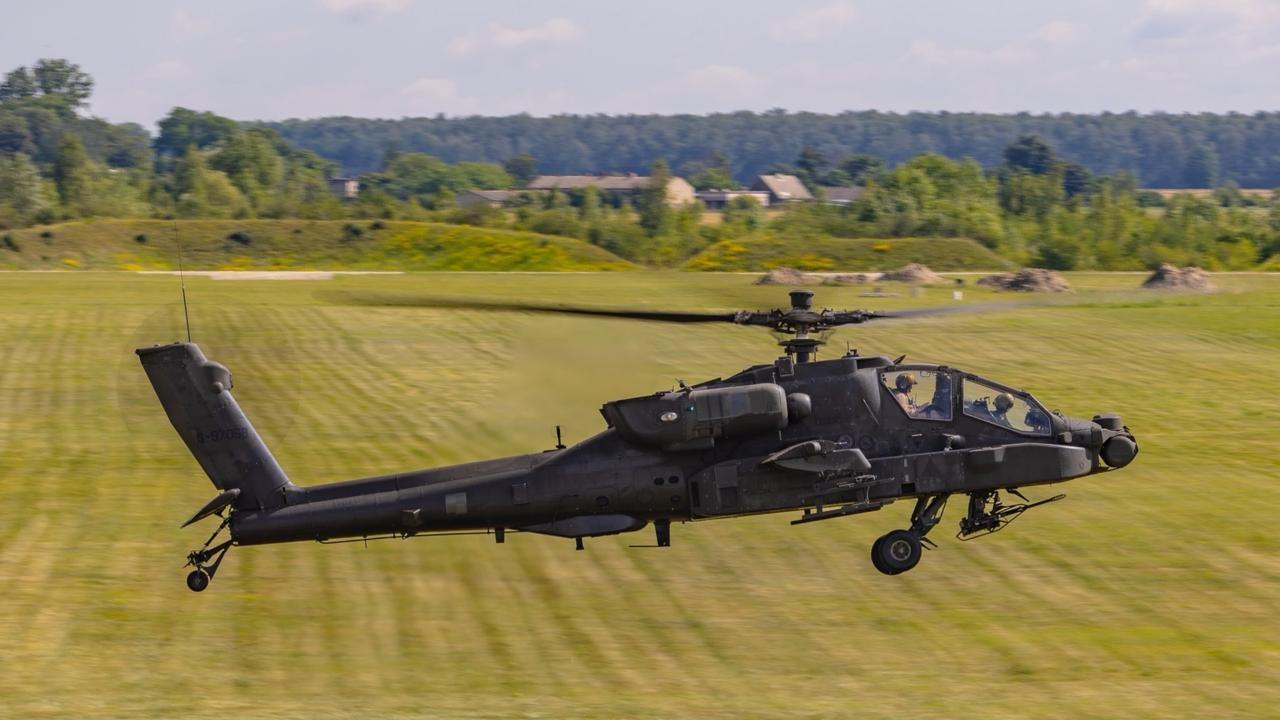
In a landmark moment for India's military aviation, the Indian Army has officially received its first batch of AH-64E Apache attack helicopters. This historic induction ceremony, held at the Boeing-Tata facility in Hyderabad, marks the Indian Army’s entry into the elite club of global land forces that operate one of the most lethal and technologically advanced helicopter gunships ever built.
Manufactured by U.S. aerospace giant Boeing, the AH-64E Apache is widely regarded as the world’s premier multi-role attack helicopter. With the Indian Air Force (IAF) already operating 22 of these formidable machines since 2019, the latest delivery is the first specifically tailored for Army Aviation—India’s rapidly expanding and increasingly assertive helicopter arm.
Background: Army’s Long-Awaited Combat Edge
The acquisition of Apache helicopters for the Indian Army has been a long-anticipated step. Initially, when India signed a $2.1 billion deal with the U.S. in 2015, the contract covered 22 Apaches exclusively for the Indian Air Force. At the time, the Army had lobbied for its own fleet of Apaches, citing operational doctrine differences and the need for autonomous close air support.
In 2020, following prolonged deliberation and a shift in strategic defense planning, the Indian Ministry of Defence cleared the procurement of six additional Apaches for the Army under a direct commercial sale agreement. The Indian Army's AH-64Es will be based at a forward aviation base near the Line of Actual Control (LAC), enhancing India’s deterrence posture amid simmering tensions with China.
Delivery Ceremony: Symbolism and Strategic Timing
The formal handover ceremony was held on July 20, 2025, and attended by top Indian Army officials, Boeing executives, and U.S. defense attachés. The helicopters were delivered at Boeing’s joint venture facility with Tata Advanced Systems Limited (TASL) in Hyderabad, where significant fuselage and component work for global Apache production also takes place.
The event carried strong symbolic weight. The Apache handover occurred just weeks after China intensified military activity along the eastern Ladakh frontier and days before India’s annual Army Aviation Corps Day. In essence, it broadcasted New Delhi’s readiness to escalate deterrence via modern warfighting platforms.
Apache AH-64E: What Makes It a Game-Changer
The AH-64E Apache Guardian is not just another attack helicopter—it is a battle-proven, network-centric flying tank. Designed for high-intensity combat, the AH-64E comes with several critical enhancements over earlier models, including:
The Army variant also includes India-specific customization, such as communication suites interoperable with Indian ground forces and customized electronic warfare systems adapted for Himalayan conditions.
Deployment Strategy: Forward-Based Firepower
While the initial fleet is limited to six helicopters, their strategic impact is outsized. According to Army Aviation officials, the first squadron will be deployed along the LAC to offer rapid fire support for integrated battle groups (IBGs) and special forces units.
The Apaches will operate from a high-altitude Advanced Landing Ground (ALG) with hardened shelters and satellite-linked command-and-control hubs. This configuration allows the Army to reduce its dependence on Air Force helicopters for frontline support and plug critical capability gaps in independent armored operations.
The long-term plan, sources suggest, is to raise a full regiment comprising 18 Apache helicopters, subject to budgetary approval and geopolitical conditions. Additional orders are likely, especially if tensions along the China border persist or escalate.
Boeing’s Role: A Growing India Partnership
Boeing has played a central role in supporting India’s vision for defense indigenization. Through its joint venture with Tata, Boeing now manufactures over 90% of the Apache fuselages used worldwide right in India. The AH-64E delivered to the Army includes components and assemblies sourced from Indian suppliers, in line with the country’s "Atmanirbhar Bharat" (self-reliant India) initiative.
Salil Gupte, President of Boeing India, noted during the ceremony that “the delivery of these helicopters is a testament to U.S.-India defense collaboration and Boeing’s commitment to strengthening India’s indigenous aerospace capabilities.”
Boeing has also committed to long-term support for the Indian Apaches through a Performance-Based Logistics (PBL) agreement. This includes mission-readiness guarantees, spare parts availability, and software support—all vital for ensuring operational availability in harsh terrains.
Geopolitical Implications: Deterrence by Dominance
The induction of Apaches into the Indian Army has raised geopolitical eyebrows, particularly in Beijing and Islamabad. China's military has no equivalent to the AH-64E in its Army Aviation fleet, relying instead on indigenous Z-10 helicopters, which have faced performance issues in extreme altitudes.
With Apaches now under Army command, India gains an edge in offensive air operations, close-air support, and high-altitude warfare—all of which are critical in contested border areas. Military analysts believe the deployment also serves as a signal to Pakistan, reinforcing India’s capability to conduct swift punitive strikes in the event of a cross-border escalation.
In the South Asian strategic theater, where speed, precision, and survivability determine battlefield outcomes, Apaches are a force multiplier.
Training, Terrain, and Integration
Despite their formidable capabilities, integrating Apaches into India’s high-altitude warfare environment won’t be without hurdles. Army Aviation Corps pilots are undergoing extensive conversion training to master Apache systems, including night operations, radar management, and coordinated strike protocols.
Moreover, India’s mountainous north and northeast pose unique aerodynamic and logistical challenges. The thin air at 15,000+ feet reduces lift, and cold starts can strain even the most rugged equipment. To mitigate these risks, the Army has invested in upgraded airbase infrastructure, predictive maintenance technologies, and real-time diagnostics.
Integration with existing Army systems will also require software and procedural alignment to ensure seamless targeting and deconfliction with ground-based artillery and drones.
More Apaches or Swarm Drones?
As the Indian Army modernizes its Aviation Corps, the question now shifts from capability gaps to force design. Should India invest further in manned heavy-lift platforms like Apaches or pivot toward loitering munitions and AI-enabled drone swarms?
While Apaches offer undeniable dominance in manned missions, they are expensive to operate and vulnerable to future electronic warfare. Hybrid doctrines involving Apache drones acting as command nodes for swarms of unmanned systems are being explored by U.S. and Israeli militaries—and could offer India the next leap in asymmetric warfare.
Nonetheless, for the present, the Apache’s arrival represents an unambiguous boost to Indian firepower and a deterrent asset that few regional adversaries can match.
An Aviation Corps Transformed
The induction of the AH-64E Apache by the Indian Army is more than a headline—it’s a transformational moment for India's military doctrine. These six helicopters, though modest in number, serve as both shield and sword in an era of fast-evolving threats. They empower the Army to operate faster, strike harder, and defend smarter across some of the world’s most treacherous battlefields.
With forward-looking defense policy, strong OEM partnerships, and ambitious expansion plans, India's Army Aviation is poised to become a central pillar of its combat readiness and strategic autonomy.
Indian Army, AH-64E Apache, Aviation



Advances in Aerospace Technology and Commercial Aviation Recovery
Insights into breakthrough aerospace technologies and commercial aviation’s recovery amid 2025 chall

Defense Modernization and Strategic Spending Trends
Explore key trends in global defense modernization and strategic military spending shaping 2025 secu

Tens of Thousands Protest in Serbia on Anniversary of Deadly Roof Collapse
Tens of thousands in Novi Sad mark a year since a deadly station roof collapse that killed 16, prote

Canada PM Carney Apologizes to Trump Over Controversial Reagan Anti-Tariff Ad
Canadian PM Mark Carney apologized to President Trump over an Ontario anti-tariff ad quoting Reagan,

The ad that stirred a hornets nest, and made Canadian PM Carney say sorry to Trump
Canadian PM Mark Carney apologizes to US President Trump after a tariff-related ad causes diplomatic

Bengaluru-Mumbai Superfast Train Approved After 30-Year Wait
Railways approves new superfast train connecting Bengaluru and Mumbai, ending a 30-year demand, easi




