Post by : Amit
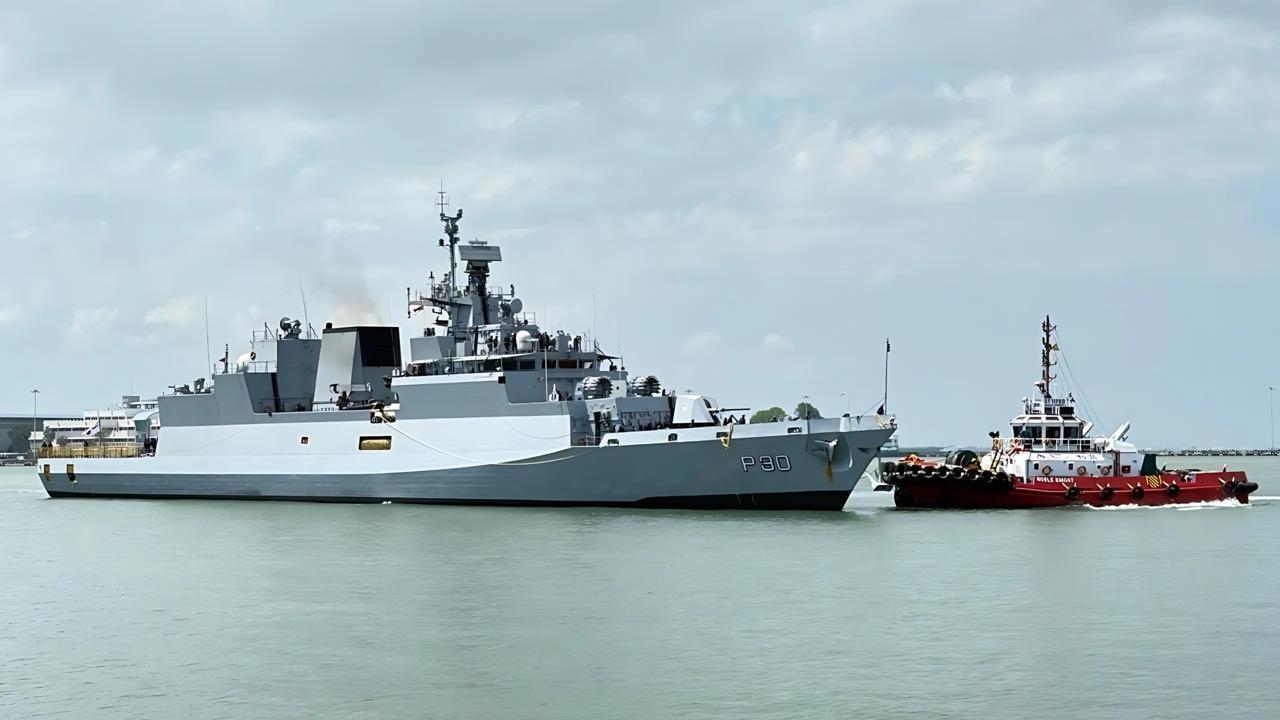
Photo : X / WarshipCam
Indian Navy Gears Up for SIMBEX 2025 Naval Exercise with Singapore
The Indo-Pacific region, the Indian Navy has confirmed its participation in SIMBEX 2025, the upcoming edition of the annual Singapore-India Maritime Bilateral Exercise. The announcement underlines India's growing commitment to regional security cooperation and interoperability with friendly navies.
SIMBEX (Singapore-India Maritime Bilateral Exercise) is not just another naval drill—it represents one of the longest uninterrupted bilateral naval exercises in the region, dating back to 1994. As both nations prepare to mark the 31st edition of this exercise in 2025, the upcoming operation is expected to be bigger, more technologically advanced, and strategically significant than ever before.
A Time-Tested Naval Partnership
The strategic relationship between India and Singapore has evolved substantially over the past three decades, and SIMBEX is a clear indicator of that maturity. What began in the early 1990s as simple anti-submarine warfare drills has now matured into complex maritime warfare simulations, involving aircraft carriers, submarines, destroyers, and maritime patrol aircraft.
The 2025 edition of the exercise is expected to push the boundaries of what India and Singapore can achieve together on the high seas. Senior defence officials have already indicated that multi-domain integration, joint planning, and live weapon firings may be key highlights of SIMBEX 2025.
What SIMBEX 2025 Will Entail
The upcoming exercise, scheduled for early 2025, will likely span over several phases, typically including both harbour and sea phases. In the harbour phase, naval officers and personnel from both sides engage in planning conferences, cross-deck visits, and professional exchanges. Once at sea, the exercise shifts focus to tactical drills and combat simulations.
According to early details shared by the Indian Ministry of Defence, SIMBEX 2025 will feature:
Notably, both navies are also expected to test AI-enabled maritime systems, such as predictive navigation and automated threat detection, showcasing the growing role of technology in naval operations.
Indian Naval Assets Set to Participate
Although the full list of participating Indian naval platforms will be finalised closer to the exercise, sources have indicated that the Indian Navy could deploy some of its most advanced warships and systems, including:
This diverse fleet ensures India can project a blue-water navy image, capable of operating far from home shores and supporting multinational missions.
Singapore's Cutting-Edge Naval Force
Singapore, though a much smaller country in terms of geography, boasts one of the most technologically advanced and disciplined navies in Southeast Asia. The Republic of Singapore Navy (RSN) is expected to field its Formidable-class stealth frigates, unmanned surface vessels (USVs), and naval helicopters like the Sikorsky S-70B.
These assets allow the RSN to integrate seamlessly with larger fleets like that of the Indian Navy, enabling realistic combat training scenarios and coordinated mission execution.
Geopolitical Context: Indo-Pacific Stability
SIMBEX 2025 is more than just a bilateral exercise—it reflects broader geopolitical dynamics unfolding in the Indo-Pacific. With rising maritime competition in the South China Sea, increased Chinese naval patrols, and growing concerns about the security of key shipping lanes, India and Singapore’s cooperation is a signal of regional balance and resolve.
India, as part of its Act East Policy, has been consistently engaging with Southeast Asian countries to bolster diplomatic, trade, and defence ties. Singapore, located at the strategic Strait of Malacca, plays a vital role in this engagement.
The timing of SIMBEX 2025 also aligns with the increasing global emphasis on Free and Open Indo-Pacific (FOIP) principles. Joint naval exercises such as SIMBEX contribute to freedom of navigation operations (FONOPs), ensuring critical trade routes remain open and secure.
India’s Naval Diplomacy on the Rise
India’s naval outreach has grown exponentially over the last decade. In 2024 alone, the Indian Navy participated in over 40 bilateral and multilateral exercises, ranging from Malabar with the US, Japan, and Australia, to Varuna with France and Zair-Al-Bahr with Qatar.
These exercises are part of India’s strategy to establish itself as a “Preferred Security Partner” in the Indian Ocean Region (IOR). The consistent participation in SIMBEX underscores the strategic trust and operational compatibility India shares with Singapore.
Focus on Maritime Security Cooperation
Both India and Singapore have a shared interest in countering piracy, trafficking, illegal fishing, and maritime terrorism. The SIMBEX 2025 exercise will provide an ideal platform to simulate real-world scenarios that both navies may confront in their respective maritime zones.
For instance, Singapore is part of the ReCAAP (Regional Cooperation Agreement on Combating Piracy and Armed Robbery), and India is a founding member of the Indian Ocean Naval Symposium (IONS). Joint exercises help build bridges between these regional security frameworks.
Technology as a New Battlefield
In addition to hardware and tactics, SIMBEX 2025 will focus heavily on technology-driven warfare. This includes AI-based combat decision support, drone swarms, electronic surveillance, and satellite-aided situational awareness.
As warfare becomes increasingly multi-domain, the goal is to integrate cyber, space, and electromagnetic capabilities with traditional naval strengths. Both navies are investing in data fusion systems that can combine inputs from sonar, radar, satellites, and onboard sensors to generate a single operating picture (SOP).
Such collaboration will help both nations future-proof their navies against emerging threats.
People-to-People and Cultural Links
SIMBEX is not just about weapons and war games. It also includes cultural events, sports competitions, and friendly exchanges that foster camaraderie and mutual respect between sailors from both countries.
Over the years, the Indian Navy and RSN have also engaged in naval training programs, academic courses, and joint seminars. Singaporean naval officers regularly train at Indian naval institutions like the Naval War College in Goa and the INS Shivaji Engineering College in Lonavala.
What This Means for India's Maritime Future
SIMBEX 2025 comes at a time when the Indian Navy is undergoing major expansion and modernisation. With over 40 new ships and submarines on order, India is aiming to build a 350-ship navy by 2040. Strengthening operational readiness through frequent bilateral exercises is central to this goal.
Moreover, by maintaining a presence in Southeast Asia, India ensures that its economic and energy interests — especially those passing through the Malacca Strait — remain protected.
Sailing Ahead Together
The Indian Navy’s participation in SIMBEX 2025 is more than just a tactical exercise—it is a powerful symbol of strategic trust, mutual capability, and shared vision. As maritime threats evolve and the Indo-Pacific becomes the epicentre of global security dynamics, strong naval partnerships like this one offer stability and deterrence.
Through deeper operational alignment, enhanced technological integration, and continued cultural ties, India and Singapore are not just navigating the seas — they are shaping the future of maritime security in the region.
As the countdown to SIMBEX 2025 begins, all eyes will be on the waters between India and Singapore — where cooperation, combat-readiness, and regional diplomacy will set sail side by side.
Indian Navy, SIMBEX 2025, Singapore



Advances in Aerospace Technology and Commercial Aviation Recovery
Insights into breakthrough aerospace technologies and commercial aviation’s recovery amid 2025 chall

Defense Modernization and Strategic Spending Trends
Explore key trends in global defense modernization and strategic military spending shaping 2025 secu

Tens of Thousands Protest in Serbia on Anniversary of Deadly Roof Collapse
Tens of thousands in Novi Sad mark a year since a deadly station roof collapse that killed 16, prote

Canada PM Carney Apologizes to Trump Over Controversial Reagan Anti-Tariff Ad
Canadian PM Mark Carney apologized to President Trump over an Ontario anti-tariff ad quoting Reagan,

The ad that stirred a hornets nest, and made Canadian PM Carney say sorry to Trump
Canadian PM Mark Carney apologizes to US President Trump after a tariff-related ad causes diplomatic

Bengaluru-Mumbai Superfast Train Approved After 30-Year Wait
Railways approves new superfast train connecting Bengaluru and Mumbai, ending a 30-year demand, easi




