Post by : Amit
Photo : X / Mega-Infro
A Historic Moment for Indian Railways
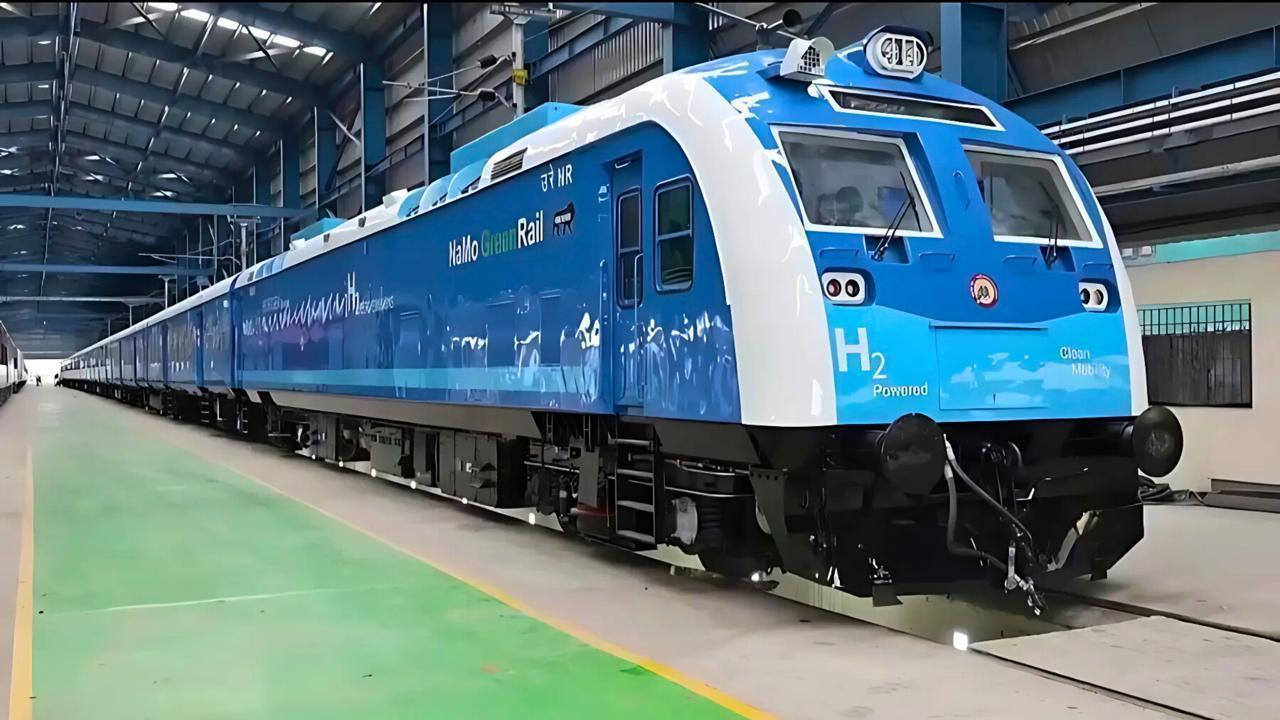
In a landmark move that could redefine the future of rail travel in India, Indian Railways is gearing up to launch the nation’s first hydrogen-powered train. The project, now in its advanced phase of development, will debut on the Jind–Sonipat route in Haryana.
Officials close to the matter describe the development as a “turning point” for the national transporter, with the potential to significantly cut emissions, modernize infrastructure, and open the door to new economic opportunities. The hydrogen-powered service will be the first of its kind in the country and will place India among a select group of nations pioneering this clean transportation technology.
Why Jind–Sonipat Was Chosen for the Pilot Run
The Jind–Sonipat section of Haryana was not picked by chance. Rail planners were strategic in their selection, focusing on a stretch that has moderate passenger traffic, relatively flat terrain, and manageable operational complexity. This allows engineers to test the hydrogen fuel cell systems without major disruptions to regular train services.
The route is also close to industrial hubs, which makes it easier to set up the specialized hydrogen refueling stations and maintenance depots needed to support the technology. According to officials, preliminary infrastructure work—ranging from safety compliance upgrades to staff training—is already underway.
Inside the Hydrogen Fuel Cell Technology
Hydrogen trains rely on fuel cells that convert hydrogen gas into electricity through a chemical process. The electricity powers the train’s motors, while the only by-products are water vapor and heat—making the process entirely emission-free at the point of use.
Unlike battery-electric trains, which require long charging times and heavy batteries, hydrogen trains can be refueled quickly, much like diesel locomotives. This gives them a significant operational advantage, particularly on non-electrified routes that stretch over long distances.
Indian Railways is taking a cost-efficient approach by retrofitting existing train coaches rather than commissioning new builds. This retrofit strategy not only saves capital but also allows the railway to fast-track deployment while leveraging the existing fleet.
A Boost to India’s Green Mission
The project dovetails perfectly with Indian Railways’ “Green Mission” and the national goal of reaching net-zero carbon emissions by 2070. While the government is pushing for complete network electrification, hydrogen offers a practical solution for certain sections where laying electric lines is costly or technically challenging—such as hilly terrains and remote regions.
Hydrogen trains, in this sense, complement electrification efforts rather than competing with them. They help close the gap in India’s clean mobility roadmap by addressing routes where electric traction is not feasible in the near term.
Environmental Gains and Cost Benefits
From an environmental perspective, the shift from diesel to hydrogen on the Jind–Sonipat route is expected to eliminate thousands of tonnes of carbon emissions annually. Beyond climate benefits, passengers and station staff will enjoy cleaner air and lower noise pollution levels.
Cost benefits are also on the horizon. While hydrogen fuel is currently more expensive than diesel, industry experts predict prices will drop as production scales up—particularly for “green hydrogen” made from renewable energy. Over the long term, hydrogen trains could reduce fuel expenses by up to 30%, with additional savings from lower maintenance costs due to the simpler mechanics of fuel cell systems.
The Safety Question
Hydrogen is a highly flammable gas, which naturally raises safety concerns. To address this, Indian Railways is working closely with global technology suppliers to integrate cutting-edge safety features. These include double-walled hydrogen storage tanks, advanced leak detection sensors, fire suppression systems, and strict handling protocols for refueling.
Maintenance crews and operational staff are undergoing specialized training to ensure they can operate and service the trains safely. Emergency response plans are also being developed in collaboration with local authorities.
Learning from Global Leaders
Hydrogen trains have already been successfully deployed in Germany, France, the UK, and China, offering valuable lessons for India’s rollout. Germany’s Coradia iLint, for instance, has proven that hydrogen trains can operate reliably in regular passenger service with refueling times as short as 15 minutes.
Indian Railways is studying these international models to adapt best practices in refueling infrastructure, fuel storage, and route selection. By doing so, the project avoids the steep learning curve that often accompanies first-time technology adoption.
Economic Ripple Effects Beyond the Rails
The introduction of hydrogen rail technology is expected to create ripple effects in multiple sectors. Domestic manufacturing could see a boost as demand grows for hydrogen fuel cells, storage systems, and safety equipment. This aligns neatly with the government’s “Make in India” push to encourage high-value industrial production.
The renewable energy sector stands to benefit as well. Green hydrogen production—generated from solar and wind power—will require new renewable projects, thereby accelerating India’s clean energy expansion. Local economies near hydrogen refueling hubs could also gain from the creation of specialized jobs in engineering, operations, and safety management.
Government Policy and Funding Support
The hydrogen train project enjoys backing from the National Hydrogen Mission, which is tasked with making India a global hub for hydrogen production, consumption, and export. This includes policy frameworks for research funding, infrastructure incentives, and public-private partnerships.
While Indian Railways is funding the core project, collaborations with international companies and research bodies are providing access to advanced designs and operational expertise. This blended approach of public oversight and private innovation could serve as a model for other large-scale green projects in India.
Passenger Experience: Quiet, Smooth, and Modern
For passengers, the shift to hydrogen power will bring noticeable differences. Without the rumble of a diesel engine, the ride will be quieter and smoother. Reduced vibration will improve onboard comfort, and the absence of exhaust fumes will enhance air quality, both inside the train and around stations.
Railway sources suggest that the interiors of the hydrogen trains will feature upgraded seating, improved lighting, and modern amenities such as energy-efficient climate control systems. This could help Indian Railways position the hydrogen service not just as a green alternative, but as a premium travel experience.
Expansion Plans
If the Jind–Sonipat trial proves successful, Indian Railways plans to expand hydrogen technology to other non-electrified routes. Mountainous regions, long rural stretches, and heritage lines could all benefit from the flexibility and efficiency of hydrogen power.
Over time, the railway aims to establish a nationwide network of hydrogen refueling stations, integrated with India’s broader energy and transport systems. This could ultimately support other hydrogen-powered vehicles—buses, trucks, and even ships—creating an interconnected clean transport ecosystem.
Expert Voices on India’s Hydrogen Future
Transportation analysts say the hydrogen train is a bold but necessary step in India’s clean mobility journey. “Hydrogen fuel cell technology is where battery-electric vehicles were 10 years ago,” says Dr. Ramesh Iyer, an energy consultant specializing in alternative fuels. “India’s early adoption will ensure it’s not left behind when the technology becomes mainstream.”
Environmental groups are also applauding the move, while urging Indian Railways to ensure that the hydrogen used is green and not derived from fossil fuels. “The climate benefits depend entirely on how the hydrogen is produced,” notes Anjali Menon of the Clean Air Collective. “If we get this right, it could be a model for other developing nations.”
A Defining Step for India’s Transport Sector
The debut of the Jind–Sonipat hydrogen train represents more than a single technological milestone. It is a signal that India is ready to explore bold, innovative solutions to meet its climate commitments while maintaining economic growth.
By blending local manufacturing, renewable energy integration, and global best practices, Indian Railways is positioning itself not just as a passenger service provider, but as a leader in sustainable transport technology. If successful, the hydrogen train could become a global showcase for how emerging economies can leapfrog to cleaner, smarter infrastructure.
In a few months, as the train rolls down the tracks for its maiden journey, it won’t just be passengers watching—it will be the world.
Indian Railways, hydrogen train, Jind-Sonipat hydrogen route



Advances in Aerospace Technology and Commercial Aviation Recovery
Insights into breakthrough aerospace technologies and commercial aviation’s recovery amid 2025 chall

Defense Modernization and Strategic Spending Trends
Explore key trends in global defense modernization and strategic military spending shaping 2025 secu

Tens of Thousands Protest in Serbia on Anniversary of Deadly Roof Collapse
Tens of thousands in Novi Sad mark a year since a deadly station roof collapse that killed 16, prote

Canada PM Carney Apologizes to Trump Over Controversial Reagan Anti-Tariff Ad
Canadian PM Mark Carney apologized to President Trump over an Ontario anti-tariff ad quoting Reagan,

The ad that stirred a hornets nest, and made Canadian PM Carney say sorry to Trump
Canadian PM Mark Carney apologizes to US President Trump after a tariff-related ad causes diplomatic

Bengaluru-Mumbai Superfast Train Approved After 30-Year Wait
Railways approves new superfast train connecting Bengaluru and Mumbai, ending a 30-year demand, easi




