Post by : Amit
A Strategic Pivot to Maritime Mobility
Japan’s Ministry of Defense has officially launched a new Maritime Transport Group within the Self-Defense Forces (SDF), aimed at significantly enhancing the nation’s military logistics capabilities across sea-based theaters. The move, announced on July 22, 2025, underscores Japan’s growing focus on mobility and rapid deployment readiness in response to intensifying regional security threats, particularly in the East China Sea and the Taiwan Strait.
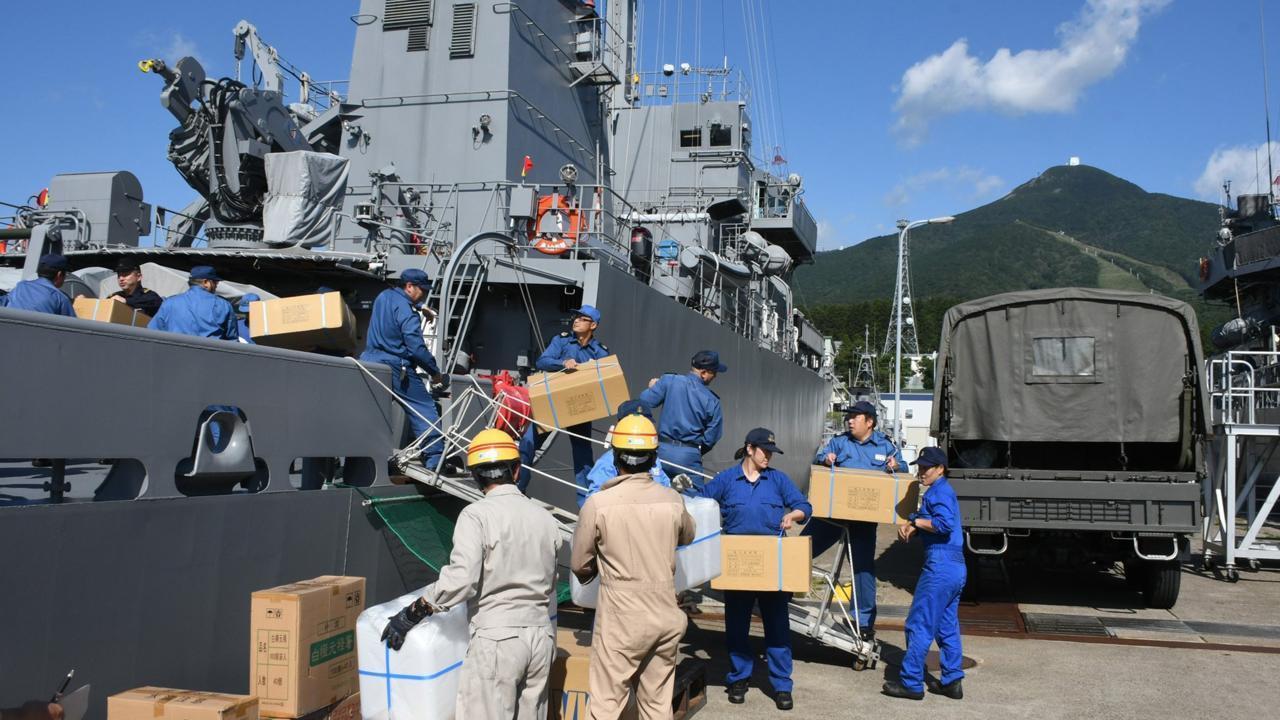
The newly established unit will be tasked with operating and coordinating SDF maritime transport vessels that have historically served in an auxiliary capacity. The Ministry is now centralizing these capabilities into a dedicated logistics corps—positioned as a vital strategic enabler for Japan’s evolving defense posture.
This development comes at a time of rising geopolitical tensions, particularly concerning China’s naval assertiveness and the ongoing concerns about Taiwan’s security. Japan’s efforts to bolster its self-defense logistics highlight a decisive shift from static homeland defense to more dynamic force projection capabilities.
Elevating Logistics to a Frontline Role
For decades, Japan’s SDF logistics and maritime transport roles were perceived as secondary support functions, operating largely behind the scenes. However, recent military doctrines have placed increasing emphasis on “strategic lift”—the ability to move troops, weapons, supplies, and relief assets swiftly across large distances. The COVID-19 pandemic, coupled with lessons drawn from the war in Ukraine, highlighted the urgency of robust logistics frameworks that are modular, redundant, and rapidly deployable.
“Modern warfare doesn’t allow for static support lines anymore,” noted retired Admiral Kazuya Inoue, a logistics strategist formerly with the Japan Maritime Self-Defense Force (JMSDF). “Your logistics capability needs to be as agile as your combat forces—possibly more so. With the creation of this new group, Japan is showing it understands that logistics is no longer backroom work. It’s frontline critical.”
Command Structure and Capabilities
The new Maritime Transport Group will operate under the direct command of the Joint Staff Office of the SDF. It consolidates multiple transport vessel units that were previously dispersed across the Maritime, Ground, and Air Self-Defense Forces. By merging these assets, the Ministry of Defense seeks to streamline operations, standardize training, and ensure interoperability among different force components.
The group is expected to manage a growing fleet of medium-to-large logistics ships capable of transporting both personnel and heavy equipment. These vessels are being retrofitted or newly procured with modular loading bays, ramp-based embarkation systems, and extended cargo holds suitable for armored vehicles, mobile radar systems, and fuel tankers.
In peacetime, the group will support joint exercises, humanitarian missions, and natural disaster responses, including earthquake and tsunami relief. During potential conflict scenarios, it will play a crucial role in force projection to remote island chains such as the Nansei Islands and possibly further into the Western Pacific.
Countering the China Challenge
Japan’s announcement comes amid growing concern over China's maritime activities. Over the past year, China’s People’s Liberation Army Navy (PLAN) has expanded its operations around Japanese territory, conducting frequent naval drills, surveillance activities, and so-called "grey zone" operations in the East China Sea, especially near the disputed Senkaku Islands.
Japanese officials have warned that a lack of integrated transport capability could hamper the country’s ability to respond quickly to such provocations. The new Maritime Transport Group addresses that gap by ensuring that SDF units can be moved swiftly from mainland bases to forward positions.
Notably, this strategy aligns closely with Japan’s newly revised National Security Strategy (NSS) and National Defense Strategy (NDS), which call for the creation of a more "multi-dimensional defense force" with an emphasis on cyber, space, and rapid mobility domains.
“This isn’t about preparing for a theoretical war,” said Akiko Fujikawa, a senior fellow at the Tokyo Institute of International and Strategic Studies. “It’s about closing very real vulnerabilities in the face of increasingly complex regional dynamics. Japan cannot afford to be caught flat-footed.”
Integrated with Allied Defense Planning
Japan’s new maritime logistics capability is also expected to play a pivotal role in allied interoperability, especially with the United States, which maintains a significant military presence in Okinawa and across the Indo-Pacific region. U.S. Indo-Pacific Command (INDOPACOM) has welcomed the move, calling it “a critical enhancement to regional deterrence and mobility.”
Joint drills with U.S. Marines, Australian Defense Forces, and South Korean units will be expanded to include simulated amphibious landings and maritime evacuation scenarios, where Japan’s new transport group will serve in both combat support and rescue roles. These scenarios are already being incorporated into the biennial “Keen Sword” and “Talisman Sabre” exercises, which emphasize coalition-based rapid deployment and contingency operations.
The Defense Ministry has stated that interoperability features—such as NATO-compatible radio communications, containerized cargo formats, and deck layouts for U.S.-origin helicopters—are being included in ship designs and crew training programs.
A Nod to Historical Lessons
The significance of this shift is not lost on military historians. During World War II, Japan’s Imperial Navy suffered significant setbacks due to logistical failures—particularly in maintaining resupply lines across the Pacific. The postwar pacifist constitution and decades of U.S.-provided security diminished Japan’s need to focus on autonomous logistics development. However, in today’s strategic landscape, such capabilities are becoming indispensable once again.
The decision to revive and reimagine a robust maritime transport division also reflects lessons drawn from the Cold War, when mobility and logistics were cornerstones of deterrence strategies. In that era, the ability to move large volumes of military assets at short notice was viewed as a decisive advantage. With this new SDF initiative, Japan appears to be resurrecting those principles, but with a 21st-century technological edge.
The Hardware Behind the Mission
The SDF is currently commissioning a new class of support vessels optimized for the maritime transport mission. These include dual-purpose ships capable of both roll-on/roll-off cargo operations and limited amphibious landings. Key features include high-efficiency diesel-electric propulsion systems, advanced ballast management for rapid cargo stabilization, and deck configurations that can accommodate mobile command posts and drone launch systems.
The vessels are being built by a consortium of Japanese shipbuilders, including Mitsubishi Heavy Industries and Japan Marine United. The Defense Acquisition Program Administration (DAPA) has earmarked over ¥90 billion ($650 million) for the first phase of the program, which includes three new ships and retrofitting four existing ones.
Initial sea trials are scheduled for early 2026, with full operational capability expected by 2028.
A Balanced View on Offensive Capability
While the development may raise eyebrows in some corners of East Asia, Japanese officials were quick to clarify that the Maritime Transport Group is not an offensive force but a support and mobility enabler. In accordance with Article 9 of Japan’s Constitution, which renounces war as a means of settling international disputes, the unit will operate under strict guidelines that prioritize defense and humanitarian missions.
Nevertheless, observers point out that the nature of such units can quickly shift depending on the context. “It’s not always about what a capability is today, but what it can be repurposed for tomorrow,” warned Professor Renji Sakamoto, a defense policy analyst at Kyoto University. “Japan is walking a fine line between deterrence and escalation.”
As Japan’s security environment becomes more complex, the establishment of the Maritime Transport Group marks a notable evolution in military doctrine—one that emphasizes logistics as a battlefield advantage, not just a background function. With increasing regional collaboration, enhanced maritime surveillance, and the modernization of fleet capabilities, Japan is building what many now see as a logistics architecture that is fit for both peace and crisis.
Looking forward, defense planners anticipate that similar organizational realignments may occur within the Air and Ground Self-Defense Forces, potentially leading to the formation of a unified logistics command covering airlift, sealift, and land transport functions under a single operational umbrella.
More Than Ships, A Shift in Mindset
Ultimately, Japan’s new Maritime Transport Group symbolizes more than a fleet of transport ships or a change in command structure. It represents a fundamental reassessment of national security through the lens of resilience, adaptability, and self-reliance.
As Japan steps into an era of great power competition and maritime uncertainty, ensuring that it can rapidly move and support its forces wherever needed is no longer a strategic luxury—it is a necessity. With this initiative, the SDF is not only adapting to modern challenges but also redefining what it means to be “ready” in a turbulent Indo-Pacific.
Japan, SDF Maritime, Bolster Logistics



Advances in Aerospace Technology and Commercial Aviation Recovery
Insights into breakthrough aerospace technologies and commercial aviation’s recovery amid 2025 chall

Defense Modernization and Strategic Spending Trends
Explore key trends in global defense modernization and strategic military spending shaping 2025 secu

Tens of Thousands Protest in Serbia on Anniversary of Deadly Roof Collapse
Tens of thousands in Novi Sad mark a year since a deadly station roof collapse that killed 16, prote

Canada PM Carney Apologizes to Trump Over Controversial Reagan Anti-Tariff Ad
Canadian PM Mark Carney apologized to President Trump over an Ontario anti-tariff ad quoting Reagan,

The ad that stirred a hornets nest, and made Canadian PM Carney say sorry to Trump
Canadian PM Mark Carney apologizes to US President Trump after a tariff-related ad causes diplomatic

Bengaluru-Mumbai Superfast Train Approved After 30-Year Wait
Railways approves new superfast train connecting Bengaluru and Mumbai, ending a 30-year demand, easi




