Post by : Amit
Photo;Reuters
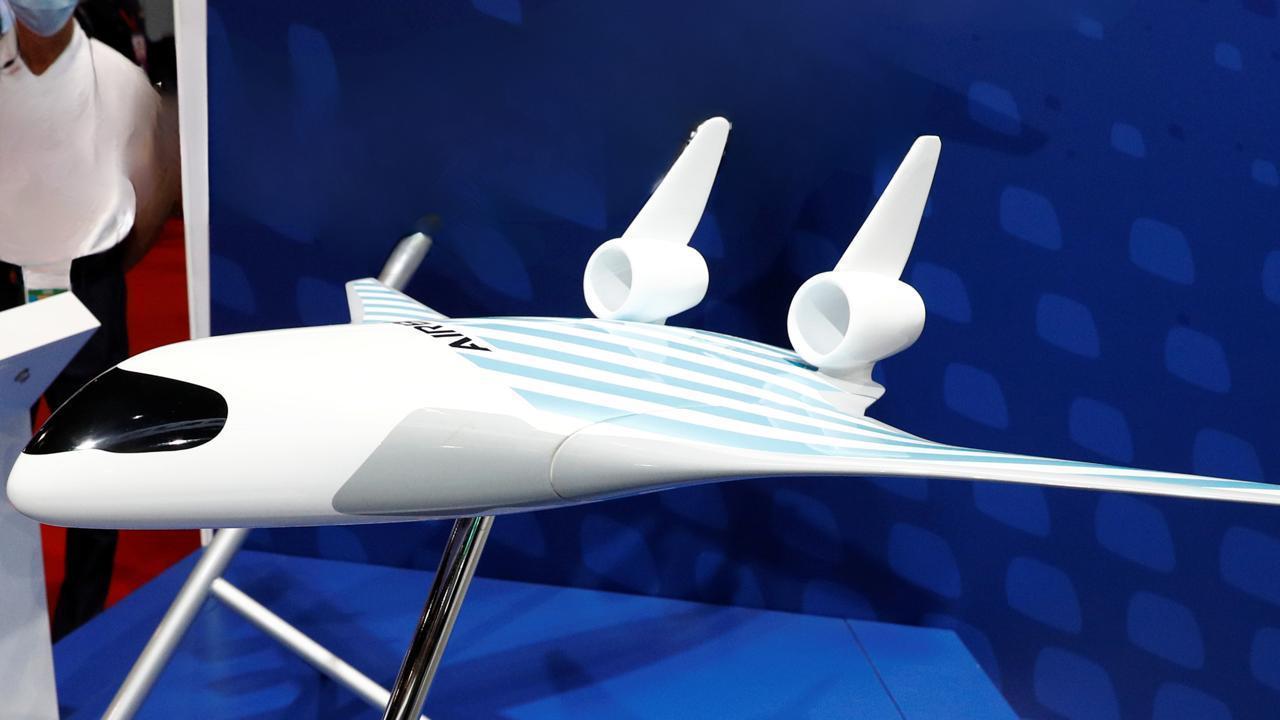
Washington D.C., June 2025 — In a groundbreaking step toward transforming the aviation landscape, American aerospace startup JetZero has announced a strategic collaboration with industry giants Pratt & Whitney and Collins Aerospace, both divisions of RTX, to develop the next generation of fuel-efficient aircraft. With strong backing from the U.S. Air Force, the ambitious project centers around the development of a futuristic blended-wing body (BWB) aircraft—a design poised to reshape commercial and military aviation for decades to come.
The visionary partnership aims to produce a demonstrator aircraft that combines advanced aerodynamics with proven engine technology to slash fuel consumption, reduce carbon emissions, and offer a quieter, more sustainable flying experience. If successful, JetZero’s innovative aircraft could become the blueprint for eco-friendly aviation, serving roles from commercial passenger transport and cargo haulage to military operations such as aerial refueling. The demonstrator’s maiden flight is expected to take place in 2027, marking a critical milestone in aviation’s ongoing quest for environmental sustainability and operational efficiency.
The heart of the project is JetZero’s adoption of the blended-wing body design—a radical departure from the traditional tube-and-wing configuration that has dominated commercial aviation for nearly a century. Unlike conventional aircraft, where the fuselage and wings are distinct, the BWB merges these elements into a single, unified structure resembling a flying wing. This integration not only reduces aerodynamic drag but also enhances lift efficiency, potentially cutting fuel consumption by up to 50% compared to today’s standard airliners.
“Blended-wing body aircraft have long been viewed as the next frontier in efficient air travel,” said Dan da Silva, Chief Operating Officer of JetZero. “With this collaboration, we are not just imagining the future—we are building it. This is a milestone moment for aviation and climate-conscious innovation.”
One of the most striking aspects of the JetZero project is its pragmatic approach to propulsion. Rather than developing an entirely new engine from scratch—an endeavor that would be both time-consuming and expensive—the company has opted to utilize four proven Pratt & Whitney PW2040 engines. These engines, which currently power the Boeing 757 as well as the U.S. Air Force’s C-17 Globemaster III, are celebrated for their reliability and robust performance, delivering up to 43,000 pounds of thrust each.
By integrating existing engine technology into the new airframe, JetZero hopes to accelerate development timelines and mitigate technical risks. This decision reflects a growing trend in the aerospace industry, where the emphasis is increasingly on marrying next-generation airframe designs with established propulsion systems to achieve faster, more scalable innovation.
“The use of the PW2040 engines allows us to focus on the airframe's transformative potential while relying on a proven powerplant,” da Silva explained. “This approach ensures a balance between innovation, safety, and speed to market.”
Collins Aerospace, the other key partner in the project, will bring its deep expertise in aircraft systems to the table. The company will supply critical components including nacelles, engine mounts, ducts, and inlet systems—essential elements that will support the performance and efficiency of the aircraft. Collins’ track record includes supplying similar systems for leading commercial jets such as the Airbus A350, giving JetZero access to a wealth of technical knowledge and manufacturing capabilities.
“This partnership leverages the strengths of all involved,” said Juan de Bedout, Chief Technology Officer at RTX. “Together, we are charting a path toward sustainable aviation that is not only visionary but also achievable.”
The potential applications of the JetZero blended-wing aircraft are extensive. Beyond commercial passenger travel, where its spacious cabin could improve passenger comfort and seating configurations, the BWB design lends itself well to freight and logistics operations due to its inherent structural efficiency. The military sector also stands to benefit significantly, particularly in roles such as aerial refueling and cargo missions where fuel efficiency translates directly to operational effectiveness and extended range.
The environmental implications of JetZero’s design are equally compelling. In an era where aviation is under mounting pressure to decarbonize, the possibility of cutting fuel use—and thus greenhouse gas emissions—by half is nothing short of revolutionary. With global passenger demand expected to continue rising in the coming decades, sustainable aviation solutions are no longer optional; they are imperative.
The blended-wing body concept is not entirely new. NASA, Boeing, and other aerospace leaders have explored the idea over the past two decades, conducting numerous wind tunnel tests and small-scale demonstrations. However, challenges related to stability, cabin pressurization, and regulatory certification have historically slowed progress. JetZero’s project, backed by the technical muscle of RTX and the strategic support of the U.S. Air Force, represents the most serious push yet to bring the BWB concept from theory to reality.
The U.S. Air Force’s interest in the project highlights the growing military recognition of the operational benefits offered by energy-efficient aircraft. Reduced fuel consumption means lower logistical burdens, longer mission endurance, and decreased environmental impact—key considerations for future military operations.
The financial and policy context surrounding the initiative also reflects a shifting global landscape. Governments and regulatory bodies worldwide are increasingly mandating stricter emissions targets for aviation, while passengers and investors alike are demanding greener alternatives. The International Air Transport Association (IATA) has called for net-zero emissions in commercial aviation by 2050, and technological leaps like JetZero’s BWB aircraft will be essential to meeting these ambitious goals.
The 2027 flight of JetZero’s demonstrator will serve as a crucial proving ground for the aircraft’s capabilities. Should the demonstrator perform as expected, the company will be well-positioned to pursue commercial certification, potentially setting the stage for widespread adoption of blended-wing designs across both civilian and military aviation markets.
Despite the excitement, significant hurdles remain. Certifying an entirely new aircraft architecture will require close collaboration with regulators such as the Federal Aviation Administration (FAA) and international bodies. Pilots, maintenance crews, and air traffic controllers will all need to adapt to the unique characteristics of the BWB design, from handling to emergency procedures.
Still, industry observers are optimistic. “The JetZero project combines visionary thinking with pragmatic execution,” said aviation analyst Laura Henley. “By leveraging established engine technology while pushing the boundaries of aerodynamic design, they’ve struck the right balance between innovation and feasibility.”
As the aerospace sector faces rising fuel costs, environmental mandates, and passenger demand for quieter, more comfortable travel, the timing could not be more opportune. The arrival of blended-wing aircraft like JetZero’s may finally fulfill decades of speculation about the next great leap in aviation technology.
For now, the sleek silhouette of JetZero’s flying wing remains on the drawing board and in wind tunnels. But by 2027, it could be soaring silently above the clouds, ushering in a greener, smarter chapter in the story of human flight.
Aircraft Fuel-Efficient Jet



Advances in Aerospace Technology and Commercial Aviation Recovery
Insights into breakthrough aerospace technologies and commercial aviation’s recovery amid 2025 chall

Defense Modernization and Strategic Spending Trends
Explore key trends in global defense modernization and strategic military spending shaping 2025 secu

Tens of Thousands Protest in Serbia on Anniversary of Deadly Roof Collapse
Tens of thousands in Novi Sad mark a year since a deadly station roof collapse that killed 16, prote

Canada PM Carney Apologizes to Trump Over Controversial Reagan Anti-Tariff Ad
Canadian PM Mark Carney apologized to President Trump over an Ontario anti-tariff ad quoting Reagan,

The ad that stirred a hornets nest, and made Canadian PM Carney say sorry to Trump
Canadian PM Mark Carney apologizes to US President Trump after a tariff-related ad causes diplomatic

Bengaluru-Mumbai Superfast Train Approved After 30-Year Wait
Railways approves new superfast train connecting Bengaluru and Mumbai, ending a 30-year demand, easi




