Post by : Amit
Photo : X / Hardik Shah
A Defining Leap for Air Mobility
In a moment that aviation historians may one day compare to the early days of powered flight, Joby Aviation has completed the first piloted electric vertical take-off and landing (eVTOL) air taxi flight between two public airports in the United States. The achievement not only cements Joby’s position as a frontrunner in the race to commercialize urban air mobility, but it also offers a tangible demonstration that the long-promised future of electric air taxis is steadily moving from imagination to reality.
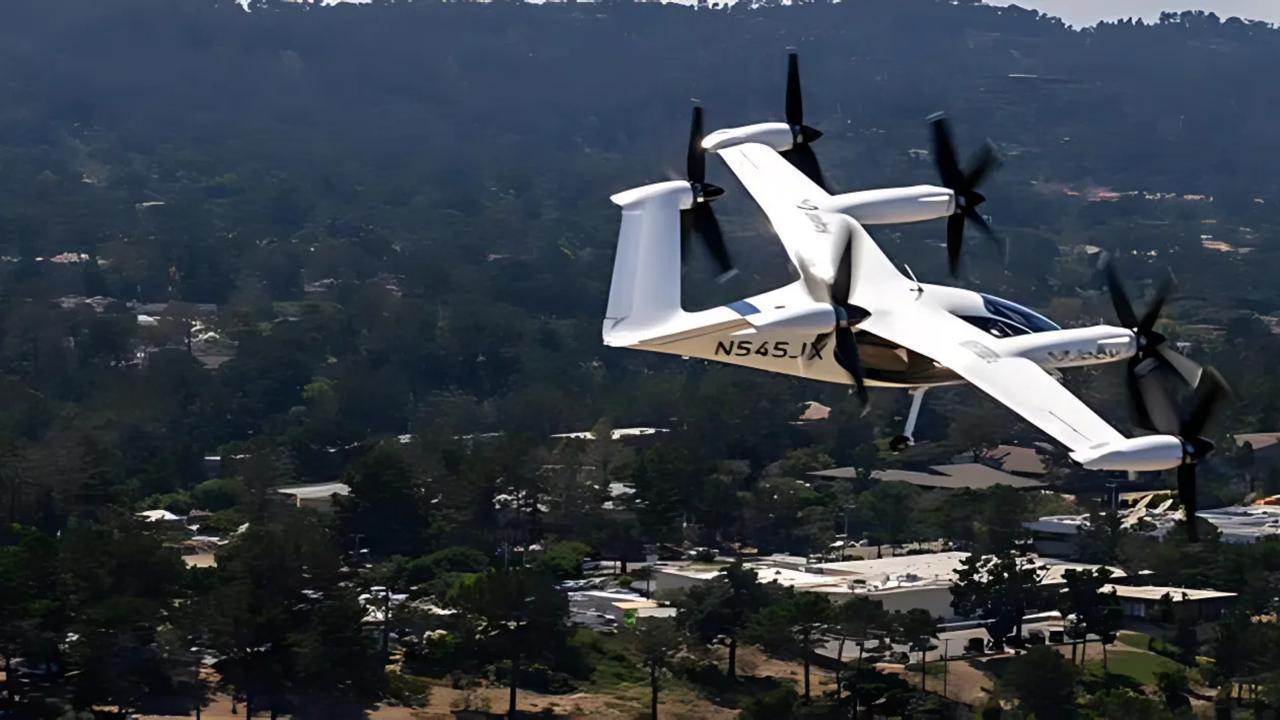
On a clear California morning, Joby’s sleek white eVTOL lifted off from Watsonville Municipal Airport and landed just 17 minutes later at Monterey Regional Airport, covering 32 miles of active civil airspace. This was not a controlled test at a private facility or a military base but a flight conducted under normal air traffic control procedures, with a licensed pilot at the controls. For the first time, an eVTOL carried out an inter-airport flight the same way any conventional aircraft would, offering a glimpse of how these vehicles could fit into everyday air travel.
The Flight That Signaled a New Era
The aircraft that made history is Joby’s five-seat, fully electric air taxi designed for short-distance hops. It can cruise at speeds of up to 200 mph (322 km/h), carry a pilot and four passengers, and fly up to 150 miles (241 km) on a single charge. The Monterey demonstration underscored its ability to integrate seamlessly into existing airport infrastructure. No futuristic “vertiports” were needed, and no unusual airspace restrictions applied—Joby simply operated as a normal aircraft would.
What stood out most was the efficiency of the journey. A 32-mile drive along the California coast from Watsonville to Monterey typically takes about 45–60 minutes by car, depending on traffic. Joby’s eVTOL cut that travel time down to less than 20 minutes. In regions where congestion clogs roads daily, such time savings could be transformative.
Integration Into the Airspace
Perhaps the most significant achievement of the flight was not the distance or speed, but integration into the national airspace system. Joby worked directly with the Federal Aviation Administration (FAA) and coordinated with air traffic control at both airports. This is critical because one of the major challenges for eVTOLs has been proving that they can operate safely alongside helicopters, small planes, and commercial airliners.
By demonstrating that its aircraft could file a flight plan, take off, cruise, and land within the same regulatory framework as existing aviation, Joby set a precedent that regulators can use when crafting the rules that will govern advanced air mobility (AAM). This was not just a test of technology—it was a test of regulatory compatibility, and it passed.
Why This Milestone Matters
The implications of Joby’s historic flight ripple far beyond California. Cities worldwide are grappling with increasing congestion, longer commutes, and rising emissions. Urban planners and policymakers are urgently seeking alternatives, and eVTOLs have been touted as a solution that combines speed, sustainability, and safety.
Unlike helicopters, which are noisy, expensive, and carbon-intensive, Joby’s aircraft produces zero in-flight emissions and is designed to be 100 times quieter than traditional rotorcraft during takeoff and landing. That makes them better suited for urban use, where noise complaints have historically limited helicopter operations.
For commuters, business travelers, and even tourists, air taxis could drastically reshape the geography of mobility. Imagine a world where getting from downtown Los Angeles to LAX takes 10 minutes instead of an hour, or where cross-bay commutes in San Francisco shrink from 45 minutes to less than 15. Joby’s Monterey-Watsonville flight was just 17 minutes, but its symbolic weight is far larger: it proved that short-range electric air travel is no longer a theory—it works.
Joby’s Road to Certification
Of course, one successful flight does not mean that eVTOL taxis are ready for mass adoption. The FAA has a multi-step certification process that includes aircraft type certification, pilot training certification, and operational approval. Joby has been working through this process and has already achieved significant milestones, including FAA Part 135 Air Carrier Certification in 2022, which allows it to operate commercial air services once the aircraft itself is certified.
Joby is targeting 2025–2026 for the commercial launch of its passenger services. Between now and then, the company will continue to conduct demonstration flights, expand pilot training programs, and build out the charging and maintenance infrastructure required for scalable operations.
Industry analysts see Joby’s progress as an advantage over competitors like Archer Aviation, Lilium, Vertical Aerospace, and Volocopter, all of which are racing to bring eVTOLs to market. Each company is pursuing slightly different designs and strategies, but Joby’s public airport flight could give it credibility with regulators, investors, and potential partners.
Expert Voices: A “Wright Brothers Moment”
Aviation experts and analysts were quick to frame Joby’s flight as a “Wright brothers moment” for the eVTOL industry. While the technology has been tested privately for years, a piloted flight between public airports carries symbolic power that few milestones can match.
“Flying from one public airport to another with a pilot on board is a signal to the world that this technology is no longer hypothetical,” said aviation consultant Richard Aboulafia. “It shows regulators, investors, and the public that air taxis are not a futuristic fantasy—they are an emerging reality.”
The FAA echoed that sentiment, noting that such real-world demonstrations help accelerate the rule-making process. Cities and local governments, meanwhile, are watching closely to understand how they might adapt infrastructure and zoning regulations to accommodate eVTOL operations.
Economic and Social Impact
If commercialized successfully, eVTOL air taxis could have profound economic and social effects. Industry forecasts suggest that the global urban air mobility market could be worth $1 trillion by 2040, creating thousands of new jobs in manufacturing, piloting, maintenance, and operations.
For cities, the promise is reduced congestion, faster connectivity between economic hubs, and the potential for new tourism and commuter markets. For individuals, the benefit is simple but powerful: saving time. In an age where time is one of the most precious commodities, cutting an hour-long commute to 15 minutes could reshape how and where people live and work.
Yet challenges remain. Infrastructure for charging, passenger boarding, and maintenance must be built at scale. Tickets must be affordable enough to move beyond luxury markets into mainstream commuting. And public trust—particularly around safety—must be earned through transparency and consistent performance.
From Airports to Downtown Rooftops
Joby’s first piloted airport-to-airport flight is just the beginning. The next phase will likely involve demonstrations from airports to downtown rooftop pads, mimicking the actual routes future passengers might take. That will test not just the aircraft’s capabilities, but also the logistics of boarding, charging, and integrating eVTOLs into densely populated areas.
The company has already secured partnerships with Delta Air Lines to connect airports with city centers, and with the U.S. Air Force’s Agility Prime program, which provides government support for testing and deployment. These collaborations show that both commercial and government stakeholders see value in Joby’s vision.
A Giant Step Toward Everyday Air Taxis
The sight of Joby’s eVTOL rising from Watsonville and touching down in Monterey may one day be remembered as the moment when air taxis truly left the drawing board and entered the skies. By proving that an electric air taxi can operate between two public airports under existing aviation rules, Joby has erased a major doubt about the practicality of eVTOLs.
Much work lies ahead before commuters are hailing Joby rides through an app, but the trajectory is clear. Just as the Wright brothers’ first 12-second flight in 1903 eventually led to today’s global aviation industry, Joby’s 17-minute hop in California could herald a new era of clean, fast, and accessible air travel.
For now, the company has secured its place in aviation history, not with futuristic promises, but with a simple, decisive fact: the future of flight is already here—and it’s electric.
Joby Aviation eVTOL flight, Electric air taxi Joby



Advances in Aerospace Technology and Commercial Aviation Recovery
Insights into breakthrough aerospace technologies and commercial aviation’s recovery amid 2025 chall

Defense Modernization and Strategic Spending Trends
Explore key trends in global defense modernization and strategic military spending shaping 2025 secu

Tens of Thousands Protest in Serbia on Anniversary of Deadly Roof Collapse
Tens of thousands in Novi Sad mark a year since a deadly station roof collapse that killed 16, prote

Canada PM Carney Apologizes to Trump Over Controversial Reagan Anti-Tariff Ad
Canadian PM Mark Carney apologized to President Trump over an Ontario anti-tariff ad quoting Reagan,

The ad that stirred a hornets nest, and made Canadian PM Carney say sorry to Trump
Canadian PM Mark Carney apologizes to US President Trump after a tariff-related ad causes diplomatic

Bengaluru-Mumbai Superfast Train Approved After 30-Year Wait
Railways approves new superfast train connecting Bengaluru and Mumbai, ending a 30-year demand, easi




