Post by : Amit
Photo : X / Kashmir Watch
Historic First for Kashmir’s Freight Rail
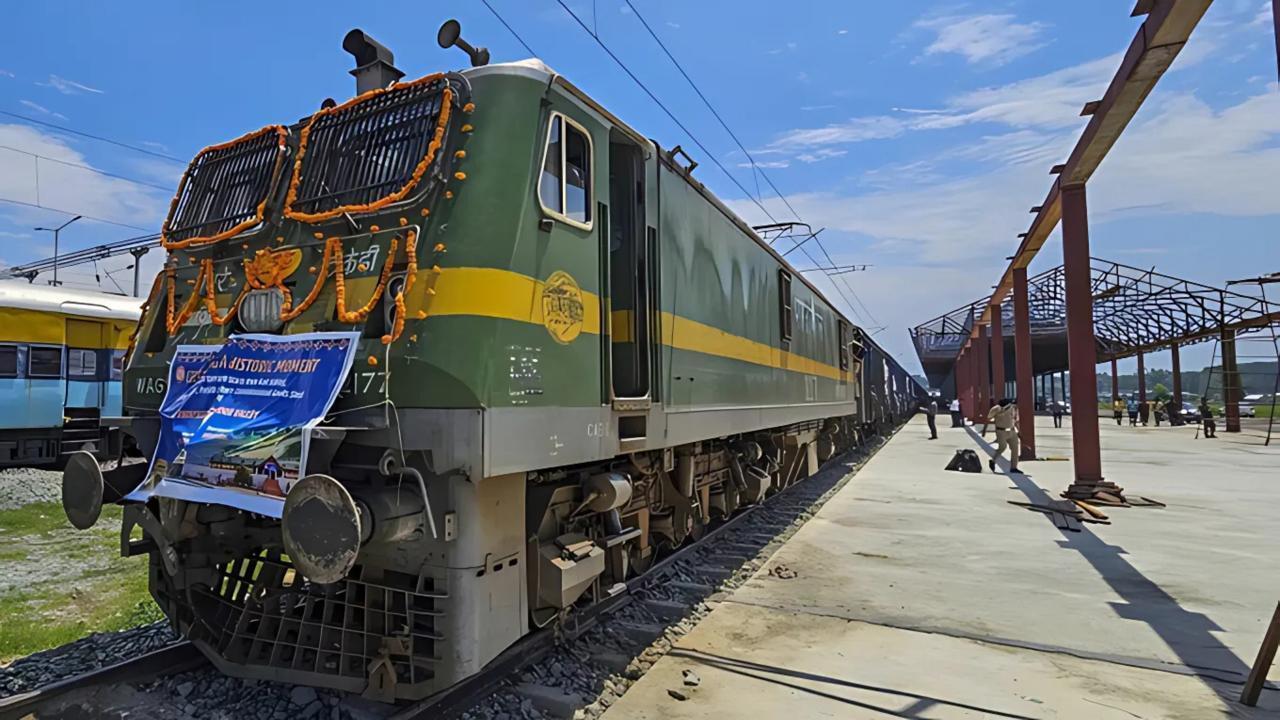
In a milestone for Jammu and Kashmir’s transport infrastructure, the first-ever freight train carrying cement from Punjab arrived at the Anantnag Goods Shed in south Kashmir on Sunday. This moment marks a turning point for the Valley’s logistics network, opening the door to more efficient, large-scale goods movement between Kashmir and the rest of India. The arrival of this train is not just about cement; it’s about the movement of commerce, the integration of markets, and a step toward the long-promised economic transformation of the region.
The freight service was made possible after the completion of critical stretches of the Udhampur–Srinagar–Baramulla Rail Link (USBRL) project. Until now, goods transport in Kashmir was heavily reliant on roadways, with trucks navigating treacherous routes through the Jammu–Srinagar National Highway. Landslides, snow, and traffic jams often delayed deliveries and inflated costs. With rail freight now operational, these challenges are expected to ease significantly.
The Anantnag Goods Shed, newly equipped to handle bulk freight, is poised to become a key node in Kashmir’s economic map. Officials said this freight link will streamline the supply chain for essential commodities, industrial goods, and construction materials — a change that could reduce logistical costs and improve market stability.
Cement was chosen as the inaugural freight cargo for a reason. The demand for construction materials in Kashmir has been surging due to infrastructure development, housing projects, and tourism-related facilities. Historically, transporting cement by road was both expensive and slow, leading to supply bottlenecks. Now, a single freight train can carry thousands of tonnes at once, ensuring timely and cost-effective delivery to the Valley’s builders and contractors.
According to railway officials, the train from Punjab to Anantnag not only symbolizes enhanced connectivity but also demonstrates how rail freight can support Kashmir’s industrial growth. With faster delivery and lower transportation costs, cement prices could stabilize, benefiting construction companies and, indirectly, the people who purchase homes or commercial spaces.
The impact of this freight service is expected to go far beyond just construction. Improved logistics will likely influence multiple sectors, including agriculture, retail, and manufacturing. Kashmiri fruit exporters, for example, could send produce more efficiently to markets in Delhi, Mumbai, and beyond — potentially opening new markets for perishable goods.
For industrial goods, the arrival of bulk items like steel, machinery, and fertilizers via freight trains will save time and money, making local manufacturing more competitive. Analysts believe that over the next two to three years, Kashmir could see a significant reduction in its dependency on high-cost road transport.
The USBRL project has long been described as one of India’s most ambitious rail undertakings. Stretching across some of the most challenging mountainous terrain in the country, it involves dozens of tunnels, bridges, and advanced engineering solutions to link the Kashmir Valley with the national rail network.
While passenger services on certain sections have been operational for years, the launch of regular freight services has taken longer due to logistical and infrastructural constraints. The completion of key tunnels and bridges between Banihal and Baramulla, combined with the operational readiness of freight-handling facilities in Anantnag, has now made this milestone possible.
At the arrival ceremony, railway officials, local administrators, and trade representatives welcomed the development, calling it a “game-changer” for Kashmir’s economy. Northern Railway officials said the move aligns with India’s larger goal of boosting rail freight efficiency and reducing dependence on roads, especially in regions with weather-related vulnerabilities.
The Ministry of Railways also emphasized that the introduction of freight trains to Kashmir is part of a broader vision to integrate the Valley with the country’s economic heartlands. By enabling faster transport of goods, the government hopes to stimulate investment in local industries, create jobs, and improve living standards.
Switching part of Kashmir’s goods transport from trucks to trains is also expected to yield environmental benefits. Freight trains consume less fuel per tonne-kilometer compared to trucks and produce significantly fewer carbon emissions. In a region where environmental preservation is critical — given its fragile ecosystem and dependence on tourism — this shift could help reduce pollution along major transport routes.
Furthermore, reducing heavy truck traffic on the Jammu–Srinagar highway could ease road congestion, cut down on accident rates, and lower highway maintenance costs. These indirect benefits, while not immediately visible, could become significant over time.
Business leaders in the Valley have already begun to anticipate the changes this freight service will bring. Wholesale traders are expected to leverage the railway for bulk imports of consumer goods, while exporters will find it easier to meet tight delivery deadlines.
The cross-border trade narrative is also quietly shifting. With efficient domestic rail links in place, Kashmir can position itself as a stronger player in inter-state commerce, potentially attracting investment in warehousing, packaging, and processing industries.
For many residents of Anantnag and nearby districts, the arrival of the first freight train was more than just an economic event — it was a moment of pride and hope. The sound of a locomotive bringing goods directly to the Valley resonated as a signal of progress, connectivity, and inclusion in the national development story.
Local shop owners expressed optimism that reduced transportation costs could eventually bring down prices for everyday goods. Farmers and small manufacturers also see opportunities to expand their reach without being burdened by expensive logistics.
While the first cement-laden freight train is a symbolic start, the future will likely see a diverse range of cargo making its way to and from Kashmir by rail. Officials are already planning for shipments of food grains, industrial chemicals, timber, and even refrigerated goods.
The Indian Railways is reportedly working on expanding freight-handling capacity in other parts of the Valley, such as Sopore and Pulwama, to ensure that the benefits of this connectivity are spread more evenly across the region.
The arrival of the first cement freight train in Anantnag is more than just a logistical achievement — it is a landmark moment for Jammu and Kashmir’s economic integration with the rest of India. By offering faster, cheaper, and more reliable goods transport, rail freight has the potential to transform trade patterns, attract new investments, and make life easier for residents and businesses alike.
In the long run, the expansion of freight services will not only strengthen the Valley’s economy but also reinforce its strategic importance in India’s transport and trade network. For now, the people of Kashmir can celebrate a first that promises many more milestones to come.
Kashmir freight train, Kashmir rail freight service



Advances in Aerospace Technology and Commercial Aviation Recovery
Insights into breakthrough aerospace technologies and commercial aviation’s recovery amid 2025 chall

Defense Modernization and Strategic Spending Trends
Explore key trends in global defense modernization and strategic military spending shaping 2025 secu

Tens of Thousands Protest in Serbia on Anniversary of Deadly Roof Collapse
Tens of thousands in Novi Sad mark a year since a deadly station roof collapse that killed 16, prote

Canada PM Carney Apologizes to Trump Over Controversial Reagan Anti-Tariff Ad
Canadian PM Mark Carney apologized to President Trump over an Ontario anti-tariff ad quoting Reagan,

The ad that stirred a hornets nest, and made Canadian PM Carney say sorry to Trump
Canadian PM Mark Carney apologizes to US President Trump after a tariff-related ad causes diplomatic

Bengaluru-Mumbai Superfast Train Approved After 30-Year Wait
Railways approves new superfast train connecting Bengaluru and Mumbai, ending a 30-year demand, easi




