Post by : Armust Desk
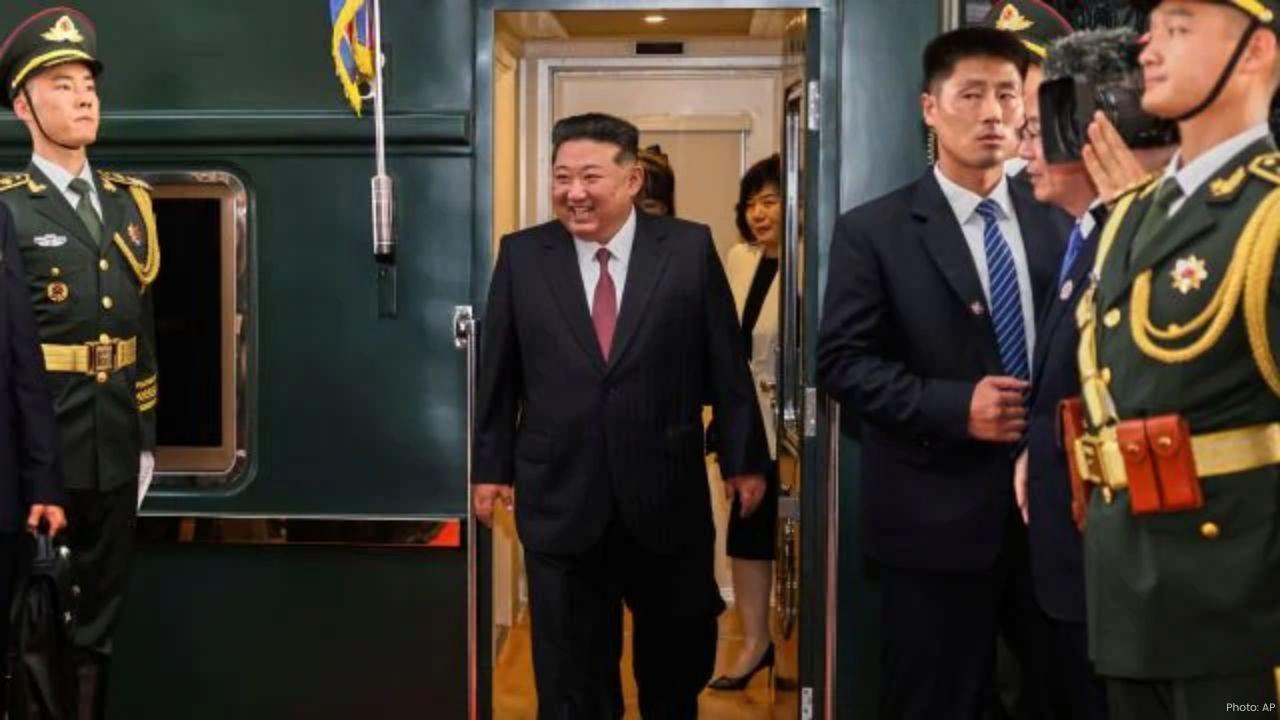
North Korean leader Kim Jong Un is known for his unique and careful approach to international travel. While most world leaders rely on airplanes for speed, Kim continues a long-standing family tradition: traveling abroad in a green armoured train. This train is not just a mode of transport—it represents security, privacy, and the legacy of the Kim family that has ruled North Korea for decades.
A Family Tradition of Rail Travel
The use of trains for foreign trips started with Kim Jong Un’s grandfather, Kim Il-sung, and became especially well-known under his father, Kim Jong Il. Kim Jong Il, in particular, had a strong dislike for flying. He preferred trains for long-distance travel, including visits to China and Russia. Kim Jong Un has inherited this tradition and continues it with his own travels.
The train itself has become a symbol of the Kim dynasty. It is a rolling reminder of the family’s approach to leadership: cautious, controlled, and focused on safety above all else. By choosing rail travel, Kim Jong Un connects with the legacy of his father and grandfather while also reinforcing the image of a careful and secure ruler.
The Train’s Appearance and Features
The train is easily recognizable by its bright green color, complemented by yellow stripes. Its design is not just for show; it reflects the idea of security and stability. While the outside of the train looks impressive, the inside is equipped with advanced features designed to protect the leader and his entourage.
The carriages are bulletproof, and the walls and floors are reinforced to withstand explosions or attacks. Each train includes private living quarters, office spaces, meeting rooms, and areas for rest. This allows Kim Jong Un to travel long distances without interrupting his work. Even during foreign visits, he can stay connected with North Korean officials, make important decisions, and maintain full control over government affairs.
Security and Secrecy
The green train is more than luxury—it is a mobile fortress. North Korea’s leadership takes security very seriously, and the train provides layers of protection that airplanes cannot. The train allows Kim to travel through countries without relying on airports, which could expose him to threats or surveillance.
Each journey is carefully planned, and routes are kept secret until departure. This ensures that foreign governments, media, or potential attackers cannot easily track the leader’s movements. By traveling on the train, Kim Jong Un demonstrates a strong emphasis on secrecy, which is a core principle of his government.
International Travel by Train
While the train is slow compared to air travel, it is highly reliable. Kim Jong Un uses the train for trips to neighboring countries, most notably China. The slow pace allows time for planning and coordination, giving North Korean officials the chance to prepare for each step of the journey.
The train also allows flexibility that airplanes do not. It can stop at various locations, move quietly across borders, and reduce the visibility of the leader’s movements. These features are especially useful for North Korea, a country that often faces international scrutiny and sanctions.
Symbolism and Power
The train is not just a practical tool—it also carries symbolic value. By traveling in a green armoured train, Kim Jong Un shows that he is a leader who prioritizes control, security, and stability. The train reflects his careful leadership style and reinforces the perception of the Kim family as cautious yet powerful rulers.
The luxurious design of the train also conveys authority. Every detail, from the reinforced windows to the private meeting rooms, signals that the leader has access to comfort and control that ordinary citizens do not. In this way, the train becomes both a literal and symbolic demonstration of power.
Maintaining the Legacy
The decision to use a train rather than a plane is also a way for Kim Jong Un to connect with his family legacy. His father’s preference for trains shaped North Korea’s approach to foreign travel, and by continuing this practice, Kim signals loyalty to family traditions. It also sends a message to both domestic and international audiences: the Kim dynasty values its unique style of governance and will continue to follow its own path, regardless of global norms.
The green train has become almost legendary in North Korea and beyond. Media reports often describe it as a “moving palace” or a “rolling fortress,” highlighting both its security features and its luxury. Despite its slow speed, the train carries immense political and symbolic weight, making every journey a carefully orchestrated statement of power.
Why the Train Matters Today
In today’s world, where air travel is fast and convenient, the continued use of the green armoured train might seem unusual. However, for Kim Jong Un, it is not about speed—it is about safety, tradition, and control. The train allows him to manage risks, maintain secrecy, and continue the family’s approach to leadership.
Moreover, the train reflects the unique conditions of North Korea. International travel for the country’s leader comes with high security risks. Air travel could expose him to surveillance, emergencies, or political complications. By using a train, Kim can move quietly and securely, maintaining full control over his trips.
Kim Jong Un’s green armoured train is much more than a vehicle—it is a symbol of North Korea’s security-focused leadership, the Kim family legacy, and the careful planning that defines the country’s ruling style. While it may seem slow or unconventional, the train is perfectly suited to the needs of a leader who values privacy, control, and the continuation of family traditions.
Kim Jong Un, green armoured train, Taeyangho, North Korea


Advances in Aerospace Technology and Commercial Aviation Recovery
Insights into breakthrough aerospace technologies and commercial aviation’s recovery amid 2025 chall
Defense Modernization and Strategic Spending Trends
Explore key trends in global defense modernization and strategic military spending shaping 2025 secu
Tens of Thousands Protest in Serbia on Anniversary of Deadly Roof Collapse
Tens of thousands in Novi Sad mark a year since a deadly station roof collapse that killed 16, prote
Canada PM Carney Apologizes to Trump Over Controversial Reagan Anti-Tariff Ad
Canadian PM Mark Carney apologized to President Trump over an Ontario anti-tariff ad quoting Reagan,

The ad that stirred a hornets nest, and made Canadian PM Carney say sorry to Trump
Canadian PM Mark Carney apologizes to US President Trump after a tariff-related ad causes diplomatic
Bengaluru-Mumbai Superfast Train Approved After 30-Year Wait
Railways approves new superfast train connecting Bengaluru and Mumbai, ending a 30-year demand, easi