Post by : Meena Rani
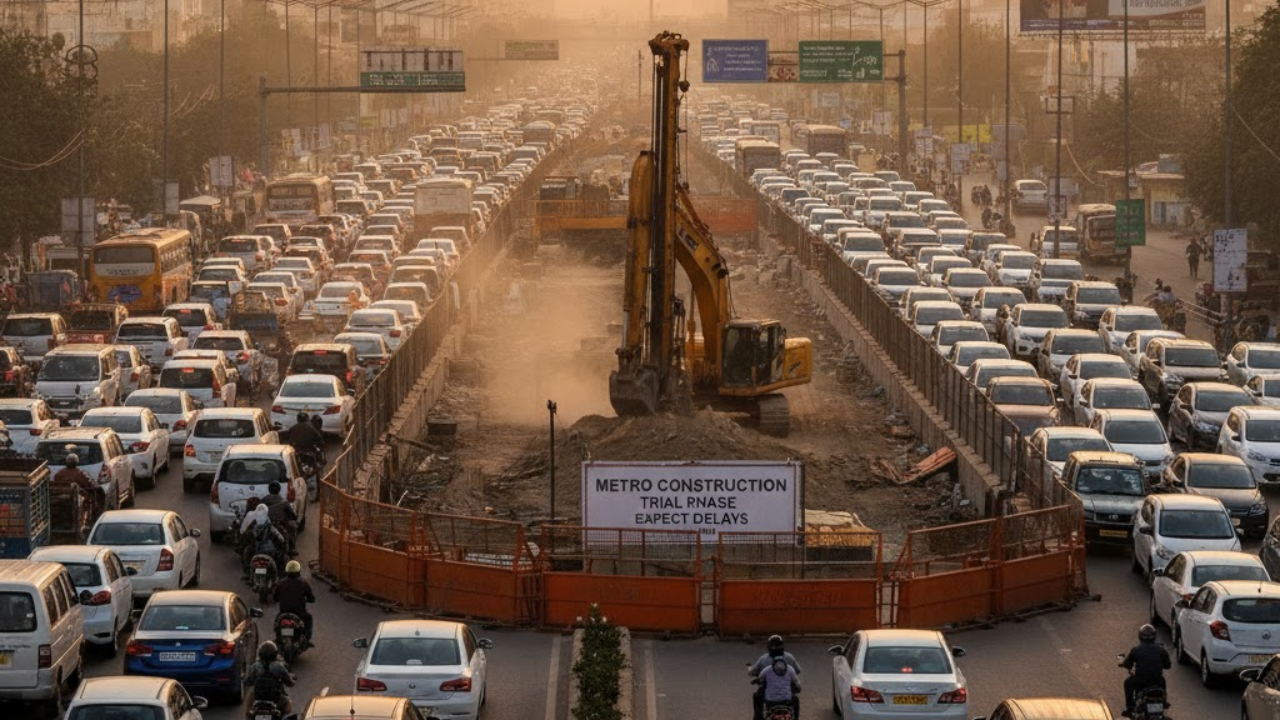
A traffic trial related to metro construction between Millennium City Centre and Kanhai T-point in Gurugram has ignited severe traffic congestion along this vital urban corridor. The trial involves lane closures and barricading to facilitate pier construction for the new metro line. Commuters report long queues, extended travel times, and delays even through underpasses that were once relatively free-flowing.
The trial is part of Gurugram Metro Rail Limited’s (GMRL) phased plan to test traffic patterns and bottlenecks before finalizing a full traffic-management plan. Officials say the trial will continue while the feedback is collected and adjustments made.
This article dives into the specifics of the trial, its causes, impacts, mitigation efforts, stakeholder perspectives, comparisons to best practices, and key lessons for cities undergoing transit infrastructure expansion.
Earlier in 2025, construction began on a new elevated metro corridor connecting Millennium City Centre to Basai (Phase 1), covering approximately 15.2 km and 14 stations. This route is a key part of Gurugram’s plan to expand urban connectivity and reduce dependence on roads.
As part of this metro expansion, road alignments and construction zones are being designated and integrated, including pier construction, pile drilling, and foundation work along road medians.
Before full-scale road closures or permanent traffic changes, GMRL and local authorities initiated a traffic trial — a temporary arrangement where lanes are partially closed or diverted to simulate final traffic designs. This helps identify chokepoints, test signal timing, and gauge commuter adaptation.
In this trial, one lane on both sides of the carriageway is barricaded around Kanhai T-point to allow space for pillar/ pier construction and related works.
To enable pier construction, GMRL has reduced lanes: one lane on each side of the road has been barricaded for works on the central verge. This constrains vehicles to fewer lanes than usual.
Vehicles passing through the corridor now converge from multiple lanes into fewer passing lanes, leading to queuing and merging delays. This is especially consequential in stretches near Kanhai T-point, a key signalized junction.
The underpass exit at Millennium City Centre now takes up to 10 minutes to exit during peak hours, per commuter reports.
The queues at Kanhai T-point stretch back to the underpass, causing delays upstream.
Because the exit of the underpass is only two lanes, but the connecting road is normally three lanes, the merging bottleneck exacerbates traffic jam severity.
Commuters working in Sector 44 and nearby areas have reported increased delays, with some choosing alternate internal roads to bypass the snarls. One commuter noted the decision to avoid Kanhai Road and instead use inner roads via Z Chowk near Fortis Hospital.
During peak hours, the congestion is most pronounced as vehicles from multiple directions converge, and lane reductions squeeze traffic flow.
Gurugram’s roads are already heavily used, especially on arterial connectors like the Millennium-Kanhai stretch. Adding construction closures reduces buffer capacity and triggers spillback.
When exits and merges funnel from wider lanes to narrower ones, delays multiply. The underpass exit being narrower than the preceding road intensifies merging friction.
Kanhai T-point is a traffic signal junction. The trial works close to this node, so queuing at signals further compounds delays, especially since traffic must traverse the intersection under constrained lanes.
Many commuters stick to habitual routes, unaware of alternative paths or diversions. If signage or guidance is weak, the trial's traffic-relief measures may not be fully used.
If pier construction or barricading occurs during peak hours or over extended durations, the impact is greater. Phased or nighttime-only works may reduce daytime congestion.
A senior GMRL official confirmed that the barricading and trial were approved by traffic police and that steps are being taken to minimize commuter hardship. Directions have been issued to the metro contractor to adjust works to minimize disruption.
Authorities have suggested diversion routes: vehicles from Z Chowk will be diverted via Dr. B. R. Ambedkar Marg, St. Thomas Marg, Bhagwan Mahavir Marg, merging onto Arya Samaj Marg en route to Subhash Chowk.
Coordination among Gurgaon traffic police, GMRL, and local administration is emphasized to smooth transition and manage bottlenecks.
The trial is deliberately provisional, intended to collect feedback, detect choke segments, and adjust the traffic design before making permanent changes.
Officials say they will work with traffic police to adjust timings, signaling, and lane discipline to keep traffic flowing.
Longer delays for daily travellers, reduced predictability of journey time, and increased fuel consumption are immediate impacts.
Congestion on the main alignment may spill over into side roads and internal sectors, burdening typically less congested roads with diverted traffic.
Public frustration tends to rise with perceived construction mismanagement, especially when mitigation is unclear or commute costs rise.
This trial exposes how critical traffic planning needs to be during large infrastructure projects. Urban corridors cannot be shut or reconfigured without robust simulations, community information, and staged mitigation.
Many cities phase construction so that heavy works happen during off-peak or nighttime windows, reducing daytime traffic impact.
Use traffic sensors, adaptive signaling, and dynamic diversion routing to manage flow in real time, rather than static lane closures.
Advance public notice, lane-change warnings, mobile alerts and clear signage help commuters choose alternate routes ahead of bottlenecks.
Rather than a long stretch, trial small snippets to validate traffic flow models before expanding the closure zone.
Where possible, leave emergency or buffer lanes open, or design temporary bypasses to recapture some lost capacity.
Commuters and local media should watch when GMRL and traffic authorities publish the final traffic pattern, adjusted signal phases, lane assignments, and timings after the trial ends.
Should see refined signal phases, turn timings, and staging around Kanhai T-point or adjacent junctions to match new lane geometry.
Traffic police must enforce lane discipline and ensure vehicles adhere to assigned lanes to prevent stray merging and choking.
Look for changes based on commuter feedback (e.g. safer crossings, adjusted diversions, alternate routes).
Monitoring whether commuters shift to alternate roads, earlier departure times, or alternative modes (e.g. two-wheelers, app-based routing) in response to the trial.
Disclaimer
This article is based on current media reporting as of 15 October 2025. Construction plans, traffic patterns, mitigation measures, and official decisions may evolve. Readers and commuters should refer to local traffic authorities, GMRL updates, and municipal notices for the latest and official information.
Gurugram metro, traffic congestion, metro construction trial, GMRL, Kanhai T-point, traffic diversion, urban mobility, commuter delays, infrastructure projects, transit planning



Advances in Aerospace Technology and Commercial Aviation Recovery
Insights into breakthrough aerospace technologies and commercial aviation’s recovery amid 2025 chall

Defense Modernization and Strategic Spending Trends
Explore key trends in global defense modernization and strategic military spending shaping 2025 secu

Tens of Thousands Protest in Serbia on Anniversary of Deadly Roof Collapse
Tens of thousands in Novi Sad mark a year since a deadly station roof collapse that killed 16, prote

Canada PM Carney Apologizes to Trump Over Controversial Reagan Anti-Tariff Ad
Canadian PM Mark Carney apologized to President Trump over an Ontario anti-tariff ad quoting Reagan,

The ad that stirred a hornets nest, and made Canadian PM Carney say sorry to Trump
Canadian PM Mark Carney apologizes to US President Trump after a tariff-related ad causes diplomatic

Bengaluru-Mumbai Superfast Train Approved After 30-Year Wait
Railways approves new superfast train connecting Bengaluru and Mumbai, ending a 30-year demand, easi




