Post by : Saif
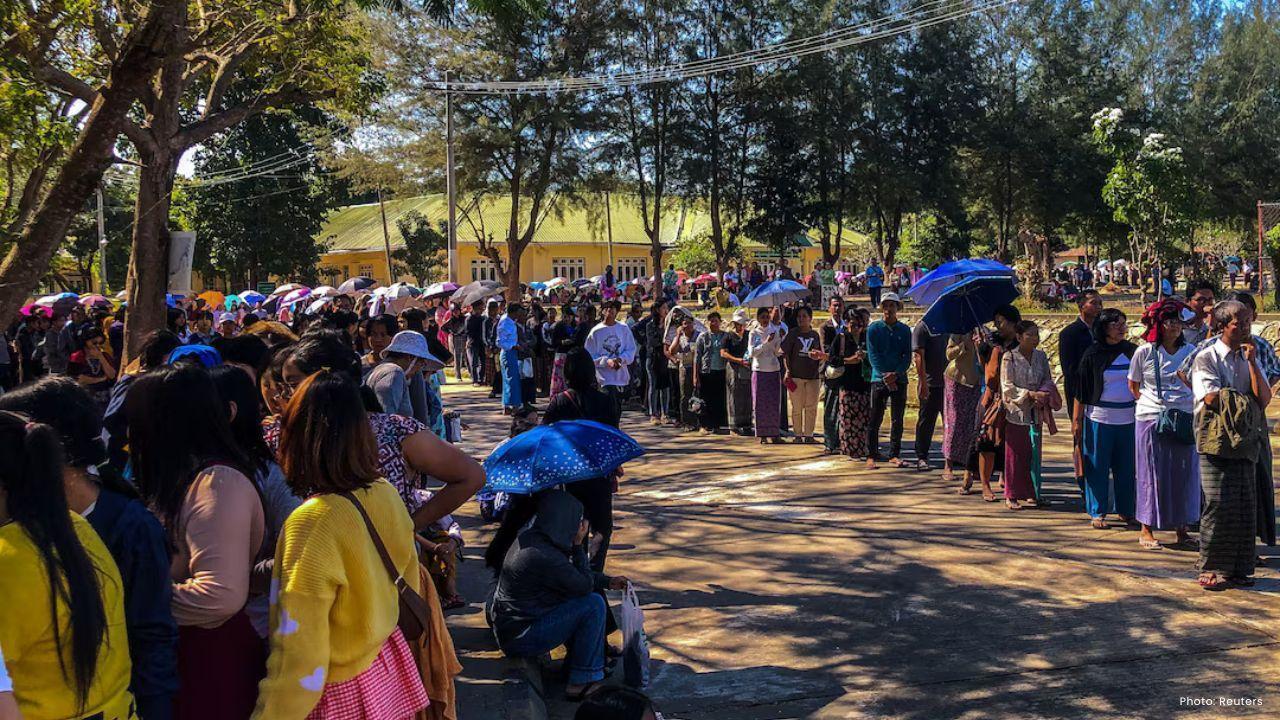
Myanmar’s general election has ended with a sweeping victory for the military-backed Union Solidarity and Development Party, reinforcing the armed forces’ hold on power at a time when the country remains divided by civil war and political repression.
According to state media, the USDP won a dominant share of seats in both chambers of parliament. In the lower house, the party secured 232 out of 263 contested seats. In the upper house, it claimed 109 of the 157 seats announced so far. With these results, the party is set to control the next government, which is expected to assume office in April after parliament meets in March.
The election was conducted in three stages, beginning in late December and concluding in January. It was held more than four years after the military seized power in a coup that removed the elected government led by Aung San Suu Kyi. Since that takeover, Myanmar has been locked in political chaos, marked by mass protests, armed resistance, and harsh crackdowns by security forces.
The military authorities say the election reflects the will of the people and represents progress toward stability. However, many local and international observers reject this claim. Regional and global critics argue the process lacked fairness and transparency, and say it was carefully managed to protect military influence rather than restore democracy.
A key concern raised by critics is the exclusion of major political opponents. Suu Kyi’s National League for Democracy, which won the 2020 election by a large margin, was dissolved along with many other parties. Several remaining groups refused to take part, saying the election rules were unfair and restrictive.
Myanmar’s political system also guarantees the military 25 percent of parliamentary seats, regardless of election results. This provision ensures that the armed forces retain decisive power even after a civilian government is formed, making it difficult for any elected leaders to challenge military authority.
The USDP has long been linked to the armed forces. It was created in 2010 as a political platform for former military leaders transitioning into civilian roles. The party’s leadership includes retired officers, and it fielded a large number of candidates nationwide. Military chief Min Aung Hlaing is widely expected to remain a central figure in the country’s leadership.
Voter turnout was noticeably lower than in previous elections. Officials reported participation at around 55 percent, compared with roughly 70 percent in earlier national polls. Voting was held in fewer than 80 percent of townships, with elections cancelled in many areas due to ongoing fighting between the military, ethnic armed groups, and resistance forces that emerged after the 2021 coup.
The conflict has caused severe hardship for civilians. Millions of people have been forced from their homes, and many regions face ongoing violence, shortages, and fear. In such conditions, many citizens were unable or unwilling to vote, further raising questions about the legitimacy of the election.
As Myanmar prepares to form a new government, the election outcome signals continuity rather than change. For many inside the country and abroad, the result confirms that real power remains with the military, while hopes for peace and democratic reform remain uncertain.
#trending #latest #Myanmar #MyanmarElection #MilitaryBackedParty #CivilWar #Democracy #HumanRights



Advances in Aerospace Technology and Commercial Aviation Recovery
Insights into breakthrough aerospace technologies and commercial aviation’s recovery amid 2025 chall

Defense Modernization and Strategic Spending Trends
Explore key trends in global defense modernization and strategic military spending shaping 2025 secu

Tens of Thousands Protest in Serbia on Anniversary of Deadly Roof Collapse
Tens of thousands in Novi Sad mark a year since a deadly station roof collapse that killed 16, prote

Canada PM Carney Apologizes to Trump Over Controversial Reagan Anti-Tariff Ad
Canadian PM Mark Carney apologized to President Trump over an Ontario anti-tariff ad quoting Reagan,

The ad that stirred a hornets nest, and made Canadian PM Carney say sorry to Trump
Canadian PM Mark Carney apologizes to US President Trump after a tariff-related ad causes diplomatic

Bengaluru-Mumbai Superfast Train Approved After 30-Year Wait
Railways approves new superfast train connecting Bengaluru and Mumbai, ending a 30-year demand, easi




