Post by : Amit
Photo: Reuters
Houston | June 20, 2025 — In what could mark a turning point in the global manufacturing landscape, Nvidia and Foxconn are reportedly in advanced talks to introduce humanoid robots into the assembly line of a new AI server plant being set up in Houston, Texas.
Slated to begin production in early 2026, the Houston facility will be responsible for building Nvidia’s high-performance GB200 AI servers, central to the future of data centers and artificial intelligence systems. But what sets this plant apart isn’t just the cutting-edge machines it will produce—it’s how those machines will be made.
Humanoids on the Assembly Line
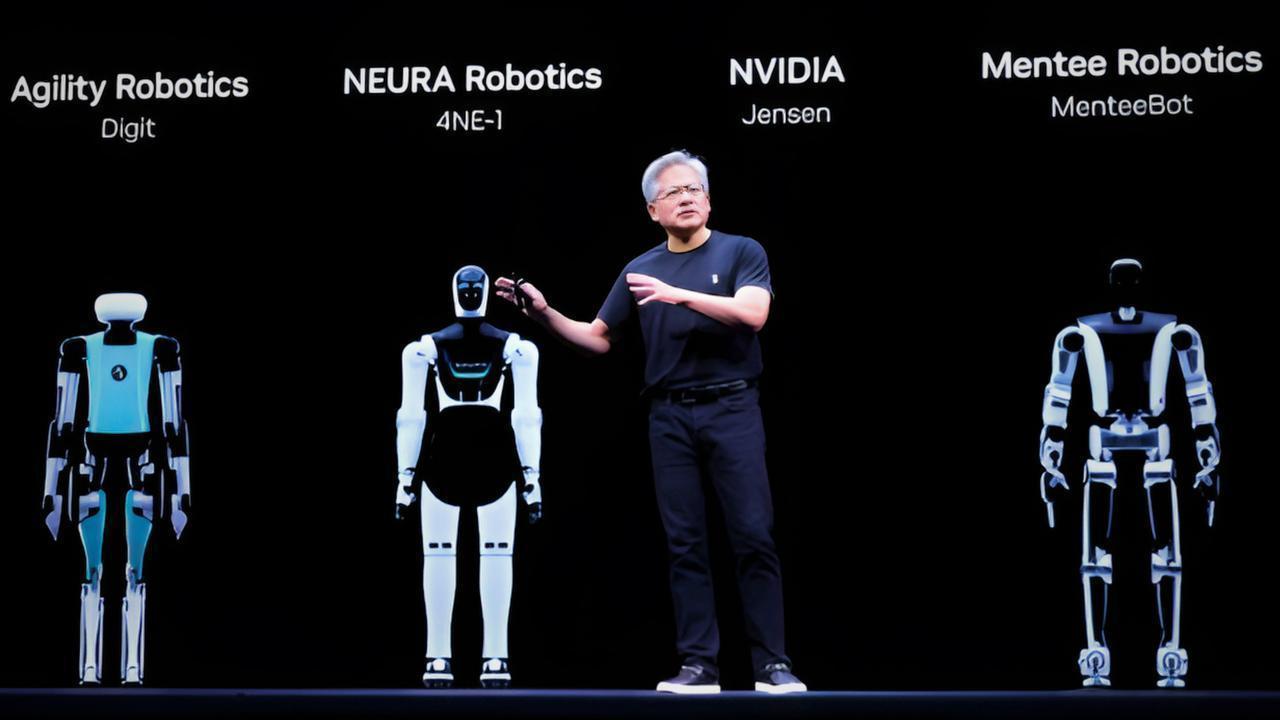
According to individuals familiar with the matter, the two tech giants plan to deploy humanoid robots directly onto the production floor, enabling them to assist—or in some cases, replace—human workers. If executed, this could be among the first large-scale efforts to integrate such robots into a sophisticated manufacturing setup.
Unlike traditional industrial robots that operate in fixed, repetitive motions, humanoid robots are designed to mimic human movement, equipped with the ability to walk, grip objects, adjust positioning, and adapt to real-world conditions. At the Houston plant, these robots are expected to handle delicate tasks such as inserting cables, fastening components, and assembling parts—jobs typically requiring human dexterity.
Foxconn’s Dual Track: Build and Buy
Sources indicate that Foxconn, widely known for assembling Apple’s iPhones, is working on its own humanoid robot prototypes, while simultaneously testing units from UBTech, a robotics firm based in China. Two models are currently under consideration—a bipedal humanoid capable of walking and a wheeled version designed for greater speed and lower cost. Both designs are expected to be unveiled publicly at a Foxconn technology event in November.
While technical specifics are still under wraps, early internal demonstrations suggest these robots are being trained to handle basic assembly-line duties, such as aligning components and managing repetitive workflows. The goal is to determine whether they can match or exceed the required benchmarks for efficiency, precision, and safety.
Why Houston Makes Sense
Foxconn’s selection of Houston wasn’t a random choice. The city offers a combination of technological infrastructure, skilled labor, and industrial space—a trio that makes it ideal for launching a next-generation production hub. The new facility is being built from scratch, allowing engineers to tailor the environment specifically for robotic operations—something that would be far more complex in a retrofitted plant.
This initiative also aligns neatly with Nvidia’s broader strategy to strengthen AI manufacturing within the United States. As part of a wider $500 billion national vision, Nvidia plans to establish server plants, chip factories, and AI supercomputing facilities across various U.S. locations.
Robot Workers at Houston Unit
Nvidia’s CEO, Jensen Huang, has been a vocal supporter of humanoid robotics, stating earlier this year that their adoption in the industry is “not a matter of if, but when.” That sentiment is being echoed across the global tech ecosystem. Companies like Tesla, BMW, and Mercedes-Benz are already investing in similar technologies to augment their production lines.
Foxconn’s entry into this space only reinforces the growing consensus: robotics are no longer a futuristic concept—they’re an imminent reality in industrial settings.
Questions Still Linger
Despite the excitement, challenges remain. The companies have not disclosed how many robots they plan to use, what exact tasks they’ll perform, or how this shift will affect the human workforce. While robotics can boost speed and consistency, they also introduce concerns about job displacement, reliability, and cost-effectiveness.
Another consideration is performance. Even the most advanced robots can struggle with unstructured environments and need consistent calibration and oversight to operate smoothly. Whether humanoid robots can meet those demands in a high-volume manufacturing line remains to be seen.
The Road Ahead
If the Houston experiment succeeds, it could set the benchmark for how future factories are designed and operated—where human engineers and robotic assistants coexist to create smarter, faster production systems.
For now, these questions are still unfolding. But the answer may come sooner than expected—from a quiet Houston plant preparing to change the way the world builds its machines.
Humanoid Robots Manufacture



Advances in Aerospace Technology and Commercial Aviation Recovery
Insights into breakthrough aerospace technologies and commercial aviation’s recovery amid 2025 chall

Defense Modernization and Strategic Spending Trends
Explore key trends in global defense modernization and strategic military spending shaping 2025 secu

Tens of Thousands Protest in Serbia on Anniversary of Deadly Roof Collapse
Tens of thousands in Novi Sad mark a year since a deadly station roof collapse that killed 16, prote

Canada PM Carney Apologizes to Trump Over Controversial Reagan Anti-Tariff Ad
Canadian PM Mark Carney apologized to President Trump over an Ontario anti-tariff ad quoting Reagan,

The ad that stirred a hornets nest, and made Canadian PM Carney say sorry to Trump
Canadian PM Mark Carney apologizes to US President Trump after a tariff-related ad causes diplomatic

Bengaluru-Mumbai Superfast Train Approved After 30-Year Wait
Railways approves new superfast train connecting Bengaluru and Mumbai, ending a 30-year demand, easi




