Post by : Meena Rani
Defence Minister Rajnath Singh praised India’s remarkable progress in building a self-reliant defence ecosystem, crediting the country’s transformation to Prime Minister Narendra Modi’s leadership. He emphasised that India’s goal is to achieve 100 per cent domestic defence manufacturing, making the nation fully secure and strategically independent.
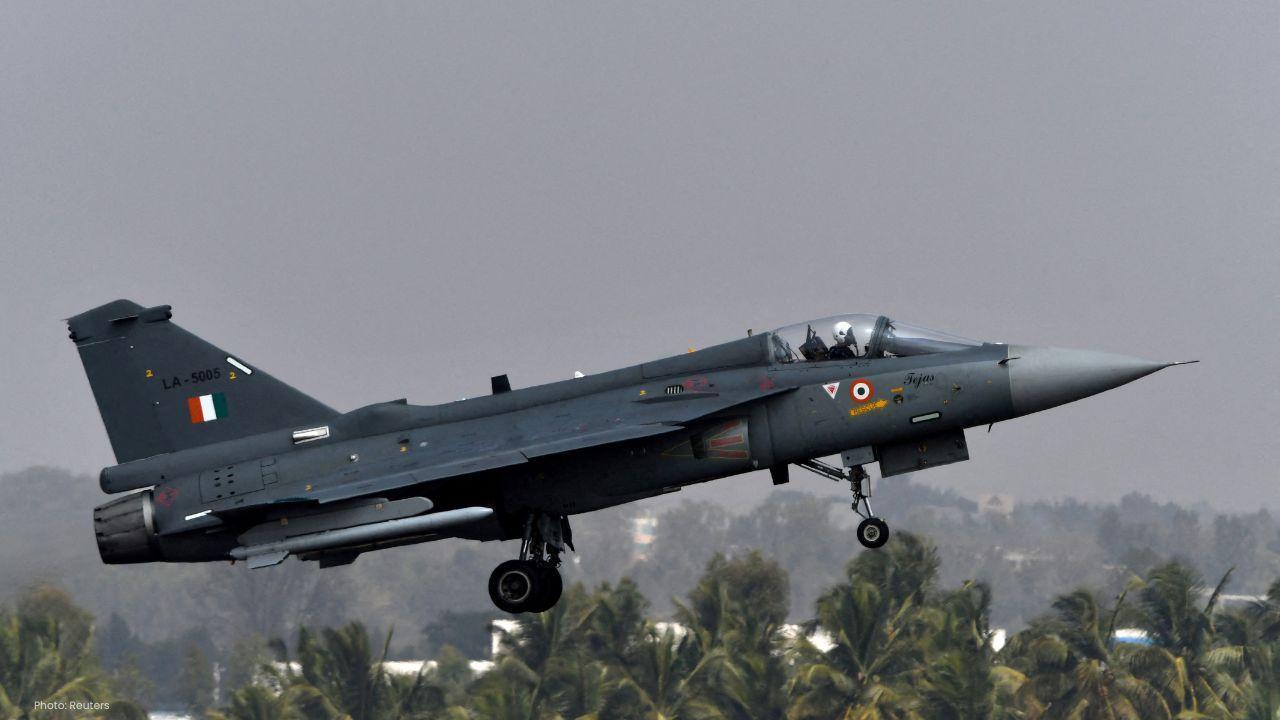
Speaking at the inauguration of new production lines for the LCA Tejas Mk1A and HTT-40 aircraft at Hindustan Aeronautics Limited (HAL) in Nashik, Singh said India has come a long way from being heavily dependent on imports to becoming a major manufacturer of indigenous defence equipment.
From import reliance to indigenisation
“When we came to power in 2014, we realised that without self-reliance, we could never be truly secure,” Singh said. “At that time, defence preparedness and production were limited, and the private sector had almost no role.”
He noted that dependence on foreign suppliers not only raised procurement costs but also created strategic vulnerabilities. However, consistent reforms, including production-linked incentives, policy changes, and greater private participation, have helped India overcome these barriers.
“Whatever we used to buy from abroad—fighter aircraft, missiles, engines, or electronic warfare systems—we are now producing domestically,” Singh said, highlighting the success of the Aatmanirbhar Bharat initiative in defence.
Record defence production
India’s annual defence production reached a record ₹1.5 lakh crore in 2024–25, reflecting the government’s commitment to self-reliance. Singh said the focus is now on developing next-generation technologies, including Artificial Intelligence, cyber warfare, drones, and advanced aircraft systems.
He urged HAL to continue expanding into unmanned systems and civil aviation technologies, beyond the successful LCA Tejas and HTT-40 platforms.
HAL Nashik: A symbol of technological excellence
Rajnath Singh commended HAL Nashik’s six-decade-long contribution to India’s defence manufacturing legacy. The facility, which has produced aircraft such as the MiG-21, MiG-27, and Su-30MKI, now plays a key role in manufacturing next-generation aircraft like the Tejas and HTT-40.
He also praised the establishment of a joint Maintenance, Repair, and Overhaul (MRO) facility for civil and military aviation, calling it a reflection of New India’s technological confidence and sustainability.
Boosting capacity and innovation
Secretary (Defence Production) Sanjeev Kumar said the inauguration of new HAL production lines represents India’s growing industrial strength and strategic foresight. He described the LCA Tejas Mk1A as a benchmark of indigenous design and the HTT-40 as an example of HAL’s capability to conceptualise and deliver critical platforms entirely within India.
HAL Chairman Dr. DK Sunil announced that the new Nashik lines can produce eight aircraft annually, with a total capacity of 24 per year, all within a digital, paperless, and sustainable setup.
Rajnath Singh concluded by reaffirming India’s vision to become a global hub for defence manufacturing and exports. “We are not only strengthening our armed forces but also building a nation that stands firmly on its own capabilities. Our goal is not just to make in India but to make for the world,” he said.
HAL Nashik production line, LCA Tejas Mk1A. HTT-40 trainer aircraft, Indigenous defence manufacturing



Advances in Aerospace Technology and Commercial Aviation Recovery
Insights into breakthrough aerospace technologies and commercial aviation’s recovery amid 2025 chall

Defense Modernization and Strategic Spending Trends
Explore key trends in global defense modernization and strategic military spending shaping 2025 secu

Tens of Thousands Protest in Serbia on Anniversary of Deadly Roof Collapse
Tens of thousands in Novi Sad mark a year since a deadly station roof collapse that killed 16, prote

Canada PM Carney Apologizes to Trump Over Controversial Reagan Anti-Tariff Ad
Canadian PM Mark Carney apologized to President Trump over an Ontario anti-tariff ad quoting Reagan,

The ad that stirred a hornets nest, and made Canadian PM Carney say sorry to Trump
Canadian PM Mark Carney apologizes to US President Trump after a tariff-related ad causes diplomatic

Bengaluru-Mumbai Superfast Train Approved After 30-Year Wait
Railways approves new superfast train connecting Bengaluru and Mumbai, ending a 30-year demand, easi




