Post by : Amit
Photo : X / Ronald van Loon
A Bold Leap in Blue Energy from France’s Atlantic Coast
As global demand for clean, renewable energy accelerates, French startup Seaturns has announced a major funding milestone that could reshape the offshore power generation landscape. The company has successfully raised €2.45 million to fund the development and deployment of its first full-scale wave energy demonstrator, marking a crucial turning point for marine-based renewables. The demonstrator is scheduled to be launched by 2026, aiming to validate Seaturns’ compact, cost-effective technology in real-world ocean conditions.
This significant achievement not only reflects investor confidence in wave energy but also highlights a growing recognition of the ocean’s untapped potential. As countries seek to diversify their renewable energy mix and reduce reliance on fossil fuels, marine energy technologies are gaining momentum.
A Compact Design to Harness the Untapped Power of Waves
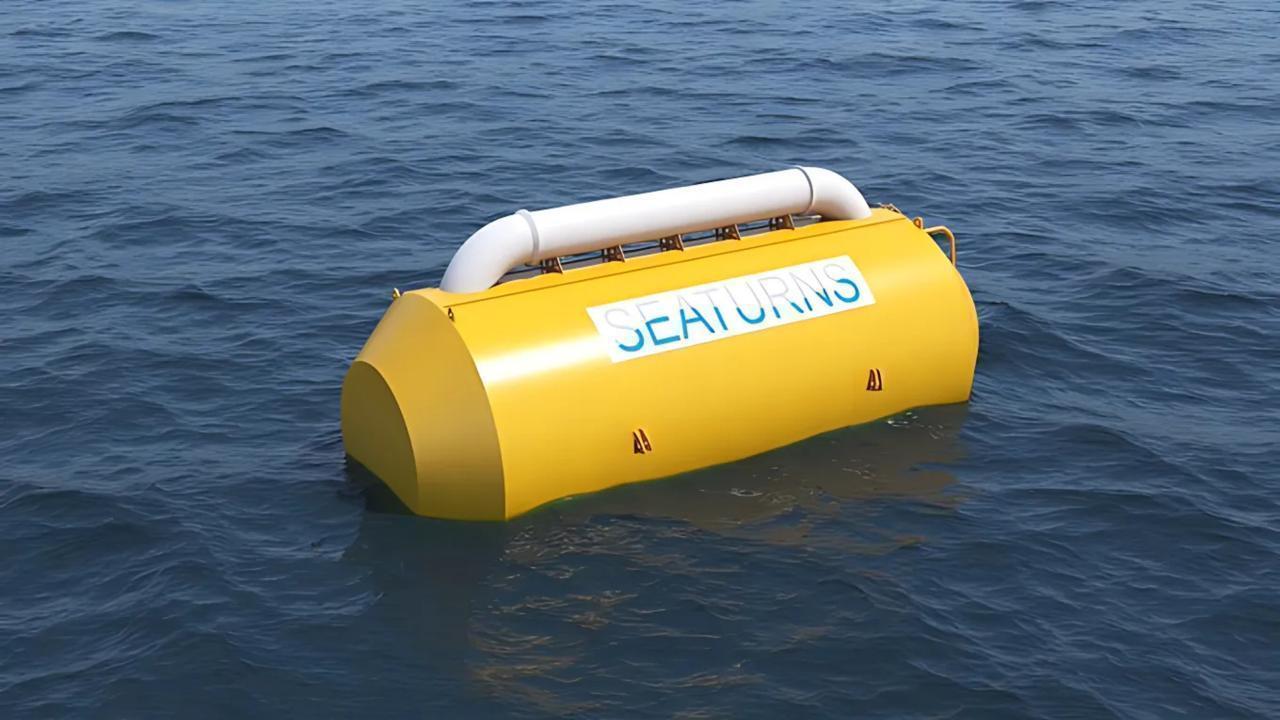
Unlike many bulkier and infrastructure-heavy wave energy designs, Seaturns proposes a small, cylindrical floating module that is anchored to the seabed with a single taut cable. This moored system captures energy from heave motion—the up-and-down movement of waves—by utilizing a hydraulic power take-off (PTO) system. The result is a streamlined, low-maintenance, and scalable unit that can be deployed individually or grouped into arrays.
Whereas traditional wave energy concepts have often required large structures, complex mooring systems, or rigid arms and platforms, Seaturns’ minimalist approach simplifies not only the energy capture process but also the challenges associated with long-term marine deployment. Each module is compact, durable, and designed for minimal interference with other ocean users, such as fisheries, shipping lanes, or recreational areas.
This discreet profile and adaptability are critical advantages in marine zones where space is limited or where visual impact is a concern. In densely trafficked coastal areas, where floating wind farms or tidal barrages may be too intrusive or impractical, Seaturns’ design offers a viable alternative.
Blending Startup Innovation with Academic R&D
Headquartered in Nouvelle-Aquitaine, Seaturns was born from over a decade of academic research in fluid mechanics and wave modeling. The company’s founding team includes engineers and researchers from top French institutions, including collaborations with engineering schools and research laboratories focused on marine dynamics and hydrodynamics.
This scientific grounding allowed Seaturns to develop its concept systematically, leveraging both numerical simulations and physical tank tests to validate key performance metrics. Before committing to real-sea deployment, the team performed extensive modeling to ensure that the design could handle the unpredictable and often violent conditions of the open ocean.
By refining their prototype in a controlled lab environment, Seaturns significantly de-risked its technology, reducing the likelihood of costly failures during full-scale trials. This is a major differentiator in a field where many companies have struggled to bridge the gap between promising lab results and commercial-scale feasibility.
Strategic Partners and Investors Fuel the Mission
Seaturns’ recent funding round attracted a mix of public and private sector backing, underscoring growing optimism about the commercial potential of wave energy. Financial support came from Région Nouvelle-Aquitaine, Bpifrance, and a consortium of energy-focused investors, including both institutional players and venture capital firms.
This diverse coalition of stakeholders sends a strong message: wave energy is not just a fringe idea but a mainstream investment opportunity. The funds will be used to finalize engineering, manufacture the demonstrator unit, and support ocean trials that will provide critical data for future scale-up efforts.
Additionally, Seaturns benefits from France’s robust maritime innovation ecosystem, which includes incubators, grant programs, and policy initiatives that align with national goals for energy transition and carbon neutrality. These structures offer both funding and technical guidance, helping startups like Seaturns bridge the notorious “valley of death” between early-stage innovation and commercial deployment.
Full-Scale Demonstrator to Hit the Water by 2026
Seaturns’ full-scale demonstrator is slated for deployment by 2026, most likely off the French Atlantic coast, where wave conditions are both energetic and consistent—ideal for stress-testing the technology. The project will validate not only the mechanical reliability of the buoy but also its power output, resilience to storms, and long-term maintenance needs.
This prototype will act as a real-world proof of concept, offering a data-rich platform for evaluating key performance indicators (KPIs), including:
Successful validation of these KPIs is crucial for unlocking the next phase: commercial-scale pilot arrays. These could consist of several units deployed in tandem to power coastal microgrids, offshore platforms, or hybrid systems integrating wave with wind or solar energy.
Addressing Longstanding Challenges in Wave Energy
Wave energy has long been regarded as a high-potential but technically elusive renewable resource. Unlike wind or solar, wave energy is denser and more consistent, particularly in regions with strong ocean swell. However, numerous challenges have hampered its rollout, including:
Seaturns tackles these problems head-on with a minimalist, resilient design focused on durability and simplicity. Its single-point mooring system drastically reduces anchoring complexity and cost. Meanwhile, the small footprint and modular construction make it easy to transport, install, and replace—important factors for remote or underserved locations.
This model could be particularly transformative for island nations, coastal villages, and port infrastructures seeking to reduce diesel fuel dependency. These locations often lack the scale or capital to deploy large offshore wind farms, making Seaturns’ compact buoy a promising alternative.
Eyes on Commercialization and Global Partnerships
With its demonstrator funded and under development, Seaturns is now turning its attention toward commercial visibility and strategic partnerships. The company plans to showcase its innovation at major industry gatherings, including Seanergy, Offshore Energy Exhibition & Conference (OEEC), and other global marine energy forums.
By building relationships with offshore wind developers, port authorities, marine contractors, and green hydrogen producers, Seaturns aims to integrate its technology into broader renewable infrastructure projects. The buoys could serve as a supplemental power source for offshore wind farms, or be used to support floating desalination units or charging stations for electric vessels.
Additionally, the technology holds promise for retrofitting existing offshore oil and gas platforms in the North Sea, Gulf of Mexico, or Southeast Asia. As fossil fuel operators look to decarbonize and repurpose their infrastructure, modular wave energy systems offer a path to transforming these platforms into clean energy hubs.
Accelerating France’s Maritime Energy Goals
France has established bold ambitions to become a global leader in offshore renewables, with a target of 40 GW of offshore wind capacity by 2050, alongside increasing interest in floating and wave-based technologies. Seaturns’ project aligns squarely with these objectives, offering a domestically developed solution that could complement existing wind and tidal initiatives.
By investing in homegrown innovation and supporting startups through funding and technical infrastructure, France positions itself at the forefront of the Blue Economy, which emphasizes sustainable use of ocean resources for economic growth, improved livelihoods, and ecosystem health.
Successful deployment of Seaturns’ technology would not only support France’s climate goals but also enhance energy resilience and regional competitiveness in marine renewable technologies.
A Small Buoy With Big Potential
Though compact in form, Seaturns’ demonstrator represents something far greater: the possibility that wave energy can finally become a mainstream renewable resource. The company’s €2.45 million funding injection, strong research pedigree, and growing support network place it in a prime position to take wave power from theoretical promise to practical reality.
If successful, this project could open the floodgates to a new class of marine energy devices—affordable, modular, and deployable in regions that previously lacked access to offshore renewables.
In a world urgently seeking solutions to reach net-zero emissions, Seaturns’ floating cylinder might be small in stature—but it carries global significance.
Seaturns wave power, Marine Energy



Advances in Aerospace Technology and Commercial Aviation Recovery
Insights into breakthrough aerospace technologies and commercial aviation’s recovery amid 2025 chall

Defense Modernization and Strategic Spending Trends
Explore key trends in global defense modernization and strategic military spending shaping 2025 secu

Tens of Thousands Protest in Serbia on Anniversary of Deadly Roof Collapse
Tens of thousands in Novi Sad mark a year since a deadly station roof collapse that killed 16, prote

Canada PM Carney Apologizes to Trump Over Controversial Reagan Anti-Tariff Ad
Canadian PM Mark Carney apologized to President Trump over an Ontario anti-tariff ad quoting Reagan,

The ad that stirred a hornets nest, and made Canadian PM Carney say sorry to Trump
Canadian PM Mark Carney apologizes to US President Trump after a tariff-related ad causes diplomatic

Bengaluru-Mumbai Superfast Train Approved After 30-Year Wait
Railways approves new superfast train connecting Bengaluru and Mumbai, ending a 30-year demand, easi




