Post by : Amit
Photo : X / tphuang
A New Era of Marine Solar Energy Emerges in China
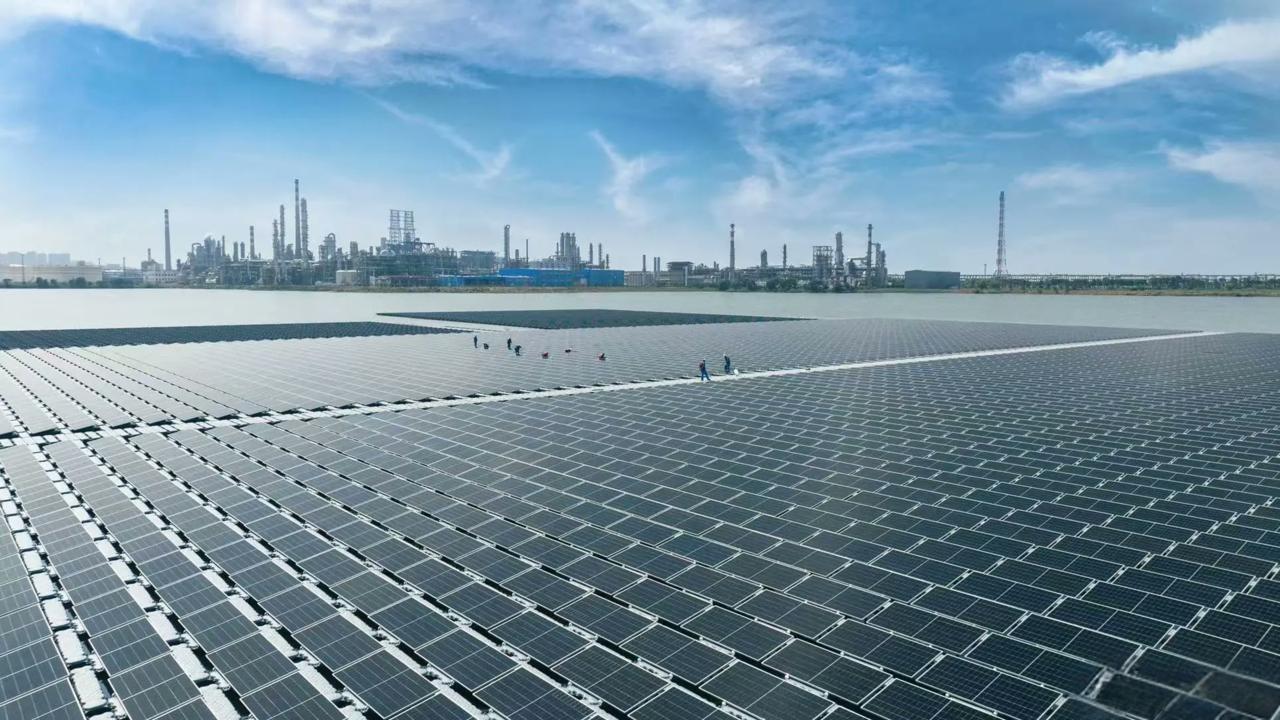
In a significant leap forward for renewable energy innovation, China Petroleum & Chemical Corporation (Sinopec) has officially launched the country’s first floating solar power plant in an offshore seawater zone. This groundbreaking initiative not only represents a technical milestone in floating photovoltaic (FPV) systems but also signals a strategic pivot for China’s massive oil and gas industry toward clean energy transition in the marine sector.
Located in the coastal waters of Shandong Province, the new offshore solar installation is designed to harness solar power on the sea’s surface, integrating solar photovoltaic panels with marine engineering—a combination rarely attempted at this scale in seawater environments.
Floating Solar, But at Sea—A Global First for China
While floating solar systems have become increasingly common on inland lakes and reservoirs around the world, Sinopec’s project is unique because it is built on open seawater, where the environmental stresses—waves, corrosion, and salinity—are significantly more extreme.
This makes the initiative China’s first true seawater-based FPV deployment, pushing the boundaries of marine renewable energy integration. Most global floating solar farms are located in sheltered freshwater bodies, but Sinopec’s project boldly navigates into offshore territory where modular resilience, anchoring, and anti-corrosion measures are put to the test.
Technical Highlights: Capacity and Infrastructure
According to project details released by Sinopec, the plant features installed capacity of 0.5 megawatts (MW)—small by terrestrial standards, but an important demonstration platform for scalability. The FPV system is mounted on custom-designed floating pontoons that are tethered to the seabed using marine-grade anchoring systems, ensuring stability under tidal movements and wind stress.
Energy generated from the plant is directed to a coastal power distribution system for localized use, supporting nearby marine operations and offering a zero-emission alternative to diesel generators in remote port or platform settings.
Pioneering Marine Renewable Synergy
This launch marks the beginning of what could become a hybrid offshore renewable ecosystem, where solar PV, wind turbines, and even wave energy converters share space and grid interconnections. Sinopec, as one of China’s largest state-owned oil companies, is now entering a new role as a marine clean energy enabler, seeking to decarbonize offshore operations, reduce emissions in shipping and port logistics, and bring distributed power generation closer to ocean-based infrastructure.
The project also offers proof-of-concept for combining FPV with offshore oil platforms, hydrogen generation, or desalination plants—an area with growing interest across Asia and the Middle East.
National and Global Context: A Timely Push
This milestone aligns with China’s aggressive renewable energy goals, which include reaching 1,200 gigawatts of wind and solar capacity by 2030. It also supports regional development plans for the Blue Economy, where marine innovation and ecological protection are expected to coexist.
Sinopec's move echoes similar exploratory efforts in South Korea, the Netherlands, and Japan, where floating solar is gradually transitioning from freshwater to nearshore and offshore locations. However, few projects have yet made it beyond pilot stage in open seawater—making this launch particularly notable on the global stage.
R&D, Testing, and Adaptability
The offshore solar facility is also intended to serve as a living laboratory. Sinopec and its research partners are conducting extensive real-time data collection, focusing on the performance of solar modules under salt spray exposure, mechanical fatigue from waves, and long-term biofouling risks.
The FPV system features double-glass solar panels and corrosion-resistant alloys in both frame and cabling. Maintenance protocols are automated where possible, with remote diagnostics and marine weather alerts integrated into the control system. Insights gained here will shape larger FPV deployments across Asia-Pacific’s coastline in the coming years.
Implications for Ports and Smart Logistics
For smart port operators, the project offers a compelling case study in on-site renewable integration, reducing the carbon footprint of marine logistics hubs. Floating solar in seawater near container terminals, refueling docks, or shipyards can replace or supplement shore power systems, lowering operating costs and reducing dependency on fossil fuels.
Additionally, as ports expand digital infrastructure under “smart port” modernization plans, the ability to integrate renewable microgrids, energy storage, and AI-powered demand response systems becomes increasingly attractive.
Long-Term Vision: Scaling Clean Offshore Power
Though modest in current capacity, Sinopec’s deployment is viewed as the first step in a long-term floating solar roadmap, which could eventually support multi-megawatt or gigawatt-scale marine solar farms. With China’s extensive coastline, underutilized marine zones, and manufacturing edge in PV technology, the country is uniquely positioned to lead in ocean-based solar innovation.
Future iterations may combine solar with floating wind farms, or be paired with green hydrogen production units—creating zero-emission offshore energy parks capable of supporting clean shipping corridors and industrial marine clusters.
Symbolic and Strategic Significance
For an oil major like Sinopec to pioneer such a project in seawater is as symbolic as it is strategic. It reflects not only the necessity of diversifying energy portfolios under carbon neutrality mandates but also the shifting balance of innovation—from land to sea, from fossil to renewables, and from centralized to modular power solutions.
The successful operation of this floating plant could prompt further government incentives and private investment into next-gen offshore renewables—including floating tidal, solar-wind hybrids, and autonomous energy buoys.
A Solar Beacon on China’s Blue Horizon
Sinopec’s offshore floating solar plant is more than an energy installation—it’s a declaration of direction. It signals China’s readiness to integrate renewable energy directly into marine operations, transforming the nation’s vast ocean territory into a clean energy frontier.
With this seawater-based FPV pilot now online, the tides of innovation are officially shifting toward a more sustainable, smarter, and sea-based energy future.
China, Solar Energy



Advances in Aerospace Technology and Commercial Aviation Recovery
Insights into breakthrough aerospace technologies and commercial aviation’s recovery amid 2025 chall

Defense Modernization and Strategic Spending Trends
Explore key trends in global defense modernization and strategic military spending shaping 2025 secu

Tens of Thousands Protest in Serbia on Anniversary of Deadly Roof Collapse
Tens of thousands in Novi Sad mark a year since a deadly station roof collapse that killed 16, prote

Canada PM Carney Apologizes to Trump Over Controversial Reagan Anti-Tariff Ad
Canadian PM Mark Carney apologized to President Trump over an Ontario anti-tariff ad quoting Reagan,

The ad that stirred a hornets nest, and made Canadian PM Carney say sorry to Trump
Canadian PM Mark Carney apologizes to US President Trump after a tariff-related ad causes diplomatic

Bengaluru-Mumbai Superfast Train Approved After 30-Year Wait
Railways approves new superfast train connecting Bengaluru and Mumbai, ending a 30-year demand, easi




