Post by : Amit
Photo : X / SpaceX
A New Chapter in Space Operations
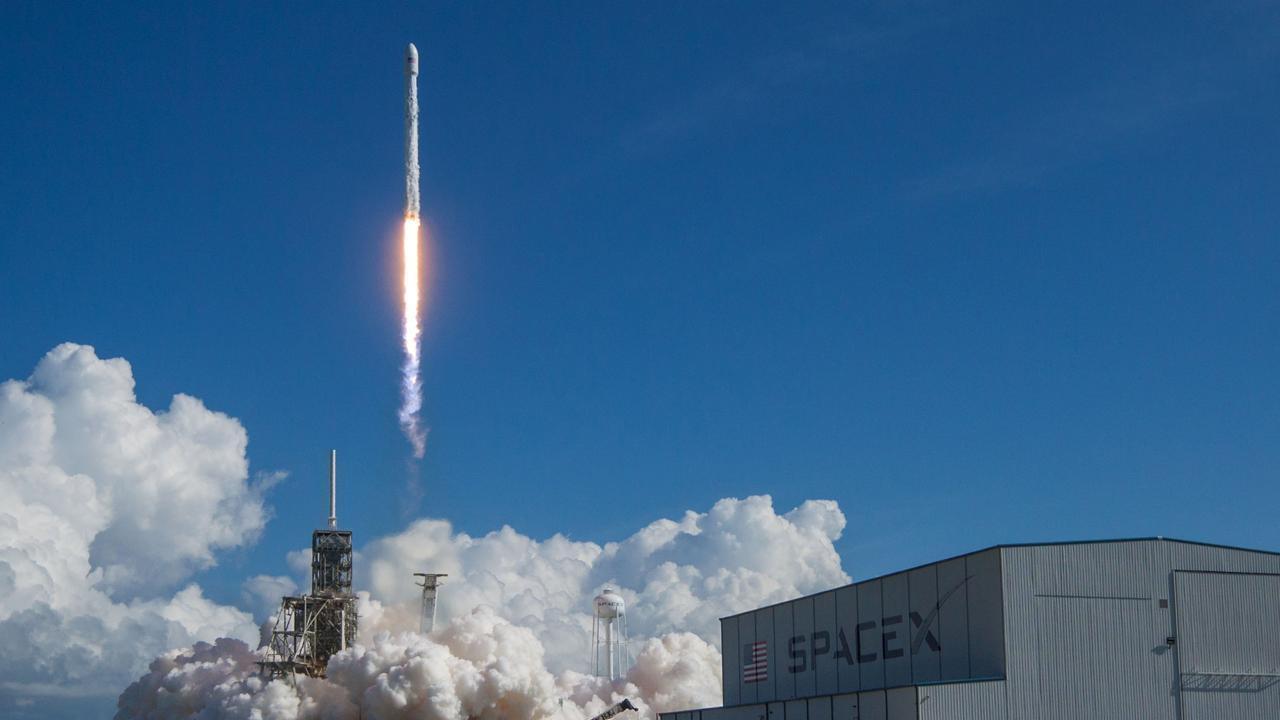
The vast night sky above Cape Canaveral lit up once again as SpaceX successfully launched the U.S. military’s secretive X-37B spaceplane on its eighth mission. The liftoff, carried out by a Falcon Heavy rocket, immediately captured global attention, not only because of the technical prowess displayed but also due to the shroud of mystery that continues to envelop the X-37B program. For years, this winged orbital vehicle has been at the center of speculation, with analysts, policymakers, and rival nations eager to decipher its true objectives.
This latest mission highlights not only America’s expanding ambitions in space but also the blurred lines between civilian exploration, commercial innovation, and military operations. With the X-37B embarking on yet another extended journey into low-Earth orbit, questions are once again swirling: What exactly is this spaceplane testing, and what does it signal about the future of space as a strategic domain?
A Spaceplane Unlike Any Other
The X-37B, developed initially by NASA before being handed over to the U.S. Department of Defense, resembles a miniature version of the retired Space Shuttle. Measuring about 29 feet long, with a wingspan just under 15 feet, the vehicle is designed for long-duration orbital missions that can last years before returning to Earth for a runway landing.
Unlike most spacecraft that are single-use or require extensive refurbishment, the X-37B boasts remarkable reusability. Its design allows it to carry payloads, conduct experiments, and deploy small satellites, all while operating under conditions that remain largely undisclosed to the public.
The U.S. Space Force, which oversees its operations, maintains that the program is focused on testing new technologies, such as advanced materials, autonomous flight systems, and space domain awareness tools. Yet the air of secrecy has fueled speculation that the X-37B could also be testing military applications, ranging from surveillance capabilities to anti-satellite technologies.
The Power of Falcon Heavy
For its eighth mission, the X-37B was launched aboard SpaceX’s Falcon Heavy, one of the most powerful operational rockets in the world. This choice of launch vehicle is itself significant.
Previous X-37B missions were launched using the Atlas V and Falcon 9 rockets. However, the switch to Falcon Heavy signals the potential for heavier payloads, higher orbits, or more complex mission objectives. The Falcon Heavy, with its three boosters and combined thrust of over 5 million pounds, allows the spaceplane to access a wider range of orbital environments, including geosynchronous orbits and even beyond.
Analysts believe that this expanded capability could open the door to missions that involve deploying advanced surveillance satellites, testing new orbital maneuvers, or experimenting with space-based communications and defense systems. The message is clear: the U.S. is investing heavily in versatile launch platforms that can support both civilian and military objectives in space.
A Program Shrouded in Secrecy
Despite being one of the most fascinating space assets in existence, very little is officially confirmed about what the X-37B actually does during its extended orbital stays. Each mission typically lasts between 200 and 900 days, with the vehicle conducting classified operations that rarely see the light of day.
The U.S. Department of Defense insists that the spaceplane’s missions are designed to advance research in reusable space technologies. Past disclosures have hinted at experiments involving solar power generation, radiation shielding, and satellite deployment. However, the opacity surrounding its missions leads many to believe that the X-37B serves a dual purpose—both scientific and strategic.
Rival nations, particularly Russia and China, have expressed concern that the spaceplane could be used to test or deploy orbital weapons, conduct close surveillance of satellites, or practice maneuvers that could disable adversary assets in the event of a conflict. While U.S. officials deny such claims, the suspicions reflect the growing mistrust in the era of great-power competition extending into outer space.
The Broader Strategic Context
The X-37B’s eighth mission cannot be viewed in isolation. It comes at a time when space is becoming increasingly contested, congested, and competitive. Both China and Russia have been developing their own spaceplanes and reusable orbital systems, signaling a new frontier in military space competition.
China’s Shenlong spaceplane, for example, has reportedly conducted multiple missions, although details remain scarce. Similarly, Russia has long been rumored to explore similar concepts, though it lags behind in demonstrated capabilities. The United States, by contrast, has now amassed over a decade of operational experience with the X-37B, giving it a decisive edge in reusability and orbital experimentation.
The U.S. Space Command and Space Force view platforms like the X-37B as essential for ensuring American dominance in space. Whether for defensive operations, intelligence gathering, or technology testing, the spaceplane symbolizes a shift from viewing space as a purely peaceful domain to recognizing it as a potential battlefield.
Public Curiosity Meets Classified Objectives
For the general public, the X-37B has long been a source of fascination. Its extended missions, which sometimes last over two years, have led to viral speculation about what the spaceplane might be doing. Amateur astronomers track its orbital paths, sometimes noting maneuvers that suggest interactions with other satellites. Space enthusiasts speculate about whether the craft could be testing new propulsion methods, such as ion drives or solar sails.
This blend of curiosity and mystery underscores the tension inherent in the X-37B program. On the one hand, it demonstrates the ingenuity of American aerospace engineering and the possibilities of reusable space vehicles. On the other, its classified nature raises concerns about transparency and the potential militarization of space.
SpaceX’s Role in the Future of Defense
The involvement of SpaceX is another important element of this story. Once viewed primarily as a disruptor in commercial space travel, SpaceX has become an indispensable partner for U.S. defense and intelligence missions. Its Falcon 9 and Falcon Heavy rockets are now among the most trusted platforms for launching sensitive payloads, including spy satellites and national security missions.
By launching the X-37B, SpaceX further cements its role as a bridge between commercial innovation and national defense. This partnership highlights how private companies are increasingly shaping the future of space operations, blurring the lines between government and commercial activities.
Elon Musk’s company has demonstrated a consistent ability to lower launch costs, increase reliability, and expand access to orbit. These qualities make it the ideal partner for missions like the X-37B, which require secrecy, precision, and long-term commitment.
What Comes Next?
The X-37B’s eighth mission is expected to last several hundred days, though exact details remain classified. Observers anticipate that it could test new satellite deployment mechanisms, study orbital endurance, or explore advanced power generation methods.
There is also speculation that this mission could involve testing new communications systems that link space assets with terrestrial military networks. If true, the X-37B could become a testbed for technologies that will define the next era of space-based warfare and surveillance.
Regardless of its specific objectives, one thing is certain: the X-37B program is not winding down anytime soon. Each successive mission builds on the lessons learned from previous ones, making the spaceplane a cornerstone of U.S. space strategy.
The Global Implications
The global implications of the X-37B’s continued operations are profound. For allies of the United States, the program provides reassurance that Washington is committed to maintaining dominance in space. For rivals, it represents a constant source of concern and a reminder of the technological gap they must close.
The secrecy surrounding the program also feeds into broader geopolitical narratives. In an age where transparency and confidence-building measures are essential to avoid conflict, the classified nature of the X-37B fuels suspicion and could contribute to an arms race in orbit. As nations grapple with the evolving rules of space governance, the X-37B stands as both a technological marvel and a potential flashpoint.
The successful launch of the X-37B spaceplane on its eighth mission represents more than just another rocket leaving Earth. It symbolizes the convergence of technology, strategy, and mystery in the modern space age. From its reusable design to its classified objectives, the spaceplane embodies the dual nature of space exploration—at once a driver of innovation and a tool of power projection.
As it embarks on another long-duration mission, the X-37B reminds the world that space is no longer just about exploration or discovery. It is about competition, deterrence, and securing advantages in the ultimate high ground. And while much about the X-37B will remain hidden from public view, its presence in orbit will continue to shape the way nations think about the future of space.
SpaceX



Advances in Aerospace Technology and Commercial Aviation Recovery
Insights into breakthrough aerospace technologies and commercial aviation’s recovery amid 2025 chall

Defense Modernization and Strategic Spending Trends
Explore key trends in global defense modernization and strategic military spending shaping 2025 secu

Tens of Thousands Protest in Serbia on Anniversary of Deadly Roof Collapse
Tens of thousands in Novi Sad mark a year since a deadly station roof collapse that killed 16, prote

Canada PM Carney Apologizes to Trump Over Controversial Reagan Anti-Tariff Ad
Canadian PM Mark Carney apologized to President Trump over an Ontario anti-tariff ad quoting Reagan,

The ad that stirred a hornets nest, and made Canadian PM Carney say sorry to Trump
Canadian PM Mark Carney apologizes to US President Trump after a tariff-related ad causes diplomatic

Bengaluru-Mumbai Superfast Train Approved After 30-Year Wait
Railways approves new superfast train connecting Bengaluru and Mumbai, ending a 30-year demand, easi




