Post by : Amit
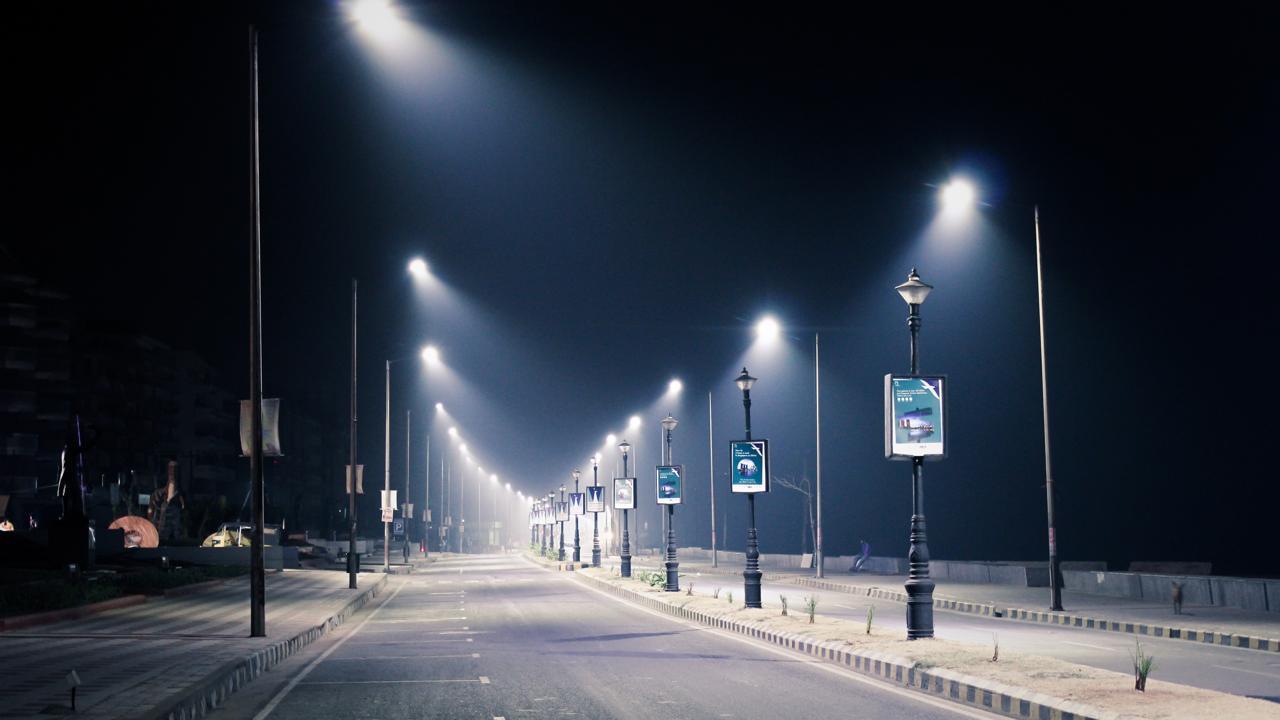
A Long-Awaited Glow: Kochi’s Container Road Finally Illuminated
For over a decade, Kochi’s 17.2-kilometre-long Container Road—also known as the Vallarpadam Terminal Road—stood as a half-finished promise of progress. Designed to support freight movement to and from the Vallarpadam International Container Transshipment Terminal (ICTT), the road was a vital cog in Kerala’s logistics vision. But as the sun dipped each day, the stretch turned treacherous. No streetlights. No clear demarcation. No safety assurance. Just darkness and danger.
That era, finally, appears to be over.
On July 25, Union Minister for Road Transport and Highways Nitin Gadkari officially confirmed that streetlights have been installed and are now operational along the entire Container Road corridor. The development, modest as it may seem on paper, signals a major victory for Kochi’s transport infrastructure and a moment of relief for thousands who traverse this vital freight link daily.
The Dark Decade: Years of Commuter Risk and Government Inaction
The Container Road was inaugurated in 2010 with great fanfare as a crucial link connecting Vallarpadam ICTT to Kalamassery, ensuring that heavy cargo movement could bypass city traffic. But despite its high priority designation, one essential element was ignored—lighting. Over the years, its pitch-dark nights led to traffic accidents, vehicle breakdowns, and even incidents of theft.
Truckers transporting containers worth crores often had no choice but to brave the unlit route. Local residents, especially women and shift workers, were forced to travel in fear. Many avoided the road entirely after dark. The absence of lights turned what should have been a smart logistics corridor into a zone of risk and resentment.
Multiple rounds of protests erupted between 2022 and 2024, driven by residents of nearby Kadamakkudy and Mulavukad panchayats. Civil society organizations, school teachers, freight unions, and even business owners staged demonstrations, demanding swift central intervention.
An RTI filed in 2024 revealed that while tenders for streetlight installation were approved under the Bharatmala Pariyojana, no physical work had started. That revelation became a turning point, pressuring both the Centre and the National Highways Authority of India (NHAI) to act.
Gadkari’s Announcement: Timely, Tactical, and Tangible
Minister Gadkari’s letter to Ernakulam MP Hibi Eden confirming the completion of the lighting work was met with cautious celebration. The installation comprises energy-efficient LED lights, many of which are connected to a centralized control panel to enable real-time monitoring and reduce power wastage. Sources say future plans include integrating solar panels into the power supply grid, aligning with national sustainability goals.
"This long-standing demand of the people of Kochi has finally been fulfilled," Gadkari wrote. “The streetlights will not only improve nighttime road safety but also enhance logistics efficiency and boost economic activity.”
Interestingly, the announcement came just months before crucial local body elections in Kerala—a state where infrastructure delivery has long been seen through a political lens. While Kerala’s Left Democratic Front and the Bharatiya Janata Party (BJP) seldom align on policy, the move drew bipartisan support.
Freight Carriers Breathe Easier
For Kochi’s port-linked truckers, the lit-up corridor is more than a visual upgrade—it is a game-changer. Every night, over 3,000 heavy vehicles ply this route, many carrying fragile or high-value cargo. In the absence of lights, drivers had to rely on fog lamps and guesswork—often with fatal consequences.
Praveen Thomas, a container truck driver with over 20 years of experience, shared his relief: “We used to pray before every night trip. Driving blind with potholes, stray animals, and waterlogging was terrifying. Now, for the first time, it feels like a real road.”
Safety advocates say that the presence of lights could reduce nighttime accidents on the road by as much as 40%. Already, traffic police units are reporting fewer breakdown incidents over the past two weeks.
Local resident and tuition teacher Divya Suresh said her commute is now manageable. “Earlier, my parents insisted I get back before 6:30 pm. Today, I reached home by 9:15 pm without fear. It’s a different feeling. A sense of security,” she noted.
Lighting Is Just the First Step
Despite the long-awaited lighting, several urban planning experts and civic engineers caution that this is only a partial fix.
According to a recent study by the Centre for Public Policy Research (CPPR), the Container Road—designed for moderate cargo volumes—has not been adequately upgraded to handle current usage levels. Many segments near Cheranalloor and Bolgatty suffer from cracked pavements, unclear lane demarcations, and chronic waterlogging during monsoons. A stretch near Moolampilly even floods regularly, disrupting port connectivity for hours.
The Kerala State Industrial Development Corporation (KSIDC) has submitted proposals to the Ministry of Shipping under the Sagarmala initiative. If sanctioned, the corridor could be widened into a four-lane expressway with dedicated logistics lanes, emergency shoulders, and digitized traffic control systems. But this remains stuck in the planning pipeline.
“While the lighting is welcome, road quality, load-bearing capacity, and drainage infrastructure need urgent overhaul,” said Ajay Pillai, an infrastructure policy analyst based in Kochi. “Otherwise, we are simply decorating a broken road.”
Missed Potential: ICTT Still Underperforming
The underutilization of Vallarpadam ICTT—India’s first transshipment terminal—is often blamed on poor last-mile connectivity. Despite its strategic location, the port consistently operates below potential, losing cargo business to Colombo, Mundra, and even Chennai.
A 2023 report by NITI Aayog singled out inadequate road and rail links as primary obstacles, citing the Container Road’s condition as a bottleneck. With the lighting now in place, stakeholders are hopeful that larger logistical upgrades will follow.
Kochi Port Authority officials told The New Indian Express that they are in talks with the Railways Ministry to fast-track double-line extensions for intermodal efficiency. Inland waterway integration is also being explored to reduce dependency on congested road corridors.
Streetlights as a Political Signal?
There’s little doubt that this seemingly minor upgrade holds significant political implications. Minister Gadkari’s track record of completing stalled projects has made him a credible face of infrastructure delivery. By addressing a long-standing grievance in a non-BJP-ruled state, the move also signals the Centre’s intent to strengthen its image as a problem-solver—even across party lines.
On the ground, MPs from both the Congress and CPI(M) have lauded the lighting initiative. Hibi Eden, who received Gadkari’s letter, said the project reflected “what democracy and persistence can achieve.”
CPI(M)’s P. Rajeev, Kerala's Industries Minister, called the development overdue but welcome. “Our aim now should be to integrate this corridor into the larger vision of coastal logistics and regional economic growth.”
What Lies Ahead?
Minister Gadkari’s letter hinted at more changes to come. The Centre is reportedly assessing smart surveillance, adaptive traffic lighting systems, and drone-based corridor mapping to improve road safety.
KSIDC is planning public consultations to involve local communities in future redevelopment phases. A proposal for pedestrian overbridges near key village junctions is also under review.
Meanwhile, Kochi’s municipal authorities are planning to link nearby arterial roads and bus routes with the Container Road to expand commuter utility.
If these steps materialize, the Container Road may finally evolve into the smart, efficient transport lifeline it was originally envisioned to be.
Lights On, Now Keep Moving
In the grand scheme of India’s infrastructure buildout—from bullet trains to smart highways—it’s easy to overlook a set of streetlights. But for Kochi, the illumination of the Container Road is nothing short of transformational.
It marks the end of a dark chapter and opens the door to a new one—where logistics, safety, and public dignity coexist. What remains to be seen is whether this light sparks a larger push toward holistic, future-ready infrastructure or fades as yet another isolated upgrade.
For now, at least, the journey feels a little safer—and a lot more visible.
Streetlights, Kochi



Advances in Aerospace Technology and Commercial Aviation Recovery
Insights into breakthrough aerospace technologies and commercial aviation’s recovery amid 2025 chall

Defense Modernization and Strategic Spending Trends
Explore key trends in global defense modernization and strategic military spending shaping 2025 secu

Tens of Thousands Protest in Serbia on Anniversary of Deadly Roof Collapse
Tens of thousands in Novi Sad mark a year since a deadly station roof collapse that killed 16, prote

Canada PM Carney Apologizes to Trump Over Controversial Reagan Anti-Tariff Ad
Canadian PM Mark Carney apologized to President Trump over an Ontario anti-tariff ad quoting Reagan,

The ad that stirred a hornets nest, and made Canadian PM Carney say sorry to Trump
Canadian PM Mark Carney apologizes to US President Trump after a tariff-related ad causes diplomatic

Bengaluru-Mumbai Superfast Train Approved After 30-Year Wait
Railways approves new superfast train connecting Bengaluru and Mumbai, ending a 30-year demand, easi




