Post by : Amit
Photo: Reuters
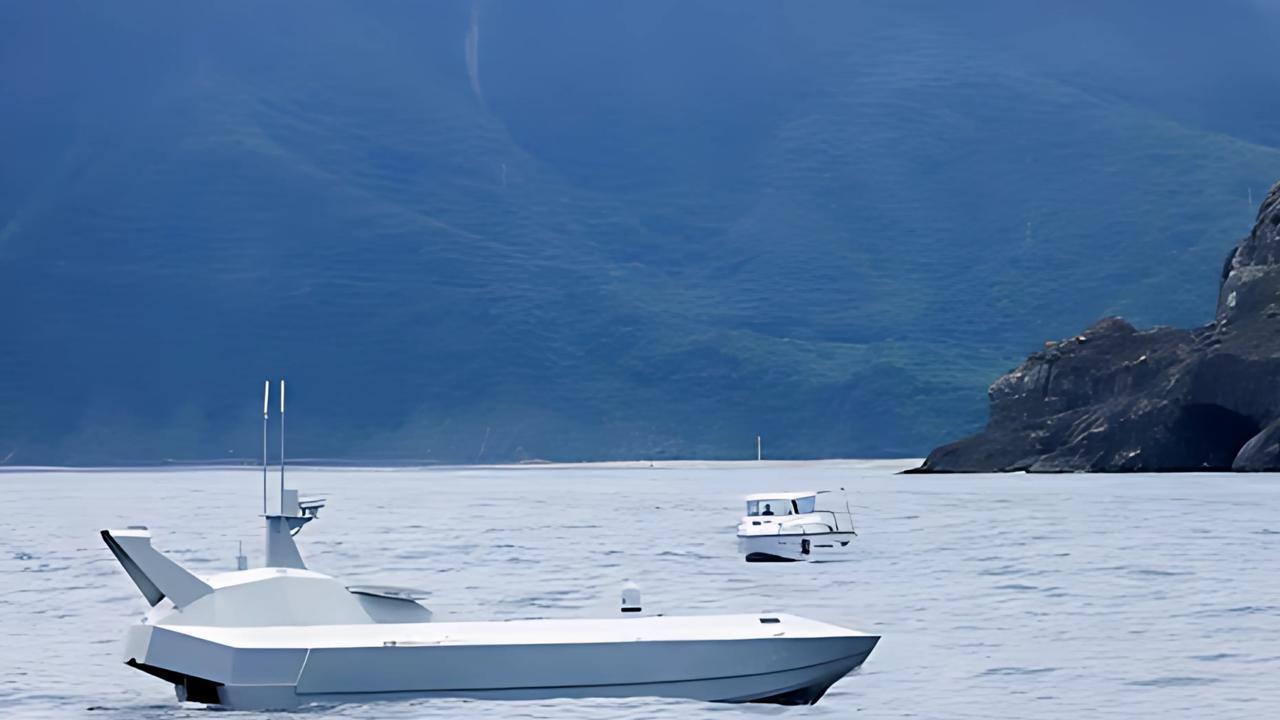
Taipei, Taiwan — As tensions across the Taiwan Strait continue to simmer, Taiwan is investing in a cutting-edge line of autonomous sea drones as part of its evolving strategy to deter potential Chinese aggression. These unmanned maritime vehicles are being developed with advanced surveillance, stealth, and combat capabilities — aiming to strengthen Taiwan’s defenses without relying solely on traditional naval firepower.
This move represents a significant shift in Taiwan’s military doctrine, focusing on asymmetric warfare technologies — smart, mobile, and cost-effective tools designed to counterbalance China’s overwhelming military advantage.
Sea drones, or unmanned surface vehicles (USVs), are emerging as a crucial element in Taiwan’s evolving defense strategy. These robotic vessels, capable of operating autonomously or via remote control, are being developed for a range of tactical roles—patrolling maritime zones, tracking enemy ships, jamming communications, and executing precision strikes during conflict scenarios.
Their key advantages include lower costs compared to traditional manned ships, reduced detectability, and the ability to be deployed in large numbers. USVs can also execute swarm tactics, overwhelming adversaries with speed and coordinated movement. Taiwan’s defense planners see these versatile platforms as ideal for frontline coastal defense, particularly in the narrow waters and complex island chains of the Penghu archipelago and Kinmen, where their agility and size provide a strategic edge over conventional naval forces.
Facing the challenge of China’s rapidly modernizing military—complete with aircraft carriers, amphibious assault ships, and hypersonic weaponry—Taiwan is shifting its defense posture toward asymmetric strategies that emphasize speed, innovation, and geographic advantage. Rather than matching Beijing’s firepower head-on, Taiwan is investing in mobile missile launchers, decentralized radar networks, AI-powered surveillance systems, and now, unmanned sea drones.
These sea drones have featured prominently in recent military exercises, simulating scenarios where they intercept or outmaneuver hostile vessels to disrupt potential amphibious assaults. Defense analysts argue that even a modest, well-coordinated fleet of such drones could complicate invasion plans and significantly raise the cost of aggression for China, reinforcing Taiwan’s deterrence posture through smarter, more flexible defense solutions.
Military planners in Taipei are closely watching how Ukraine has used sea drones in the Black Sea to harass and damage Russian naval assets. These tactics — often carried out using low-profile, commercially modified vessels equipped with explosives or jammers — have proven highly effective in contested waters.
Taiwan is now drawing from that playbook and adapting it to its unique maritime challenges.
According to defense officials, the island is working with both domestic tech firms and foreign partners to develop AI-guided sea drones, with some reports suggesting early prototypes are already being tested in restricted zones.
China has denounced Taiwan’s growing reliance on foreign defense support and "provocative military developments." Chinese warships and surveillance aircraft have increased their activity around Taiwan, and Beijing continues to warn against what it calls “splittist ambitions.”
However, Taiwanese officials maintain that their defense efforts are purely defensive in nature and aimed at preserving peace through deterrence.
As the Indo-Pacific becomes the world’s most strategically contested region, the role of unmanned systems — whether aerial, ground-based, or maritime — is set to grow rapidly.
For Taiwan, sea drones are more than just machines. They are part of a broader effort to transform its defense strategy, making it more agile, high-tech, and unpredictable — all without triggering the kind of escalation that comes from large-scale weapons purchases or joint war games.And in a world where technology is rapidly reshaping warfare, Taiwan’s investment in autonomous sea drones may prove to be a decisive innovation in defending its fragile democracy.
sea drones, Warfare Technologies



Advances in Aerospace Technology and Commercial Aviation Recovery
Insights into breakthrough aerospace technologies and commercial aviation’s recovery amid 2025 chall

Defense Modernization and Strategic Spending Trends
Explore key trends in global defense modernization and strategic military spending shaping 2025 secu

Tens of Thousands Protest in Serbia on Anniversary of Deadly Roof Collapse
Tens of thousands in Novi Sad mark a year since a deadly station roof collapse that killed 16, prote

Canada PM Carney Apologizes to Trump Over Controversial Reagan Anti-Tariff Ad
Canadian PM Mark Carney apologized to President Trump over an Ontario anti-tariff ad quoting Reagan,

The ad that stirred a hornets nest, and made Canadian PM Carney say sorry to Trump
Canadian PM Mark Carney apologizes to US President Trump after a tariff-related ad causes diplomatic

Bengaluru-Mumbai Superfast Train Approved After 30-Year Wait
Railways approves new superfast train connecting Bengaluru and Mumbai, ending a 30-year demand, easi




