Post by : Amit
Photo : X / Sunderdeep - Volklub
India’s EV Revolution Finds New Roads
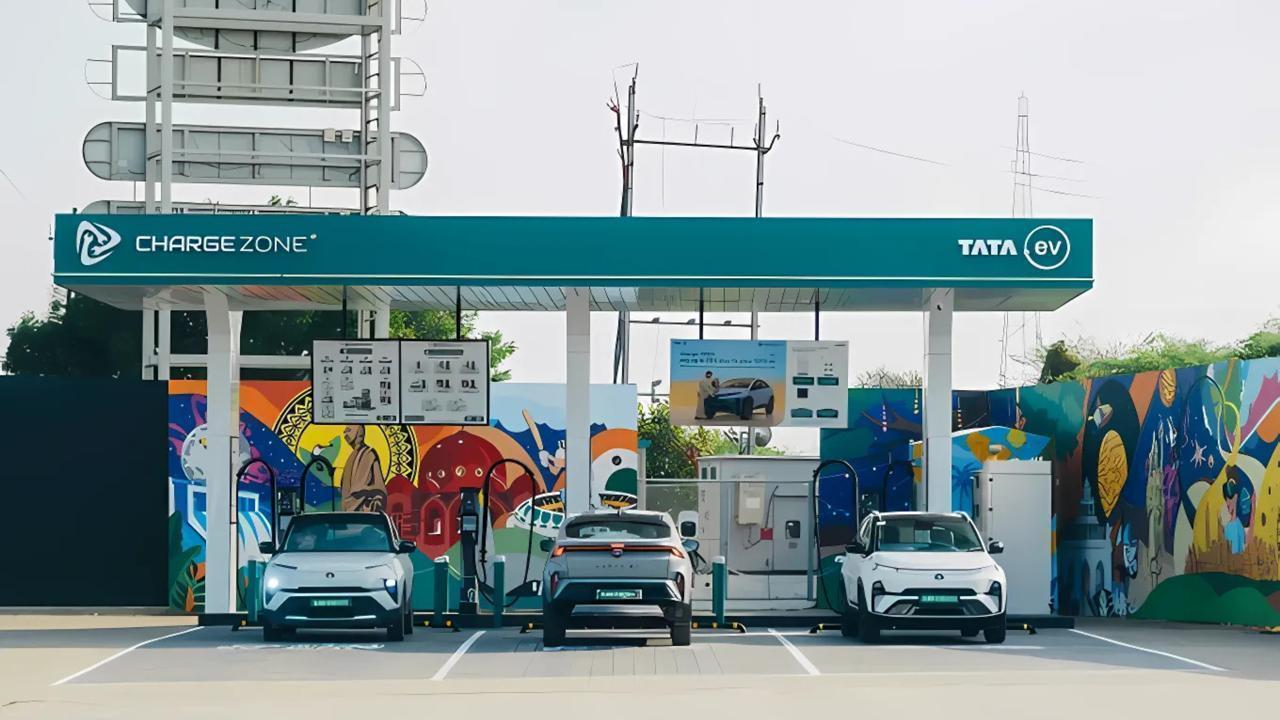
In the glitzy conversations about India’s EV revolution, cities like Delhi, Mumbai, and Bengaluru have long stolen the spotlight. But change is brewing beyond the metros. As electric vehicles quietly multiply on roads in cities like Bhopal, Indore, Surat, Nagpur, and Kochi, Tata Power is leading the charge—literally. The company has launched a sweeping expansion of its EV charging network across Tier-2 cities, aiming to democratize clean mobility and break the urban monopoly on EV infrastructure.
This aggressive push comes as part of Tata Power's larger ambition to become India’s top player in clean energy distribution. With over 85,000 home chargers and nearly 6,000 public/semi-public chargers already installed, the utility giant is now setting its sights on regions that have long been underserved in the electric mobility landscape.
“This is the next frontier,” says Dr. Praveer Sinha, CEO & MD of Tata Power. “Our mission is to enable zero-emission travel not just for the elite few in big cities, but for all Indians. Tier-2 cities are where the next million EV users will come from.”
Tier-2 Cities: The Sleeping Giants of EV Adoption
Why Tier-2 cities? The answer lies in a mix of market readiness, infrastructure gaps, and untapped potential. Cities like Lucknow, Mysuru, Vadodara, and Coimbatore have seen a rapid spike in EV registrations over the past two years—especially in the two-wheeler and three-wheeler segments. Yet, the charging ecosystem has remained patchy, forcing users to rely on home sockets or improvised solutions.
Tata Power recognized this vacuum early. Unlike metro cities where multiple players jostle for charging real estate, Tier-2 cities offered a cleaner slate—and an eager user base.
“Residents in these cities are incredibly enthusiastic about EVs. The only thing missing was a reliable, accessible charging backbone,” says Varun Mehta, Head of Business Development at Tata Power EV Charging Solutions.
The company’s market research revealed that Tier-2 customers were highly cost-conscious, preferred easy-to-use mobile payment systems, and wanted fast-charging stations at predictable locations like malls, petrol pumps, apartment complexes, and public transport hubs.
Strategic Rollout: From Temples to Tech Parks
Over the past six months, Tata Power has quietly rolled out nearly 1,500 new charging points across 35 Tier-2 cities. These include both fast DC chargers and more affordable AC wall boxes, depending on local demand patterns. The goal is to build a “15-minute charging radius”—ensuring that no user is more than 15 minutes away from a Tata Power EV charging point.
In Kochi, for instance, Tata Power has partnered with Lulu Group to set up 15 charging stations across its retail zones. In Indore, chargers have been installed at key locations near educational institutes and railway stations. In Mysuru, temple towns and tourism corridors are being prioritized.
Interestingly, the rollout isn’t just focused on four-wheelers. Tata Power is working with state transport departments to support electric rickshaws and buses, and even integrating charging into smart city mobility plans.
“We’re not just deploying chargers—we’re embedding EV infrastructure into the daily mobility patterns of these cities,” says Mehta.
Affordability Meets Accessibility
A major barrier to EV charging in smaller cities has been cost—both in terms of infrastructure deployment and user tariffs. Tata Power’s solution is two-fold: localization and modularity.
First, the company is localizing infrastructure components such as charger cabinets, wiring harnesses, and payment kiosks. Much of the hardware is now manufactured in India, slashing costs by up to 30%.
Second, the company is offering tiered pricing plans, allowing users to pay per kWh or through subscriptions. For instance, commercial EV fleet operators in Raipur can now avail of unlimited monthly charging plans for under ₹2,000—a boon for logistics startups.
“Affordability is key. We’ve designed tariffs that match the economic profile of each city while still ensuring commercial viability,” says Smriti Khanna, Strategy Lead for Emerging Markets at Tata Power.
The company is also rolling out offline payment options for areas with weak internet connectivity, allowing users to tap and pay via prepaid cards, SMS codes, or UPI-linked QR codes.
The Digital Nervous System
Behind the physical charging infrastructure lies a highly sophisticated digital backbone. Tata Power’s EV platform is integrated with real-time analytics, AI-driven load balancing, and predictive maintenance protocols. This ensures chargers stay online, grid loads remain stable, and user experience is seamless.
“Every charger is a smart node,” explains CTO Rajat Mohan. “We monitor uptime, usage, temperature, and voltage remotely. If there’s an issue, we often fix it before the customer even notices.”
The Tata Power EZ Charge app, which has over 1 million downloads, allows users to find nearby chargers, check availability, book slots, and even get carbon-saving stats after each session. The app is being localized into regional languages as the Tier-2 rollout continues.
For fleet operators, the company has launched a dedicated dashboard that tracks vehicle charging patterns, energy usage, and route efficiency, enabling smarter dispatch planning.
Partners in Progress: Working with States and Startups
Tata Power isn’t going it alone. Its Tier-2 expansion strategy relies heavily on local partnerships—with state governments, municipal corporations, real estate developers, and tech startups.
In Tamil Nadu, the company has signed MoUs with the Smart Cities Mission to deploy charging at bus terminals and parking lots. In Gujarat, it's collaborating with urban co-operatives to offer residential EV packages. In Assam, the state transport authority has roped in Tata Power for an ambitious plan to electrify 20% of public buses in Guwahati by 2027.
Meanwhile, local energy startups are helping with installation, maintenance, and customer support—creating a hyperlocal EV workforce. Tata Power has even launched a training program for “EV charge technicians” in partnership with ITIs and polytechnic colleges.
“These are jobs of the future,” says Khanna. “Our ecosystem approach ensures that the benefits of EV growth stay rooted in local economies.”
A Tailwind of Policy and Momentum
Government policies have also provided a significant tailwind to Tata Power’s strategy. The FAME-II subsidy, state-level incentives for charging infra, and recent GST cuts on EVs have created fertile ground for expansion.
In fact, the Ministry of Power’s revised guidelines for EV charging infrastructure, released earlier this year, specifically emphasize expansion into Tier-2 and Tier-3 cities, citing their growing vehicle populations and urban sprawl.
Union Power Minister R.K. Singh has praised Tata Power’s efforts, calling them a “template for how private players can align business goals with national sustainability objectives.”
Challenges and Roadblocks
Despite the momentum, the road ahead is not without speed bumps. Land acquisition remains a bottleneck in many cities, especially for larger DC fast-charging sites. Local power grids in some Tier-2 zones lack the capacity for high-load draw, requiring upgrades and transformer installations.
Customer education is another hurdle. Many first-time EV buyers still grapple with range anxiety, charger compatibility, and payment know-how. Tata Power is investing in public outreach, including radio ads, digital campaigns, and EV awareness drives at schools and housing societies.
“We have to build not just infrastructure, but trust,” says Mehta. “The average user needs to feel that EVs are not experimental—they’re everyday.”
100,000 Chargers by 2030
Tata Power has set an ambitious goal: to operate over 100,000 public EV charging points across India by 2030, with at least 40% located in Tier-2 and Tier-3 cities. This would make it not only the largest EV network in South Asia, but also one of the most inclusive.
In the coming year, the company plans to focus on:
As India’s EV journey shifts gears, Tata Power’s Tier-2 expansion could well be the catalyst that unlocks a truly mass-market transition—one that stretches far beyond city skylines and into the heart of a new mobility era.
A Quiet Revolution Roars in Small Cities
While headlines often celebrate flashy EV launches and metro-level innovations, it is in India’s quieter cities that the real revolution is taking root. Tata Power’s expansion of its EV charging network into Tier-2 towns isn’t just an infrastructure play—it’s a strategic bet on democratization, decentralization, and digital-first thinking.
In empowering the next wave of EV adopters, Tata Power is doing more than building chargers. It’s building confidence, convenience, and a cleaner future—from Mysuru to Meerut, from Surat to Siliguri.
And in doing so, it's showing the rest of the world that sustainable mobility isn’t a luxury for the few—it’s a right for all.
Tata Power, Ev Charging



Advances in Aerospace Technology and Commercial Aviation Recovery
Insights into breakthrough aerospace technologies and commercial aviation’s recovery amid 2025 chall

Defense Modernization and Strategic Spending Trends
Explore key trends in global defense modernization and strategic military spending shaping 2025 secu

Tens of Thousands Protest in Serbia on Anniversary of Deadly Roof Collapse
Tens of thousands in Novi Sad mark a year since a deadly station roof collapse that killed 16, prote

Canada PM Carney Apologizes to Trump Over Controversial Reagan Anti-Tariff Ad
Canadian PM Mark Carney apologized to President Trump over an Ontario anti-tariff ad quoting Reagan,

The ad that stirred a hornets nest, and made Canadian PM Carney say sorry to Trump
Canadian PM Mark Carney apologizes to US President Trump after a tariff-related ad causes diplomatic

Bengaluru-Mumbai Superfast Train Approved After 30-Year Wait
Railways approves new superfast train connecting Bengaluru and Mumbai, ending a 30-year demand, easi




