Post by : Amit
Photo : X / The Executive Report 👔
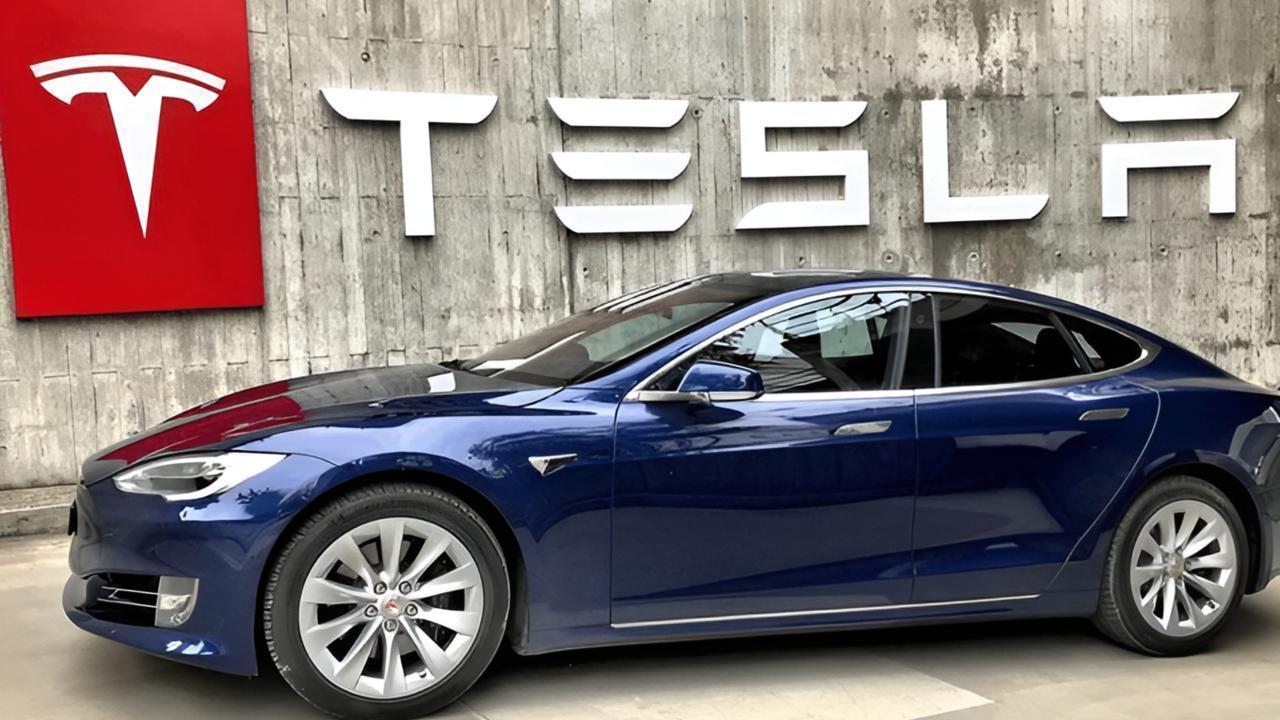
Beijing, July 2025 — Tesla, the American EV giant, is once again in the headlines in China—but this time for outperforming domestic automakers in a high-stakes government-led evaluation of driver-assistance systems. The results, disclosed through China’s state media and tech channels this week, suggest Tesla vehicles offer superior safety and functionality in certain core driving scenarios, challenging local rivals like BYD, Xpeng, and Nio on their home turf.
China, the world’s largest EV market, has seen a flood of competition in the driver-assistance space, where global and local automakers are vying to build the most reliable, intelligent, and adaptable AI driving systems. The latest round of tests was administered by a government-affiliated body closely tied to the Ministry of Industry and Information Technology (MIIT), as part of a broader effort to create standardised benchmarks for ADAS (Advanced Driver Assistance Systems).
Standardized AI Road Trials: A Big Step for Regulation
The trials are part of China’s new push toward regulatory clarity in semi-autonomous driving. Instead of relying solely on manufacturer claims or third-party reviews, the government itself has begun running controlled tests under simulated and real-world conditions. Vehicles were scored across a wide range of maneuvers, including emergency lane changes, auto-braking for pedestrians, adaptive cruise control under congestion, and driver disengagement safety protocols.
Tesla’s Model Y and Model 3 were among the top performers, particularly in dynamic decision-making scenarios, while some local models lagged in consistency and reaction time. According to preliminary results, Tesla’s software was better calibrated to handle unexpected human behaviors—such as jaywalking or erratic vehicle cut-ins.
"Tesla’s system showed a faster hazard response time and more effective collision avoidance behavior compared to most domestic brands," said an unnamed official involved in the testing, as quoted by China Central Television (CCTV).
BYD, Xpeng, Nio React: A Wake-Up Call
The results did not sit lightly with China’s top EV manufacturers, who have long pitched their intelligent driving suites as superior for Chinese roads. BYD, the country’s largest EV maker, issued a statement defending its technology and emphasizing its efforts toward real-world road training. Xpeng, which brands itself as an autonomous driving pioneer, acknowledged gaps in software calibration and said improvements were already underway in its latest firmware updates.
Industry insiders believe the test results could accelerate development cycles among Chinese OEMs. "This is a shot across the bow," said Lin Zhen, a mobility tech analyst based in Shenzhen. "The Chinese government is now saying: ‘We will decide who leads in safety.’ That shifts the competitive balance."
Data, Sensors, and the Battle for AI Supremacy
One of Tesla’s strongest advantages lies in its global fleet data pool. Unlike its Chinese competitors, Tesla collects vast driving behavior data from North America, Europe, and Asia, feeding it back into its neural networks. This real-world dataset allows for robust edge-case training, something that pure-simulation training often lacks.
Chinese companies, by contrast, have been limited largely to domestic data pools, governed by strict national cybersecurity rules. While local giants like Baidu and Huawei have helped integrate smart city infrastructure into certain vehicle systems, their breadth of real-time adaptive training remains narrower.
According to analysts at Canalys, Tesla’s Dojo supercomputer and Full Self-Driving (FSD) beta program—though controversial—have given it a massive learning advantage. "The more cars on the road, the better the algorithm becomes," Canalys noted in a recent brief. "Tesla is evolving through scale."
Consumer Confidence and Market Share Impacts
While the test results are not yet part of formal safety rankings, they are expected to influence consumer perception. Chinese buyers are increasingly aware of driver-assistance technologies, especially as urban congestion and long commutes raise the demand for semi-autonomous driving comfort.
Social media platforms like Weibo and Douyin (China’s version of TikTok) lit up with discussion. Some users expressed surprise that a foreign brand was outperforming local ones on Chinese roads. Others saw it as validation of Tesla’s premium pricing. "Now I know what I’m paying for," one commenter wrote.
Auto dealerships have also taken note. Multiple Tesla showrooms reported a spike in walk-ins the day after the news broke, suggesting the results might influence purchasing behavior—especially among tech-savvy younger buyers.
Policy Implications: Setting a National Standard
The larger objective behind the tests is policy-driven. China aims to establish a national standard for driver-assistance systems in anticipation of a broader rollout of Level 3 and Level 4 autonomous vehicles. Officials say transparency and technical validation will be key to gaining public trust.
In a recent statement, MIIT confirmed that more rounds of testing would follow, including extreme weather scenarios, mountain terrain, and nighttime urban driving. Manufacturers will be allowed to observe and participate, but not influence the scoring.
Interestingly, China’s emerging standards may also serve as an export certification tool. As Chinese EVs push into Europe, Southeast Asia, and Latin America, verifiable safety credentials will be essential.
Tesla’s China Strategy Gets a Boost
For Tesla, these results could not have come at a better time. The company is navigating an increasingly complex regulatory and market landscape in China. Although Tesla's Shanghai Gigafactory continues to be a major manufacturing hub, geopolitical tensions and data localization laws have raised questions about Tesla’s long-term positioning.
This public recognition from a government-sanctioned test helps reinforce Tesla’s narrative of being a global technology leader. Moreover, it puts pressure on local rivals not just to innovate, but to meet or exceed public benchmarks—on the government’s terms.
As China moves from mass EV adoption to intelligent mobility leadership, the race is no longer just about building EVs. It's about who builds the smartest, safest, and most trusted driving systems. And for now, Tesla appears to have taken a confident lead.
An AI Arms Race on Wheels
The results of China’s driver-assistance tests are more than a bragging right—they're a glimpse into the future of mobility regulation and innovation. As governments increasingly seek to guide AI adoption in transportation, the days of opaque performance claims are ending.
Tesla’s edge, built on a decade of machine learning refinement and user data feedback, is showing tangible returns. But the Chinese EV sector is anything but complacent. With fierce national pride, vast R&D budgets, and government backing, local players are poised to respond quickly.
What we’re witnessing is not just an EV race, but an AI arms race on wheels. One that will redefine who sets the pace in global mobility—and who gets left behind.
Tesla, Chinese, Advanced Driver Assistance Tests



Advances in Aerospace Technology and Commercial Aviation Recovery
Insights into breakthrough aerospace technologies and commercial aviation’s recovery amid 2025 chall

Defense Modernization and Strategic Spending Trends
Explore key trends in global defense modernization and strategic military spending shaping 2025 secu

Tens of Thousands Protest in Serbia on Anniversary of Deadly Roof Collapse
Tens of thousands in Novi Sad mark a year since a deadly station roof collapse that killed 16, prote

Canada PM Carney Apologizes to Trump Over Controversial Reagan Anti-Tariff Ad
Canadian PM Mark Carney apologized to President Trump over an Ontario anti-tariff ad quoting Reagan,

The ad that stirred a hornets nest, and made Canadian PM Carney say sorry to Trump
Canadian PM Mark Carney apologizes to US President Trump after a tariff-related ad causes diplomatic

Bengaluru-Mumbai Superfast Train Approved After 30-Year Wait
Railways approves new superfast train connecting Bengaluru and Mumbai, ending a 30-year demand, easi




