Post by : Saif
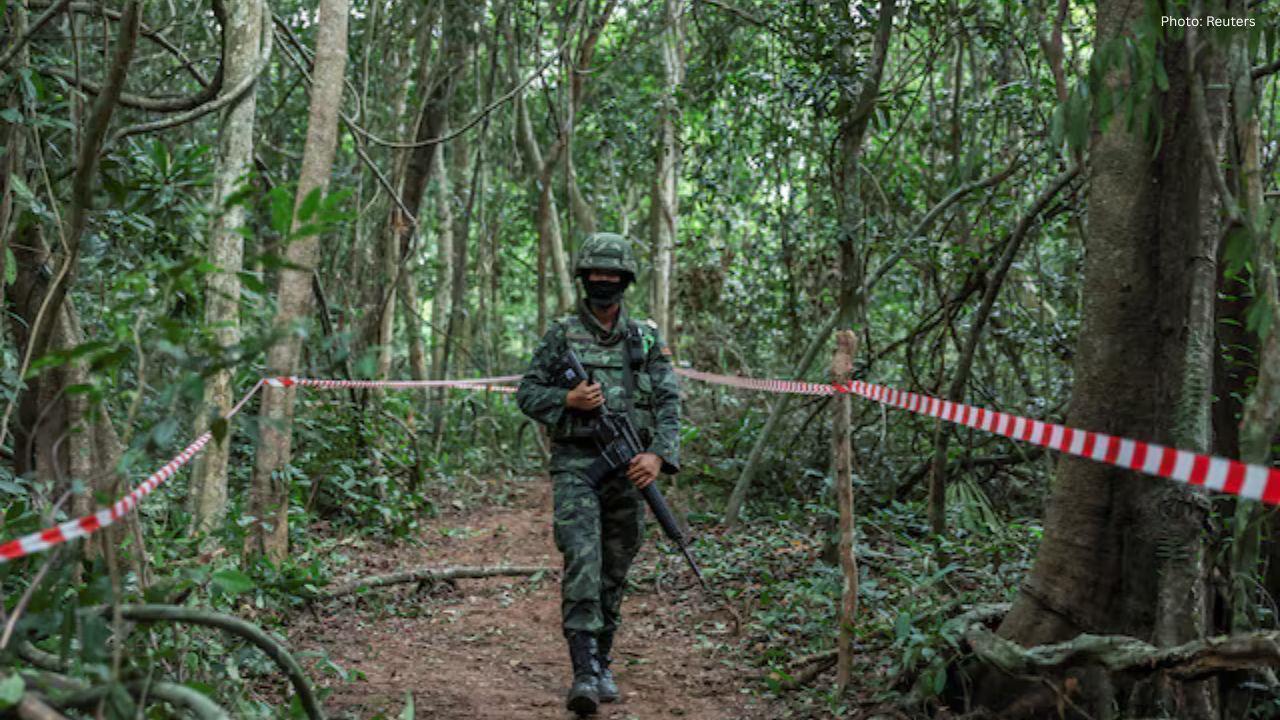
The growing military tension between Thailand and Cambodia has raised serious concerns across Southeast Asia. Recent air strikes and border clashes have not only created fear among civilians but also highlighted a major difference in military strength between the two countries. This difference makes the situation more dangerous and harder to control.
Thailand and Cambodia share a long and troubled border history. For more than a century, both countries have argued over parts of their 817-kilometer border. These disputes started during colonial times when borders were poorly mapped. Over the years, these disagreements have led to repeated clashes, including deadly fighting in 2011 and the most recent conflict this year.
One of the biggest differences between the two countries is their military budgets. Cambodia spent about $1.3 billion on defense in 2024. In comparison, Thailand spent around $5.73 billion — more than four times Cambodia’s budget. This large gap shows how much more Thailand can invest in weapons, training, and equipment.
Cambodia has around 124,300 active military personnel. Its army is its largest force, with about 75,000 soldiers. It owns more than 200 battle tanks and around 480 pieces of artillery. While this is a strong force for a smaller country, it is limited when compared to Thailand’s military power.
Thailand has over 360,000 active military personnel. Its army alone has about 245,000 troops, including more than 100,000 conscripts. Thailand also has around 400 battle tanks, more than 1,200 armored vehicles, and about 2,600 artillery weapons. This gives Thailand a big advantage in both size and firepower.
The air power gap is even more striking. Cambodia’s air force is small, with only about 1,500 personnel. It does not have any fighter jets. It mainly uses transport planes and helicopters, including older Soviet and Chinese models.
Thailand, on the other hand, has one of the strongest air forces in Southeast Asia. It has about 46,000 air force personnel and more than 100 combat-capable aircraft. This includes American-made F-16 fighter jets and advanced Swedish Gripen jets. Thailand also operates many helicopters and drones, giving it strong surveillance and strike abilities.
At sea, the difference is just as large. Cambodia’s navy has around 2,800 personnel and a small number of patrol boats and coastal vessels. It has only one amphibious landing craft, which limits its ability to carry troops by sea.
Thailand’s navy is much larger and more advanced. It has nearly 70,000 personnel, an aircraft carrier, seven frigates, and dozens of patrol and combat vessels. It also has landing ships that can carry hundreds of troops, along with a strong marine force supported by armored vehicles and aircraft.
This military imbalance makes the current tensions especially risky. When one country is much stronger than the other, misunderstandings can quickly turn into serious violence. At the same time, the weaker side may feel cornered and more likely to react emotionally rather than carefully.
However, military strength should not decide the future of this region. Power should not replace dialogue. History shows that wars between neighbors leave deep scars that last for generations. Civilians lose homes, children lose schools, and families lose peace.
Both Thailand and Cambodia must understand that using weapons will not solve a border problem that has existed for more than 100 years. Only talks, trust-building, and international mediation can prevent this crisis from becoming a larger disaster.
This is not just a military issue. It is a human issue. The people living near the border are the ones who suffer the most. Their safety should be the top priority for both governments.
#trending #latest #ThailandCambodia #MilitaryComparison #BorderTensions #PeaceInAsia #DefenseNews #NoMoreWar



Advances in Aerospace Technology and Commercial Aviation Recovery
Insights into breakthrough aerospace technologies and commercial aviation’s recovery amid 2025 chall

Defense Modernization and Strategic Spending Trends
Explore key trends in global defense modernization and strategic military spending shaping 2025 secu

Tens of Thousands Protest in Serbia on Anniversary of Deadly Roof Collapse
Tens of thousands in Novi Sad mark a year since a deadly station roof collapse that killed 16, prote

Canada PM Carney Apologizes to Trump Over Controversial Reagan Anti-Tariff Ad
Canadian PM Mark Carney apologized to President Trump over an Ontario anti-tariff ad quoting Reagan,

The ad that stirred a hornets nest, and made Canadian PM Carney say sorry to Trump
Canadian PM Mark Carney apologizes to US President Trump after a tariff-related ad causes diplomatic

Bengaluru-Mumbai Superfast Train Approved After 30-Year Wait
Railways approves new superfast train connecting Bengaluru and Mumbai, ending a 30-year demand, easi




