Post by : Amit
Photo : X / The Tradesman
A Ceremony Bridging Two Nations
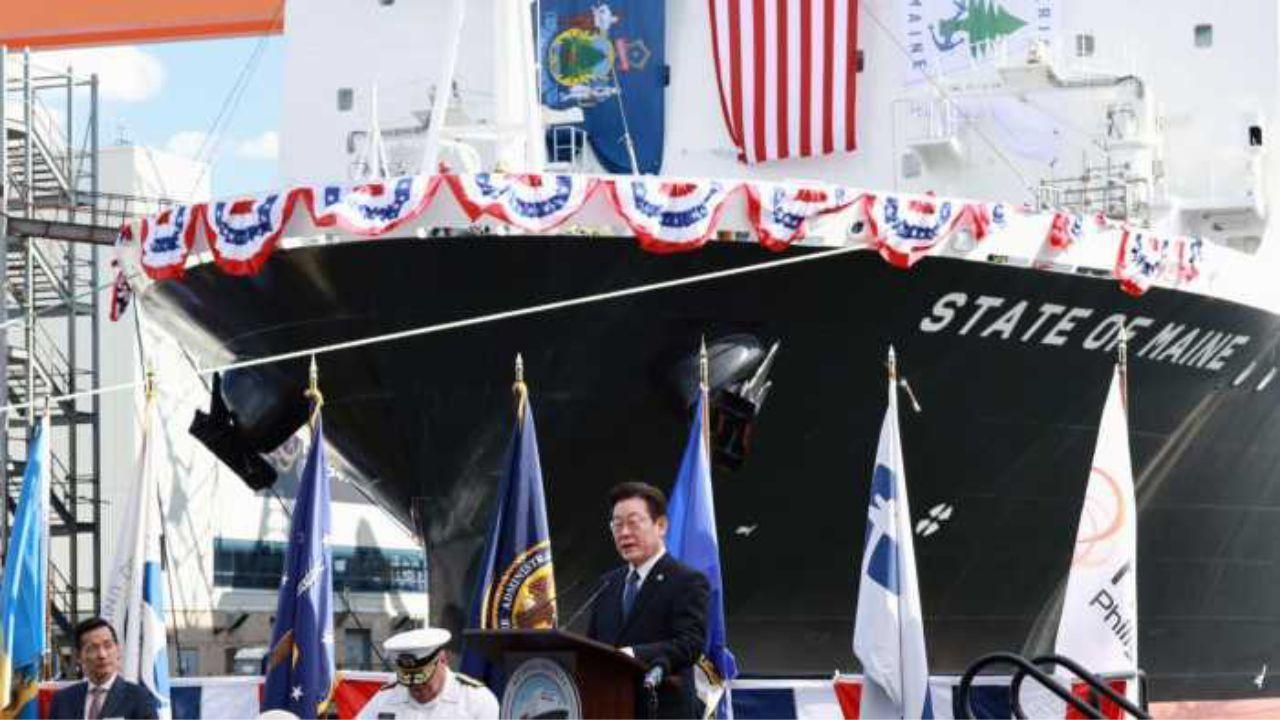
Under the gleaming August skies of Philadelphia, a steel-beamed icon slipped into the spotlight: the State of Maine, a training ship christened at Hanwha's Philly Shipyard. The ceremony was more than tradition—it was a symbol of an emerging U.S.–South Korea alliance aimed at revitalizing the shipbuilding surge in American waters. With dignitaries from both nations watching closely, the vessel cut the ribbon on a new chapter of trans-Pacific industrial collaboration.
The Vessel That Speaks Volumes
The training ship State of Maine is the third in the National Security Multi-Mission Vessel (NSMV) series, purpose-built to train cadets of maritime academies while serving as a humanitarian rescue asset. It can carry up to 600 cadets or convert swiftly to transport 1,000 people in crisis times. The ship is emblematic of how vessels can be engineered for both learning and rescue—designed with classrooms, labs, medical zones, and even a helicopter pad to ensure versatility.
A Shipyard Reborn
Wrapped in the ceremony’s pomp is Hanwha Ocean’s bold investment in Philly Shipyard. Acquired in late 2024, the facility is undergoing a $5 billion transformation to increase production capability from fewer than two vessels a year to up to 20. New docks, quays, and block assembly lines aim to convert Philadelphia’s maritime patch into a hive of shipbuilding activity, an echo of its industrial past now powered by global ambition.
A Strategic Showpiece
The timing of the christening was deliberate. South Korea’s President Lee Jae Myung had visited U.S. officials, and the ceremony served as a visual anchor to the “MASGA”—Make American Shipbuilding Great Again—agenda. As he toured the shipyard, Lee spoke of a partnership that would lift both countries’ shipbuilding industries, calling the project a modern-day “miracle of K-shipbuilding” and a sign that America and Korea would advance “together, sea by sea.”
Ships That Shape Alliances
The christening was lit with flags—U.S. and South Korean—and leaders including Governor Josh Shapiro and Vice Chairman Kim Dong-kwan took turns at the podium. Their words were purposeful, signaling that this is not just shipbuilding—it’s statecraft. The ship and shipyard are now symbols of strategic collaboration, where maritime tradition meets contemporary geopolitics in every rivet and hatch.
Reindustrializing America's Maritime Heart
The shipyard expansion is part of a broader push to revitalize American shipyards, retrain the workforce, and secure vital maritime infrastructure. South Korea’s $150 billion MASGA commitment underpins the urgency. Hanwha’s presence in Philadelphia speaks volumes: building ships again requires bold partnerships, infrastructure scaling, and the long view of industrial revival.
Training More Than Cadets
Ships like the State of Maine are not merely floating classrooms. They embody resilience—ready to shift roles from education to emergency response. Whether teaching cadets or delivering aid in crises, these vessels reflect how training and humanitarian missions can share a blueprint—and a hull.
Jobs, Skills, and Industry Revival
Beyond hulks and hulls, this surge brings job growth and niche skill development. Engineers, welders, and maritime technicians stand to gain—from specialty welding to ship systems management. The shipyard promises to grow its workforce from roughly 7,000 to more than 10,000, transforming Philadelphia’s docklands into a modern manufacturing hub.
A Stronger Maritime Alliance
The ceremony and investment are more than PR—they embody a strategic pivot toward Asia-Pacific maritime readiness. As concerns rise over global naval dominance, states like the U.S. and South Korea are leaning into shared production, training, and vessel repair. Their aligned shipbuilding surge isn’t just industrial—it’s a strategic horizon anchored in shared challenges.
Challenges Beneath the Steel
Despite the optimism, challenges remain. Scaling output to 20 ships annually requires supply chain fidelity, skilled labor, regulatory alignment, and sustained investment. The global tensions around steel, electronics, and geopolitical supply chains could test the alliance’s momentum. Yet Hanwha’s presence and U.S. political support suggest the deck is stacked for success.
A Symbol Woven into Metal
This ship is more than welded steel—it’s a woven symbol of ambition, alliance, and maritime legacy. It serves as training grounds, rescue vessel, and industrial milestone fused into one. For cadets, it's practical education; for diplomats, symbolic strategy; for the public, a story of shared capacity.
Where Waves Meet Legacy
Philadelphia once built warships that shaped the nation. Now, as the State of Maine slides into the water under the Hanwha banner, history comes full circle. The shipyard’s rebirth combines maritime roots with modern mission, and it reminds us that ships do more than sail—they connect aspiration with reality.
Anchoring the Future
In naming the State of Maine, U.S.–South Korean leaders named more than a ship. They christened a shared future where cooperation powers industry and where education meets emergency readiness. As the ship departs its birthplace, it sails on the currents of friendship, rebirth, and ambition. In American and Korean shipyards alike, the shipbuilding surge is underway—and this training ship carries a bold message: we build together, we stand together, we sail forward together.
Training ship, U.S.–South Korea, Shipbuilding surge



Advances in Aerospace Technology and Commercial Aviation Recovery
Insights into breakthrough aerospace technologies and commercial aviation’s recovery amid 2025 chall

Defense Modernization and Strategic Spending Trends
Explore key trends in global defense modernization and strategic military spending shaping 2025 secu

Tens of Thousands Protest in Serbia on Anniversary of Deadly Roof Collapse
Tens of thousands in Novi Sad mark a year since a deadly station roof collapse that killed 16, prote

Canada PM Carney Apologizes to Trump Over Controversial Reagan Anti-Tariff Ad
Canadian PM Mark Carney apologized to President Trump over an Ontario anti-tariff ad quoting Reagan,

The ad that stirred a hornets nest, and made Canadian PM Carney say sorry to Trump
Canadian PM Mark Carney apologizes to US President Trump after a tariff-related ad causes diplomatic

Bengaluru-Mumbai Superfast Train Approved After 30-Year Wait
Railways approves new superfast train connecting Bengaluru and Mumbai, ending a 30-year demand, easi




