Post by : Shivani
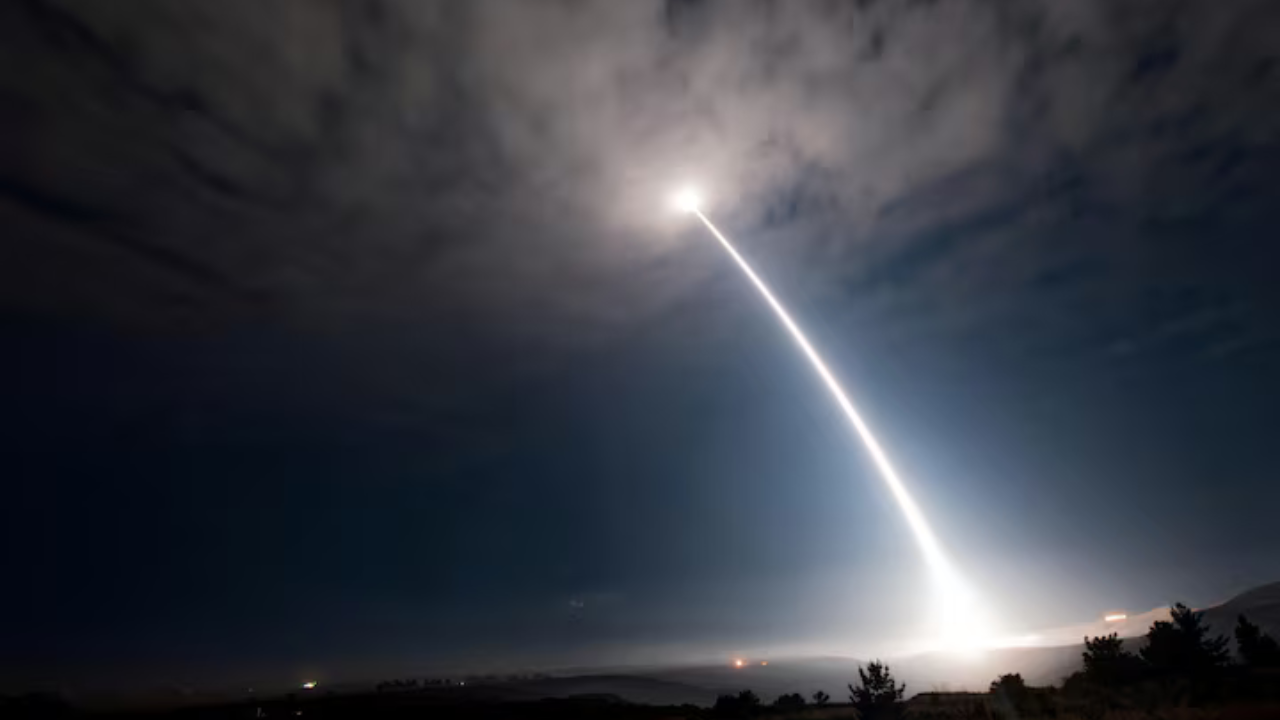
In a dramatic escalation of global nuclear tensions, President Donald Trump has directed the Pentagon to immediately resume testing of U.S. nuclear weapons, shattering a 33-year moratorium that has underpinned international arms control efforts since the Cold War's end. The order, announced via a fiery Truth Social post while Trump helicoptered toward a high-stakes summit with Chinese President Xi Jinping, frames the move as a necessary response to perceived provocations by Russia and China. Coming amid Russia's flurry of recent nuclear-capable tests and China's rapid arsenal expansion, the directive risks unraveling the Nuclear Non-Proliferation Treaty (NPT) and igniting a new arms race, experts warn.
Trump's announcement, posted from Marine One en route to Busan, South Korea, for trade talks with Xi, underscores the intertwining of economic diplomacy and strategic brinkmanship in his second term. "Because of other countries testing programs, I have instructed the Department of War to start testing our Nuclear Weapons on an equal basis," Trump wrote, referring to the Pentagon in a nod to historical nomenclature. "That process will begin immediately." He later elaborated aboard Air Force One: "With others doing testing, I think it's appropriate that we do also," adding that test sites would be selected in due course.
This bold stroke arrives at a precarious moment. Just days earlier, Russia conducted a series of high-profile demonstrations of its nuclear-powered arsenal, including a cruise missile test on October 21, nuclear readiness drills on October 22, and a Poseidon super-torpedo trial on October 28. While these did not involve explosive detonations—Russia's last full nuclear test dates to 1990 under the Soviet Union—they signal Moscow's intent to modernize its edge in asymmetric nuclear threats. China, meanwhile, has more than doubled its warhead count to around 600 since 2020, with projections of over 1,000 by 2030, per U.S. intelligence assessments.
Trump positioned the U.S.—with its 5,225 warheads dwarfing China's but trailing Russia's 5,580—as the arsenal's guardian, yet vulnerable to catching up. "Russia is second, and China is a distant third, but will be even within 5 years," he posted, blending bravado with a surprising olive branch: openness to denuclearization talks. "I'd like to see a denuclearisation because we have so many... We are actually talking to Russia about that and China would be added to that if we do something."
Yet, the rhetoric belies profound risks. No nuclear power has detonated a weapon in over 25 years, save North Korea's 2017 blast. The U.S. moratorium, self-imposed in 1992, has been a cornerstone of global non-proliferation, enabling computer simulations and subcritical tests to maintain stockpile reliability without the environmental and political fallout of explosions. Trump's order—ambiguous on whether it targets full explosive trials or missile flights—could upend this equilibrium, prompting reciprocal escalations from adversaries.
The U.S. nuclear testing saga traces back to the Trinity blast in 1945, encompassing over 1,000 detonations across Nevada, the Pacific, and underground shafts until the 1992 halt. That pause, echoed by Russia (post-1990) and China (post-1996), fostered the Comprehensive Nuclear-Test-Ban Treaty (CTBT), signed in 1996 but unratified by key players like the U.S. and China. Trump's revival evokes Reagan-era saber-rattling, when Star Wars fantasies and Pershing II deployments chilled U.S.-Soviet ties.
Today's context amplifies the stakes. Russia's Ukraine invasion has blurred conventional and nuclear thresholds, with Putin invoking his arsenal to deter NATO aid. The Poseidon torpedo, tested last week, promises "radioactive tsunamis" against coastal cities, a doomsday device underscoring Moscow's deterrence doctrine. China, accelerating under Xi, views its buildup as a "minimum deterrent" against U.S. encirclement, from Taiwan Strait patrols to AUKUS pacts.
Trump's August 2025 overture for tripartite arms talks with Putin and Xi faltered on Beijing's insistence on parity—a non-starter given arsenal disparities. Now, as trade frictions simmer (U.S. tariffs on Chinese EVs hit 100% this year), nuclear posturing inserts volatility into Busan's agenda. Analysts see it as Trump's "madman theory" redux: feigned unpredictability to extract concessions, from fentanyl curbs to IP theft halts.
Implementation hurdles loom large. Daryl Kimball, executive director of the Arms Control Association, estimates 36 months minimum to revive underground testing at Nevada's Yucca Flat, involving seismic reinforcements and environmental waivers. "Trump is misinformed and out of touch," Kimball told Reuters. "The U.S. has no technical, military or political reason to resume nuclear explosive testing for the first time since 1992." He warns the move could "trigger a chain reaction of nuclear testing by U.S. adversaries, and blow apart the nuclear Non-Proliferation Treaty."
Reactions poured in swiftly, a barometer of frayed trust. The Kremlin, via spokesman Dmitry Peskov, expressed bewilderment: "President Trump mentioned in his statement that other countries are engaged in testing nuclear weapons. Until now, we didn't know that anyone was testing." Putin, who has vowed mirror responses to any rival tests, oversees drills that blend bluster with capability—his October 22 exercise simulated strikes on European targets, per state media.
China's Foreign Ministry struck a measured tone, urging Washington to "abide by its commitment to a moratorium on nuclear testing and uphold global strategic balance and stability." With Xi facing Trump amid hopes for a trade truce—potentially easing soybean and Boeing export bans—the timing stings. Beijing's arsenal growth, from 300 warheads in 2020 to 600 today (per the Center for Strategic and International Studies), reflects anxieties over U.S. missile defenses and Indo-Pacific alliances.
At home, bipartisan alarm rang out. Nevada Rep. Dina Titus, whose district abuts the old test site, fired back on X: "I'll be introducing legislation to put a stop to this." Her bill, co-sponsored by Sens. Jacky Rosen and Catherine Cortez Masto, would mandate congressional approval for any resumption, citing health legacies like fallout-linked cancers in downwind communities. Environmental groups, from the Sierra Club to Beyond Nuclear, decried the order as "reckless," invoking Trinity's radiation plumes that scarred Pacific atolls.
International watchdogs echoed the dread. The Vienna-based CTBT Organization called the announcement "deeply regrettable," warning of seismic ripple effects—literally and figuratively. In Geneva, NPT review talks, already stalled by Iran's uranium enrichment, face derailment; non-nuclear states like Brazil and South Africa may bolt, viewing great-power hypocrisy as license for proliferation.
Yet, Trump's base cheers the assertiveness. On Truth Social and Fox News circuits, commentators hail it as "peace through strength," contrasting Biden's "weakness" with Reagan's resolve. Defense hawks in Congress, like Sen. Tom Cotton, praised the directive as overdue, arguing simulations can't match live data for next-gen warheads like the W87-1.
Decoding Trump's "immediate" edict reveals layers. The National Nuclear Security Administration (NNSA), under Energy Secretary Chris Wright, oversees warhead certification via the Stockpile Stewardship Program—$20 billion annually on lasers and supercomputers mimicking blasts. Subcritical tests, compressing plutonium without fission, occur routinely at Los Alamos.
Full explosive trials demand resurrection: Nevada's 928 underground holes, dormant since 1992, require geological surveys and International Monitoring System compliance. Costs could top $5 billion, per a 2023 Government Accountability Office report, with yields up to 150 kilotons—Hiroshima's eightfold. Alternatives like flight tests over the Pacific or barge bursts face legal and diplomatic minefields.
Strategic calculus weighs modernization: The U.S. Sentinel ICBM, Sentinel sub, and B-21 bomber integrate new physics packages unproven in detonations. Rivals' advances—Russia's Sarmat "Satan II" and China's DF-41 hypersonics—erode deterrence edges, Trump argues. But critics counter that testing signals weakness, inviting copycats: India-Pakistan escalations or Saudi forays into the bomb club.
| Country | Warheads | Last Test | Recent Activity |
|---|---|---|---|
| United States | 5,225 | 1992 | Subcritical tests; stockpile stewardship |
| Russia | 5,580 | 1990 | Poseidon torpedo, Burevestnik missile tests (Oct 2025) |
| China | 600 | 1996 | Arsenal doubling; silo expansions |
| North Korea | 50 | 2017 | Missile launches; uranium enrichment |
Beyond Busan, the order reverberates. NATO allies, from London's AUKUS partners to Berlin's Ukraine skeptics, brace for fallout—literally, if Nevada winds carry particulates. Japan's hibakusha survivors, guardians of Hiroshima's peace flame, petitioned the White House pre-summit, fearing a domino to Asia's non-proliferators.
Economically, it shadows trade: U.S. farmers eye China's retaliatory soy bans, while chipmakers like TSMC weigh export controls. Trump's denuclearization tease—echoing his 2018 Singapore pledge to Kim—hints at grand bargains: cap China's growth for tariff relief, or link Russia's tests to Ukraine ceasefires.
Optimists recall 1987's INF Treaty, born of Reagan-Gorbachev tests. Pessimists invoke 1963's Partial Test Ban, forged in Cuban Missile Crisis ashes. As Trump and Xi parley, the world ponders: Is this brinkmanship's endgame, or proliferation's prelude?
Kimball's verdict: "This isn't strength—it's sabotage." With Congress reconvening November 2026, Titus's bill tests GOP unity. For now, Nevada's sands stir, a ghost from 1992 whispering warnings to 2025's heirs.
"Resuming tests would validate adversaries' narratives of U.S. aggression, accelerating their programs while eroding our moral high ground." — Siegfried Hecker, former Los Alamos director.
"Trump's play is classic: Shock to negotiate from strength. But nukes aren't tariffs—miscalculation costs cities." — Mira Rapp-Hooper, Yale Jackson School of Global Affairs.
"The NPT's fragility is exposed. Without U.S. leadership, the treaty's 191 states may fracture into nuclear haves and have-nots." — Kelsey Davenport, Arms Control Association.
Trump's nuclear clarion call, blending isolationist ire with interventionist zeal, redefines his tenure's foreign policy. As Busan's lights flicker for Xi-Trump, the Pacific's waves—once test-scarred—hold breath. Will this birth bold arms pacts, or bury the post-Cold War order? History, detonated or not, awaits the yield.
This article draws on official statements, expert analyses, and historical records. Reuters upholds the Thomson Reuters Trust Principles.
#DonaldTrump #USNuclearTesting #TrumpNews #GlobalTensions #ArmsRace #NuclearWeapons #Pentagon #XiJinping #Russia #China #WorldNews #BreakingNews



Advances in Aerospace Technology and Commercial Aviation Recovery
Insights into breakthrough aerospace technologies and commercial aviation’s recovery amid 2025 chall

Defense Modernization and Strategic Spending Trends
Explore key trends in global defense modernization and strategic military spending shaping 2025 secu

Tens of Thousands Protest in Serbia on Anniversary of Deadly Roof Collapse
Tens of thousands in Novi Sad mark a year since a deadly station roof collapse that killed 16, prote

Canada PM Carney Apologizes to Trump Over Controversial Reagan Anti-Tariff Ad
Canadian PM Mark Carney apologized to President Trump over an Ontario anti-tariff ad quoting Reagan,

The ad that stirred a hornets nest, and made Canadian PM Carney say sorry to Trump
Canadian PM Mark Carney apologizes to US President Trump after a tariff-related ad causes diplomatic

Bengaluru-Mumbai Superfast Train Approved After 30-Year Wait
Railways approves new superfast train connecting Bengaluru and Mumbai, ending a 30-year demand, easi




