Post by : Amit
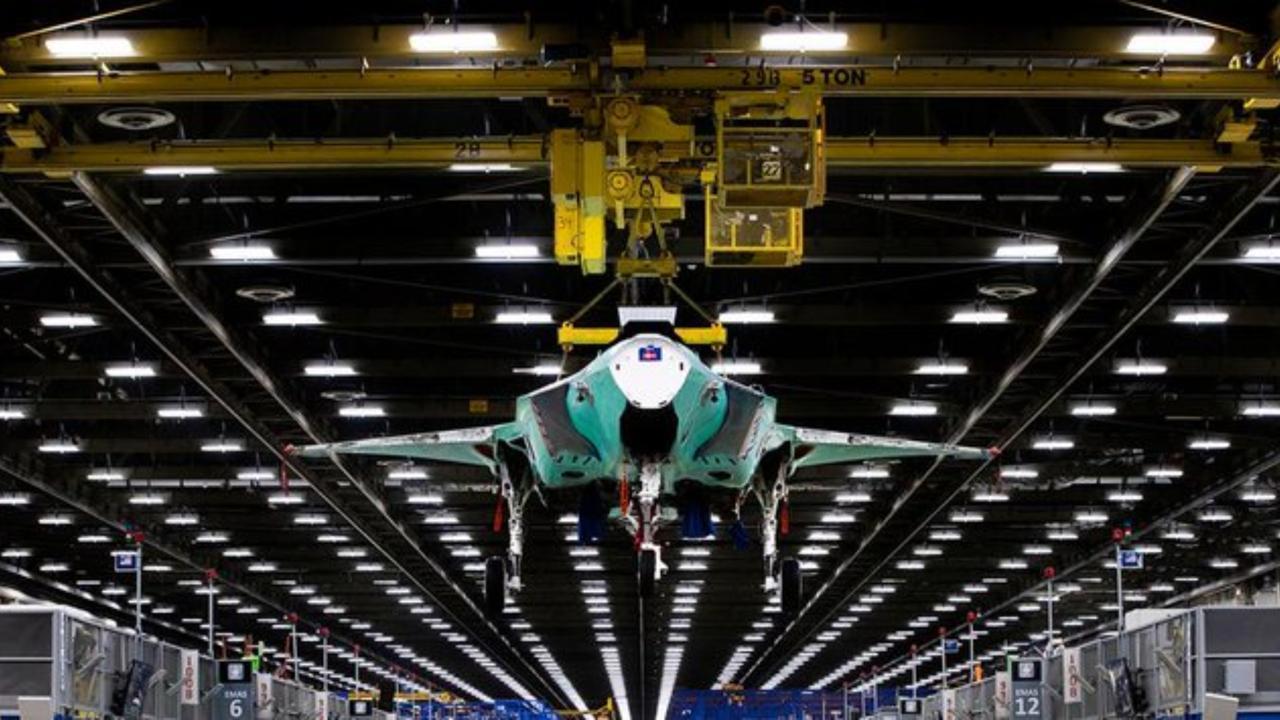
Photo : X / FlightGlobal
A Surprising Proposal from Washington
In a move that has startled both Wall Street and Washington’s defense establishment, the Trump administration is weighing a proposal to take partial government ownership in some of the United States’ most critical defense companies. The idea, circulating in late-stage policy discussions, is driven by growing concerns about the fragility of supply chains, the financial pressures on defense contractors, and the looming shadow of global competition in advanced military technologies.
At its core, the proposal reflects a striking reversal of decades-long American orthodoxy that government should stay out of corporate boardrooms. Yet to its backers, the concept is less about ideology and more about survival—ensuring the nation’s ability to produce weapons, aircraft, missiles, and advanced defense systems without disruption.
A Radical Departure from Tradition
The United States has historically relied on private enterprise to run its defense industry, with the Pentagon acting as a powerful buyer rather than a shareholder. For decades, this model was viewed as a cornerstone of American capitalism, in sharp contrast to nations like China or Russia, where governments directly control defense conglomerates.
But recent crises—ranging from supply chain breakdowns during the COVID-19 pandemic to semiconductor shortages and inflationary cost spikes—have rattled confidence in the resilience of the defense base. The administration’s floated plan suggests Washington may be willing to break with tradition, acquiring minority stakes in strategically vital firms to keep production lines running and safeguard national security.
Supply Chain Shocks Spark Concern
Much of the momentum for the idea stems from vulnerabilities exposed over the last five years. During the pandemic, many defense companies struggled to source critical components, from microchips to specialized alloys. Smaller suppliers—often the Tier 2 or Tier 3 firms tucked deep into the supply chains—were hit especially hard, with some shutting down permanently.
Officials worry that such disruptions could cripple production of fighter jets, naval vessels, or missile defense systems at moments when geopolitical tensions are escalating. A Pentagon official, speaking anonymously, described the stakes bluntly: “If a single supplier of a critical component goes under, we risk entire weapons programs grinding to a halt. That’s not a risk we can afford when adversaries are modernizing at breakneck speed.”
Echoes of History in Wartime Controls
Although unusual by today’s standards, government intervention in defense companies is not without precedent. During World War II, Washington effectively controlled vast swathes of American industry, directing output to the war effort. In the 2008 financial crisis, the U.S. government took stakes in banks and automakers to prevent systemic collapse.
Supporters of the current proposal argue that the defense sector, too, is “too important to fail.” Unlike the financial world, however, the issue is not liquidity but resilience—ensuring factories can withstand economic shocks and geopolitical pressures.
Industry Divided Over Government Role
Reaction within the defense industry has been mixed, if not outright divided. Some executives welcome the possibility of direct government backing, particularly smaller firms that struggle with volatile contracts and razor-thin margins. For them, partial government ownership could bring stability, long-term investment, and security guarantees.
But larger defense companies are wary. They fear that government stakes could translate into interference with corporate governance, reduced flexibility, and slower decision-making. A senior executive at one aerospace giant voiced concern: “The private sector’s agility is one of America’s competitive advantages. We don’t want Washington making boardroom decisions.”
National Security at the Heart of Debate
Ultimately, the proposal’s central justification is national security. Advocates insist that the U.S. cannot afford to let critical defense companies falter, particularly as adversaries invest heavily in hypersonics, drones, and next-generation aircraft. By taking partial ownership, Washington could guarantee continuity of production, safeguard intellectual property, and prevent hostile foreign acquisitions.
Some policymakers have pointed to recent moves by China, which has accelerated its development of state-backed defense champions, as evidence that the U.S. must be equally bold. “We’re in a global race where security is measured not only in missiles but in manufacturing capacity,” said one defense policy analyst. “If our supply chains are fragile, our security is fragile.”
Critics Warn of Slippery Slope
Not everyone is convinced. Critics argue that government ownership of defense companies risks politicizing procurement, distorting markets, and setting a dangerous precedent. They warn that once Washington begins buying stakes in corporations, it may struggle to draw boundaries.
“This is a slippery slope toward industrial nationalization,” said a senior fellow at a Washington think tank. “What starts as a limited measure to protect supply chains could quickly expand into broader government control, undermining competition and innovation.”
Global Context: Allies Watching Closely
America’s allies are watching closely. In Europe, where many governments already maintain stakes in defense firms such as Airbus, BAE Systems, or Leonardo, Washington’s move would not be considered radical. In fact, some European officials have quietly suggested that U.S. participation in ownership could strengthen transatlantic defense cooperation, making joint ventures more resilient.
In Asia, however, the picture is more complex. Japan and South Korea have sought to build strong private defense industries with limited state interference. If Washington moves toward ownership, it could spark debates in those countries about whether to follow suit.
Economic Pressures Cannot Be Ignored
Behind the strategic arguments lies a harsh economic reality. Inflation has driven up material and labor costs, while budget uncertainty in Congress often leaves defense companies navigating unpredictable funding cycles. Smaller suppliers, in particular, lack the cash reserves to absorb delays or disruptions.
For the administration, partial ownership is seen as a tool to stabilize these companies, ensuring they survive downturns and remain capable of supporting major prime contractors like Lockheed Martin, Boeing, or Raytheon.
Investors and Wall Street React
Wall Street’s initial response to the floated idea has been cautious. Investors worry that government stakes could dilute returns or impose additional regulatory burdens. Defense companies, traditionally seen as stable investments due to guaranteed Pentagon spending, could become riskier if government ownership introduces political uncertainty.
Yet some analysts see potential upside. “If the government takes an equity stake, it signals long-term commitment to the defense sector,” one market strategist observed. “That could actually reassure investors that these companies won’t be allowed to fail.”
Political Calculations Enter the Equation
The proposal also carries significant political undertones. Within the Trump administration, national security hawks argue forcefully for intervention, framing it as essential to America’s global standing. Fiscal conservatives, however, bristle at the idea of expanding government’s role in the private sector, fearing it violates core principles of limited government.
On Capitol Hill, early reactions suggest partisan divides will shape the debate. Some Democrats, long supportive of industrial policy, may back the idea if it is framed as job-saving and supply chain protection. Many Republicans, traditionally champions of free markets, are more skeptical, though Trump’s own influence complicates the calculus.
Balancing Innovation with Security
One of the thorniest questions is whether partial ownership would stifle innovation. The U.S. defense industry has thrived on competition, risk-taking, and entrepreneurial energy, producing breakthroughs from stealth aircraft to GPS. Critics fear that government stakes could make firms more cautious, slowing the pace of technological progress.
Supporters counter that partial ownership need not mean control. They envision a model where the government holds minority shares, offering financial support without micromanaging. “Think of it as an insurance policy,” one advocate said. “We’re not telling companies how to build; we’re making sure they can keep building.”
Looking Ahead to Implementation
If the administration pushes forward, the mechanics of implementation remain unclear. Would Washington target only smaller suppliers, or also take stakes in major defense primes? Would ownership be permanent, or phased out once companies stabilize? Would the Pentagon or the Treasury manage the stakes?
These unanswered questions highlight the complexity of turning a provocative idea into policy. For now, the proposal remains just that—an idea, debated behind closed doors but not yet codified in legislation or executive order.
A Debate That Defines an Era
Whether or not it advances, the proposal has already ignited a larger conversation about how the United States secures its defense industrial base in an era of global uncertainty. Between fragile supply chains, rising competition, and political polarization, the traditional hands-off approach may no longer feel adequate to policymakers.
What emerges from this debate will shape not only the balance of government and business but also the nation’s ability to project power and safeguard national security in the decades to come.
The Future of Defense in a Shifting World
The Trump administration’s floated idea of partial government ownership in defense companies may never leave the policy table, but it underscores a profound reality: America’s defense is no longer just about missiles and aircraft. It is about the supply chains that build them, the companies that sustain them, and the choices leaders make to protect them.
At stake is not merely economic philosophy but the core of national security itself.
Defense companies, National security, Supply chains



Advances in Aerospace Technology and Commercial Aviation Recovery
Insights into breakthrough aerospace technologies and commercial aviation’s recovery amid 2025 chall

Defense Modernization and Strategic Spending Trends
Explore key trends in global defense modernization and strategic military spending shaping 2025 secu

Tens of Thousands Protest in Serbia on Anniversary of Deadly Roof Collapse
Tens of thousands in Novi Sad mark a year since a deadly station roof collapse that killed 16, prote

Canada PM Carney Apologizes to Trump Over Controversial Reagan Anti-Tariff Ad
Canadian PM Mark Carney apologized to President Trump over an Ontario anti-tariff ad quoting Reagan,

The ad that stirred a hornets nest, and made Canadian PM Carney say sorry to Trump
Canadian PM Mark Carney apologizes to US President Trump after a tariff-related ad causes diplomatic

Bengaluru-Mumbai Superfast Train Approved After 30-Year Wait
Railways approves new superfast train connecting Bengaluru and Mumbai, ending a 30-year demand, easi




