Post by : Amit
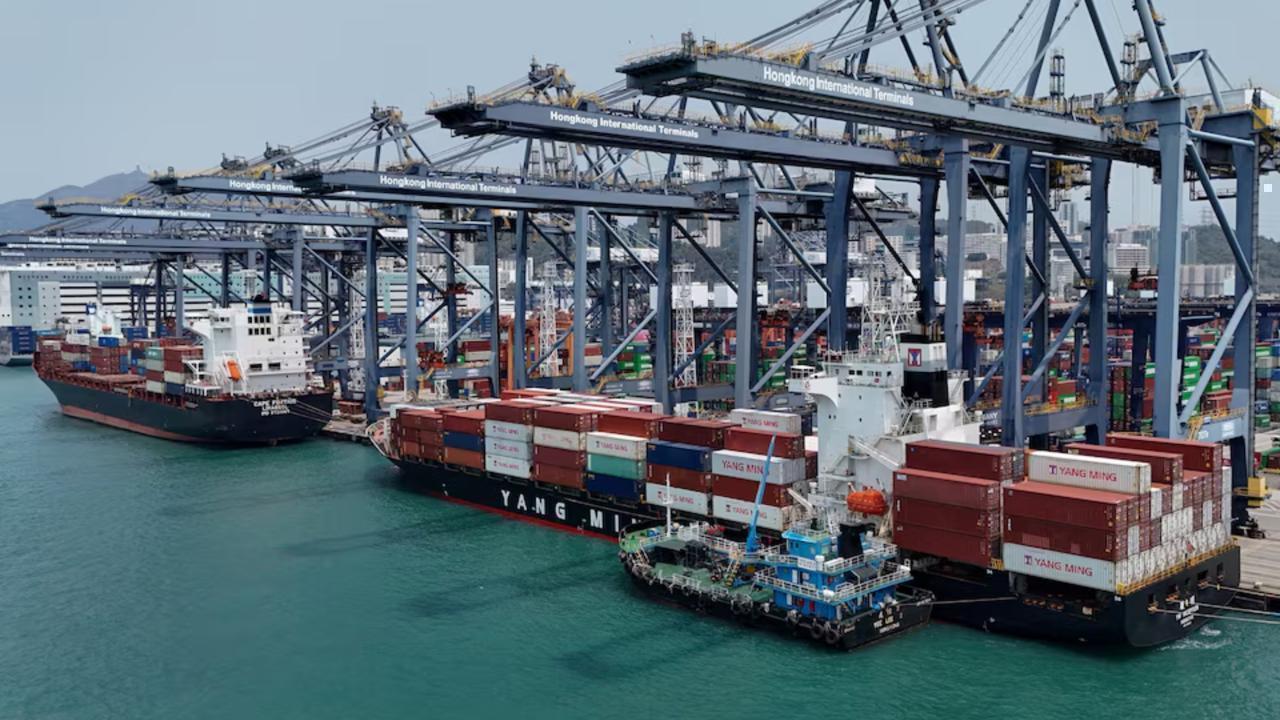
Photo : Reuters
A High-Stakes Comeback: Trade Tensions Resurface in 2025
As the world adjusts to a new economic era in 2025, the return of Donald Trump to the center stage of American politics has once again ignited a fierce debate over trade. At the heart of his revived agenda is a full-blown escalation of tariffs and a combative stance on global imports—a strategy that is beginning to ripple through global supply chains, stock markets, and industry boardrooms. This unfolding scenario marks the revival of one of Trump’s most controversial economic policies: a renewed “America First” trade war.
In late May 2025, the Trump campaign released a detailed outline of its trade war revival plan. The roadmap includes sweeping 10% tariffs on all imports into the United States, alongside significantly higher duties on specific sectors like autos, steel, semiconductors, and green energy components. Analysts and business leaders are now scrambling to assess the potential consequences on global production lines, consumer prices, and geopolitical dynamics.
A Familiar Playbook, but with New Tools
Trump’s renewed trade strategy is not merely a rerun of the 2018–2019 confrontation with China. It is more expansive, more structured, and notably more global. Unlike his first term, when China was the central target, the 2025 iteration aims at a broader list of trade partners, including the European Union, Mexico, and South Korea. These regions, according to Trump’s team, are “abusing trade advantages” through weak currencies, government subsidies, and what they call unfair labor practices.
The proposed universal 10% import tariff—if implemented—would mark a significant shift from selective duties to an across-the-board strategy. Trump advisors claim this “baseline tariff” is designed to level the playing field and fund U.S. manufacturing revitalization. However, critics warn that such a broad-based policy could backfire, spiking inflation and triggering countermeasures from trading partners.
The strategy also revives the concept of “reciprocal tariffs,” where duties mirror those imposed by other nations on U.S. exports. Trump’s campaign notes that these would “punish” countries that tax American goods at higher levels than the U.S. does theirs. While the approach is theoretically fair in principle, experts caution that it invites an endless spiral of retaliatory measures.
The Automotive Sector: First to Flinch
Perhaps the industry most rattled by the trade war revival is the automotive sector, which thrives on complex, just-in-time global supply chains. North American carmakers—many of whom source parts from Mexico, Canada, and Asia—face the immediate threat of cost escalation. According to early assessments by the Center for Automotive Research, a universal 10% import tariff could add between $1,500 and $2,500 to the cost of a typical vehicle sold in the U.S.
The effects would not only be economic but also political. Mexico and Canada are closely tied to U.S. automakers through the USMCA agreement. A tariff push could strain relations between the three North American trade partners and lead to renegotiations or retaliatory measures that could damage regional cooperation.
U.S. electric vehicle (EV) manufacturers are also sounding alarms. Many EV components—especially battery cells and rare earth elements—are imported from Asia. A tariff hike would undermine the Biden administration’s previous investments in domestic clean energy and jeopardize EV affordability at a time when adoption is just beginning to scale.
Agriculture Faces Retaliation and Uncertainty
American farmers, many of whom had already felt the sting of Chinese retaliation during the previous trade war, are again caught in the crossfire. With Trump suggesting renewed tariffs on Chinese and European goods, retaliatory measures against American agricultural exports are likely.
In 2019, soybeans, pork, and corn were among the top targets for Chinese counter-tariffs, leading to storage surpluses and government bailouts in the billions. A repeat of those conditions could wreak havoc on rural economies already struggling with inflation, climate-related crop failures, and labor shortages.
Agricultural groups, including the American Farm Bureau Federation, have issued cautionary statements. “We support fair trade, not trade wars,” a recent statement read. “Tariffs are a tax on our exports and our livelihoods.” The group warns that without export market stability, farm incomes could dip below sustainable levels in 2026.
Tech Sector Braces for Supply Chain Shakeup
The U.S. tech industry—particularly semiconductor firms and hardware manufacturers—may bear a disproportionate share of the fallout. During the first trade war, tariffs on Chinese-made circuit boards, smartphones, and processors led to a spike in hardware costs and supply chain fragmentation.
In 2025, as the tech sector relies even more heavily on transnational supply networks, the universal 10% tariff threatens to disrupt not just imports but innovation cycles. Companies like Apple, Nvidia, and Qualcomm may be forced to shift production or accelerate reshoring efforts, a process that is expensive, time-consuming, and logistically complex.
Industry lobbying groups are already mobilizing. The Information Technology Industry Council (ITI) has urged Congress to block any unilateral tariff plans, calling the move “regressive, inflationary, and damaging to U.S. competitiveness in emerging tech sectors.”
Global Response: Trade Allies Push Back
The European Union, which faced tariffs on steel and aluminum under Trump’s first term, has not taken the new proposals lightly. EU trade commissioner Maria Zakharova has called the plan “economic nationalism in hyperdrive” and warned that any tariff increases would be met with proportionate retaliation.
South Korea, another major U.S. trade partner, has hinted at raising barriers on U.S. electronics, agriculture, and autos if its exports are hit. Meanwhile, Mexico has requested urgent consultations under the terms of the USMCA, fearing damage to its automotive and manufacturing exports, which are deeply integrated with U.S. buyers.
China has remained somewhat muted in its response, though analysts suggest Beijing is likely to wait until post-election clarity before escalating or negotiating. However, state-controlled media has criticized the “short-sightedness” of U.S. protectionism and hinted at efforts to deepen trade with Europe, Africa, and Southeast Asia in response.
The Inflation Equation
One of the most urgent concerns about Trump’s tariff push is its potential to revive inflation just as the U.S. Federal Reserve begins to stabilize interest rates. Tariffs act as consumption taxes—they increase the cost of imported goods, and that cost is often passed on to consumers.
In the current economic context, where inflation has been gradually cooling, a tariff-induced price surge could undo months of monetary policy progress. Economists at Moody’s Analytics estimate that the 10% blanket tariff could increase overall consumer inflation by 1.2% within the first 12 months of implementation.
This scenario places the Federal Reserve in a bind—either tolerate higher inflation or resume interest rate hikes that could slow economic growth and hiring.
Political Implications and the 2026 Outlook
The trade war redux is as much about politics as it is about economics. Trump’s base largely supports protectionist policies, viewing them as a defense against job outsourcing and unfair foreign competition. However, the broader electorate—especially independents and suburban voters—may not be as tolerant if tariffs result in higher prices for cars, electronics, and groceries.
Democrats, meanwhile, are divided. While some support selective tariffs to protect strategic industries, others argue that a broad-based approach will hurt working families and provoke unnecessary diplomatic strife.
The outcome of the 2026 midterm elections may well determine whether this trade war blueprint becomes permanent policy or fizzles under legislative gridlock.
Can Global Trade Withstand the Shock?
As the global economy becomes increasingly interconnected, a shift back toward isolationist trade policy could undermine years of supply chain optimization. Companies that had begun to re-stabilize after COVID-19 disruptions now face renewed uncertainty.
For now, Trump’s plan remains a campaign proposal—but one with enough detail, precedent, and political traction to merit serious attention. Businesses across sectors are preparing contingency plans, reassessing their supplier bases, and lobbying lawmakers in hopes of averting an all-out trade showdown.
Whether this new trade war is ultimately enacted, negotiated down, or sidestepped entirely, one thing is clear: global supply chains are once again entering a period of heightened volatility—and every link in the chain will be tested.
Trump, Trade Shipping, Logistics, Usa



Advances in Aerospace Technology and Commercial Aviation Recovery
Insights into breakthrough aerospace technologies and commercial aviation’s recovery amid 2025 chall

Defense Modernization and Strategic Spending Trends
Explore key trends in global defense modernization and strategic military spending shaping 2025 secu

Tens of Thousands Protest in Serbia on Anniversary of Deadly Roof Collapse
Tens of thousands in Novi Sad mark a year since a deadly station roof collapse that killed 16, prote

Canada PM Carney Apologizes to Trump Over Controversial Reagan Anti-Tariff Ad
Canadian PM Mark Carney apologized to President Trump over an Ontario anti-tariff ad quoting Reagan,

The ad that stirred a hornets nest, and made Canadian PM Carney say sorry to Trump
Canadian PM Mark Carney apologizes to US President Trump after a tariff-related ad causes diplomatic

Bengaluru-Mumbai Superfast Train Approved After 30-Year Wait
Railways approves new superfast train connecting Bengaluru and Mumbai, ending a 30-year demand, easi




