Post by : Amit
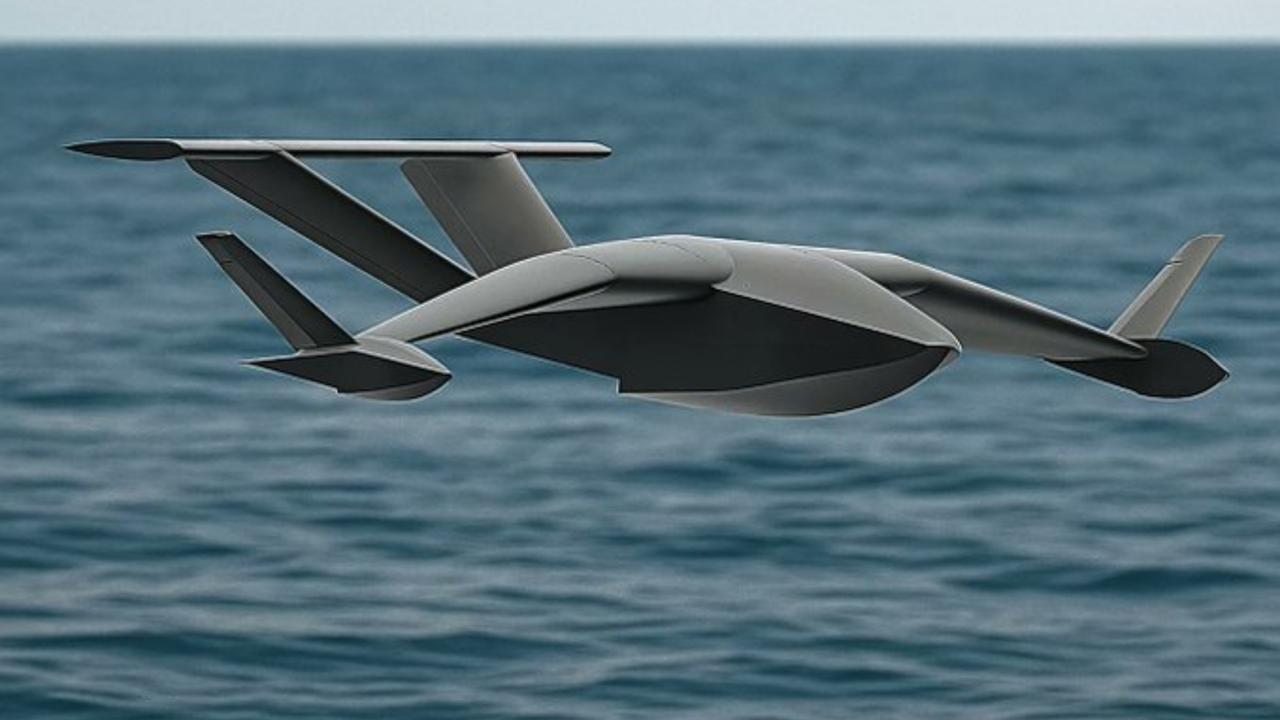
Photo : X / Parasizceo
A Revolutionary Leap in Maritime Warfare
In a development that could reshape the global naval defense landscape, Turkey has revealed what it calls the world’s first production-ready sea-skimming combat drone. Built on the principle of a wing-in-ground (WIG) effect craft, this stealthy platform is designed to fly just meters above the water’s surface, effectively blending the speed of an aircraft with the low-detectability of a maritime skimmer.
Turkish defense officials presented the drone as a breakthrough that no other military — including the United States, Russia, or China — has yet fielded in an operational, production-ready form.
The WIG effect allows an aircraft to take advantage of aerodynamic lift when flying close to a surface, typically water, reducing drag and increasing fuel efficiency. This makes the new drone faster and more energy-efficient than conventional seaplanes or patrol boats, while also reducing radar visibility. Cold War powers explored the concept in the 1960s and 1970s, most famously through Soviet “Ekranoplan” projects, but those efforts were hampered by technical and cost challenges. Turkey’s achievement marks the first time it has been realized in a fully autonomous, combat-ready platform.
Combining Stealth and Speed at Sea Level
Flying at altitudes of just one to five meters above the water, the drone effectively disappears beneath traditional radar horizons. Naval radar systems — even those on advanced destroyers — often struggle to detect sea-skimming targets until they are dangerously close. This gives the platform a unique edge in conducting surprise attacks, intelligence gathering, and covert resupply missions.
Turkish engineers have paired the low-altitude profile with a stealth-shaped fuselage coated in radar-absorbing composite materials. The craft reportedly carries an advanced electronic countermeasures suite, designed to jam enemy radar and disrupt incoming missile guidance. Officials say the drone can reach speeds exceeding 300 kilometers per hour and is capable of carrying payloads such as precision-guided munitions, small cruise missiles, or advanced electro-optical surveillance systems.
Defense insiders note that its twin-use design — capable of switching between strike and reconnaissance roles — makes it particularly attractive for countries with limited naval aviation assets.
Strategic Uses and Mission Profiles
The combat drone’s potential applications are broad. In a maritime strike role, it could launch anti-ship missiles or loitering munitions at coastal targets before adversaries have time to respond. In an intelligence, surveillance, and reconnaissance (ISR) role, it could shadow enemy fleets, gather targeting data, or scout amphibious landing zones.
Its low flight profile also makes it ideal for high-risk logistical missions — delivering critical supplies, communications gear, or even small drones to frontline units or special operations teams without alerting hostile radar.
Military analysts point out that the drone could also be deployed in “swarm” tactics, releasing multiple units simultaneously to overwhelm enemy air defenses. This concept is particularly relevant in contested zones such as the Aegean Sea, the Eastern Mediterranean, or strategically vital maritime chokepoints like the Strait of Hormuz or Bab el-Mandeb.
A Product of Turkey’s Expanding Defense Industry
The unveiling is the latest in a string of high-profile Turkish defense projects, following the global success of the Bayraktar TB2 and Akinci drones. Over the last decade, Turkey’s defense sector has evolved from a regional supplier to a global player, leveraging indigenous design, state-backed R&D programs, and combat testing in live operational theaters.
The sea-skimming drone expands Turkey’s unmanned portfolio into the maritime domain, complementing its naval modernization program, which includes advanced frigates, new-generation submarines, and an amphibious assault ship capable of operating UAVs.
This project also underscores Ankara’s drive for defense self-sufficiency — a priority reinforced by past arms embargoes that have limited access to certain Western technologies. Officials say the program relied heavily on domestically produced avionics, propulsion systems, and composite materials to avoid foreign supply chain vulnerabilities.
International Reactions and Security Implications
The announcement has sparked global interest. NATO defense planners see potential in the platform as a cost-effective force multiplier, particularly for littoral defense and quick-reaction maritime strike forces.
However, potential adversaries are viewing the system as a disruptive threat. In the Eastern Mediterranean, tensions over maritime boundaries, energy exploration rights, and naval presence have already pitted Turkey against Greece, Cyprus, and several EU member states. The arrival of a stealthy, low-altitude strike drone could alter the balance of deterrence in the region.
In Asia, military observers in the South China Sea region have noted that such drones could be adapted for archipelagic defense, anti-piracy patrols, or contested reef monitoring. For Russia, which once invested heavily in manned WIG craft, Turkey’s success is a reminder of how unmanned systems can leapfrog traditional aviation development cycles.
Technical and Operational Unknowns
Despite the excitement, defense experts caution that several performance questions remain unanswered. Key unknowns include:
Another challenge will be integrating the drone into existing naval command-and-control frameworks, ensuring that it can operate alongside manned aircraft, surface vessels, and sub-surface assets without risking friendly fire incidents.
Turkish defense officials have confirmed that initial sea trials were successful and that operational testing with the Turkish Navy is planned for the coming year. No production schedule or unit pricing has been released.
Turkey’s Edge in Drone Innovation
Turkey’s UAV programs have benefited from an iterative development approach, deploying prototypes in active conflict zones and using real-world feedback to refine designs rapidly. This willingness to accept operational risk has allowed Turkish engineers to innovate faster than many Western defense contractors bound by lengthy acquisition cycles.
If the sea-skimming drone follows this path, it could see incremental upgrades in payload capacity, endurance, and autonomous navigation software within just a few years. Its AI-assisted flight controls and satellite communication links could enable networked operations with other Turkish drones, forming a multi-domain strike capability that integrates land, air, and maritime platforms.
Potential Export Market
Industry analysts believe there is significant export potential for the platform. Countries with long coastlines, island chains, or persistent maritime security threats could see value in an affordable, low-detectability strike and surveillance system.
Potential markets include Southeast Asian states facing Chinese expansion in the South China Sea, Gulf nations protecting offshore oil infrastructure, and African coastal states combating piracy and illegal fishing.
As with other advanced UAVs, sales will likely be shaped by geopolitical considerations, alliance commitments, and Turkey’s willingness to transfer sensitive technology.
Historical Context: From Soviet Giants to Turkish Drones
While the WIG effect is not new, its military applications have been limited. The Soviet Union’s massive “Caspian Sea Monster” in the 1960s proved the concept’s speed and lift efficiency but suffered from cost, maintenance, and weather limitations. Later, smaller experimental craft were tested by the U.S. Navy and Japanese engineers, but none reached full-scale production.
By applying modern UAV technologies — lightweight composites, autonomous flight controls, miniaturized radar, and efficient propulsion — Turkey has effectively sidestepped many of the challenges that plagued earlier projects. The result is a smaller, unmanned platform that is cheaper to build, easier to maintain, and capable of missions impossible for its Cold War predecessors.
A New Chapter in Naval Warfare
If the Turkish sea-skimming drone lives up to its operational promises, it could prompt a doctrinal rethink in navies worldwide. Traditional anti-ship missile defenses — optimized for high-altitude bombers, large surface combatants, and submarines — may not be as effective against radar-evading WIG drones.
Navies might respond by investing in:
For Turkey, the platform is both a technological statement and a strategic tool. It positions the country as a pioneer in unmanned maritime strike technology and offers a new dimension to its drone warfare capabilities.
As production ramps up and operational trials progress, the world will be watching closely to see whether this innovation remains a niche specialty or becomes a globally adopted naval standard.
Turkey, War drone



Advances in Aerospace Technology and Commercial Aviation Recovery
Insights into breakthrough aerospace technologies and commercial aviation’s recovery amid 2025 chall

Defense Modernization and Strategic Spending Trends
Explore key trends in global defense modernization and strategic military spending shaping 2025 secu

Tens of Thousands Protest in Serbia on Anniversary of Deadly Roof Collapse
Tens of thousands in Novi Sad mark a year since a deadly station roof collapse that killed 16, prote

Canada PM Carney Apologizes to Trump Over Controversial Reagan Anti-Tariff Ad
Canadian PM Mark Carney apologized to President Trump over an Ontario anti-tariff ad quoting Reagan,

The ad that stirred a hornets nest, and made Canadian PM Carney say sorry to Trump
Canadian PM Mark Carney apologizes to US President Trump after a tariff-related ad causes diplomatic

Bengaluru-Mumbai Superfast Train Approved After 30-Year Wait
Railways approves new superfast train connecting Bengaluru and Mumbai, ending a 30-year demand, easi




