Post by : Amit
Photo : X / U.S. Coast Guard
America’s Polar Presence Gets a Boost
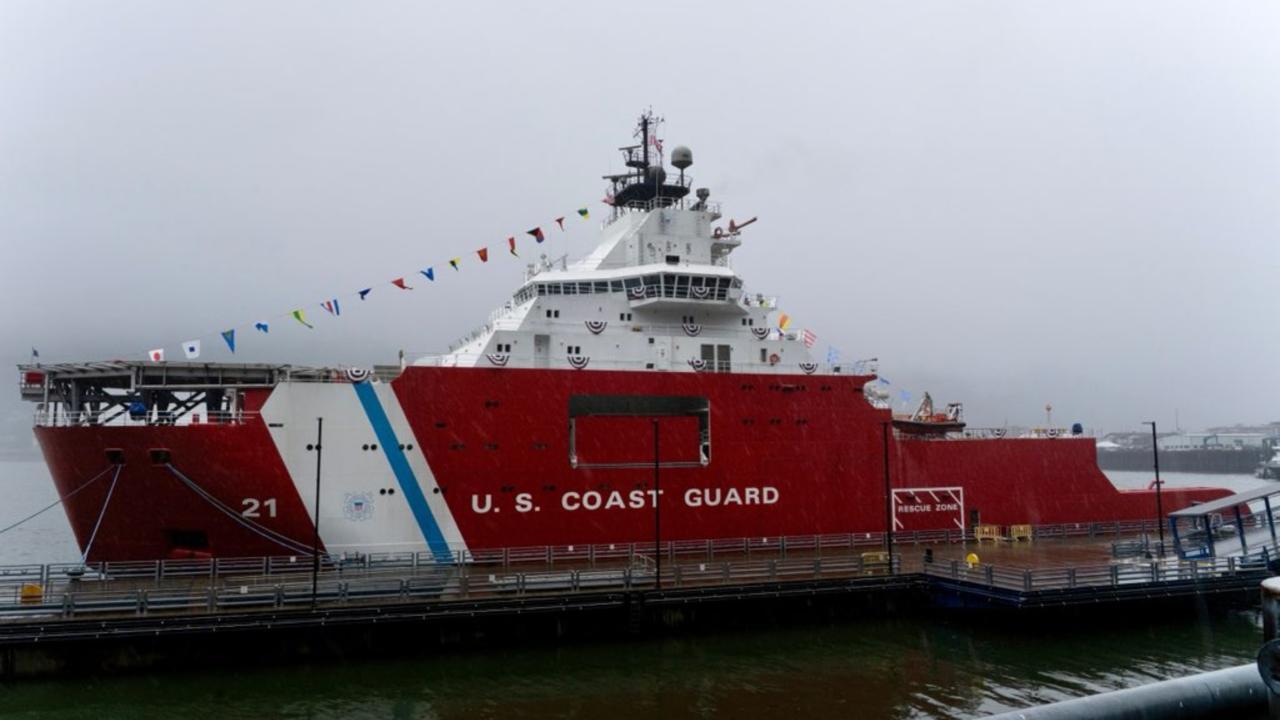
In a move signaling Washington’s renewed commitment to Arctic readiness, the U.S. Coast Guard has officially re-commissioned the privately built icebreaker Aiviq into active military service as the USCGC Storis. The transition marks a significant leap in America’s polar operational capacity at a time when the region’s strategic and commercial importance is rapidly rising. The re-commissioning ceremony, held with full military honors, underscored the vessel’s shift from a commercial asset to a front-line tool in the Coast Guard’s mission to safeguard U.S. interests in the high latitudes.
From Offshore Workhorse to Polar Sentinel
Originally launched in 2012 by Edison Chouest Offshore as an offshore supply and icebreaking vessel, Aiviq was purpose-built to support oil exploration in the Arctic’s harsh environment. With an ice-class hull, immense pulling power, and systems designed for extreme conditions, it quickly became one of the most capable privately owned ice-capable ships in the world. However, following the slowdown in Arctic oil operations, Aiviq’s full potential remained underutilized—until the Coast Guard stepped in.
Renamed USCGC Storis in honor of the legendary cutter that served from 1942 to 2007, the ship’s re-commissioning represents not just a name change but a transformation of purpose. The original Storis famously became the first American vessel to circumnavigate North America via the Northwest Passage. By reviving the name, the Coast Guard is signaling a continuation of that legacy of Arctic exploration and presence.
A Strategic Answer to the Icebreaker Gap
For years, U.S. policymakers and defense experts have warned of a “capability gap” in America’s icebreaking fleet. Currently, the Coast Guard operates just two heavy icebreakers—one of which, the Polar Star, is over 45 years old. This stands in stark contrast to Russia’s vast fleet of more than 40 ice-capable ships, including nuclear-powered heavy icebreakers. With the Arctic becoming increasingly navigable due to climate change, the race for access to shipping routes, fisheries, and natural resources is intensifying.
The re-commissioning of the Storis gives the U.S. a much-needed operational bridge while it awaits the delivery of new Polar Security Cutters, the first of which is not expected before the late 2020s. The move is not just about numbers—it’s about having the right vessel in the right place at the right time.
Technical Capabilities for Polar Missions
Measuring approximately 360 feet in length and displacing over 16,000 tons, USCGC Storis is equipped with four powerful diesel engines capable of producing more than 22,000 horsepower. Its reinforced hull allows it to break through thick ice, enabling year-round Arctic and Antarctic missions. The vessel also features advanced navigation and communication systems designed for the challenging polar environment, where magnetic compasses are unreliable and satellite connectivity is often limited.
The ship’s design allows for multi-mission flexibility, from search-and-rescue operations and scientific research to law enforcement and logistical support for remote communities. It can carry substantial cargo, support helicopters, and host scientific laboratories—making it a critical asset not just for defense, but for environmental monitoring and international cooperation.
Aligning with National Security Priorities
The Biden administration’s 2022 Arctic strategy emphasizes safeguarding U.S. sovereignty, protecting the environment, and working with allies to ensure the Arctic remains peaceful and open. The re-commissioning of the Storis directly supports these goals, enhancing the Coast Guard’s ability to project presence and respond to crises in a region where the U.S. is playing catch-up.
Admiral Linda Fagan, Commandant of the Coast Guard, called the vessel’s entry into service “a decisive step forward” in closing the icebreaker gap. “With the Storis, we’re not just adding a ship,” she said during the commissioning ceremony. “We’re adding capability, endurance, and a platform for cooperation with our Arctic partners.”
Economic and Environmental Stakes
The Arctic is estimated to hold 13% of the world’s undiscovered oil and 30% of its untapped natural gas. Beyond hydrocarbons, it offers rich fisheries and newly accessible maritime trade routes that could cut thousands of miles from global shipping. The Northern Sea Route along Russia’s coast, for example, is already seeing increased use by commercial operators seeking faster transit between Asia and Europe.
However, the environmental stakes are equally high. Melting ice is disrupting ecosystems, threatening indigenous communities’ way of life, and accelerating global climate change. The Storis will be vital in enforcing environmental laws, conducting pollution response operations, and supporting scientific studies aimed at mitigating these impacts.
A Legacy Name with Renewed Purpose
Naming the ship Storis was no accident. The original cutter of that name became a symbol of U.S. Arctic presence, serving through World War II, Cold War patrols, and peacetime scientific missions. Its decommissioning in 2007 left a symbolic and operational void. By bringing the name back, the Coast Guard is honoring that history while adapting it to the 21st-century Arctic’s complex realities.
Industry and International Collaboration
The transition from Aiviq to Storis was made possible through close cooperation between the Coast Guard and Edison Chouest Offshore. The ship underwent modifications to meet military requirements, including enhanced communications security, upgraded crew accommodations, and expanded mission support systems.
The Storis is also expected to operate alongside allied icebreakers from Canada, Finland, and other Arctic nations. Joint exercises, information sharing, and port visits will help strengthen the network of countries committed to maintaining open and secure polar waters.
Bridging to the Future Fleet
While the Storis is a powerful interim solution, it is not a replacement for the forthcoming Polar Security Cutters, which will be purpose-built for extended heavy icebreaking. However, its availability now means that the Coast Guard will be better prepared to address immediate challenges, from supporting scientific missions in the Arctic Ocean to escorting supply ships to isolated Alaskan villages.
A Visible Commitment in a Changing Arctic
The re-commissioning of the USCGC Storis comes at a time when the Arctic is shifting from a remote frontier to a center of global attention. With geopolitical competition, climate change, and economic opportunity converging, the region demands capable vessels and experienced crews. The Storis will be at the forefront of this effort, embodying both America’s maritime heritage and its forward-looking strategy.
As one Coast Guard officer put it at the ceremony: “The Arctic is no longer a distant horizon—it’s our neighborhood. And the Storis is here to make sure we can look after it.”
USCGC Storis, U.S. Coast Guard icebreaker



Advances in Aerospace Technology and Commercial Aviation Recovery
Insights into breakthrough aerospace technologies and commercial aviation’s recovery amid 2025 chall

Defense Modernization and Strategic Spending Trends
Explore key trends in global defense modernization and strategic military spending shaping 2025 secu

Tens of Thousands Protest in Serbia on Anniversary of Deadly Roof Collapse
Tens of thousands in Novi Sad mark a year since a deadly station roof collapse that killed 16, prote

Canada PM Carney Apologizes to Trump Over Controversial Reagan Anti-Tariff Ad
Canadian PM Mark Carney apologized to President Trump over an Ontario anti-tariff ad quoting Reagan,

The ad that stirred a hornets nest, and made Canadian PM Carney say sorry to Trump
Canadian PM Mark Carney apologizes to US President Trump after a tariff-related ad causes diplomatic

Bengaluru-Mumbai Superfast Train Approved After 30-Year Wait
Railways approves new superfast train connecting Bengaluru and Mumbai, ending a 30-year demand, easi




