Post by : Amit
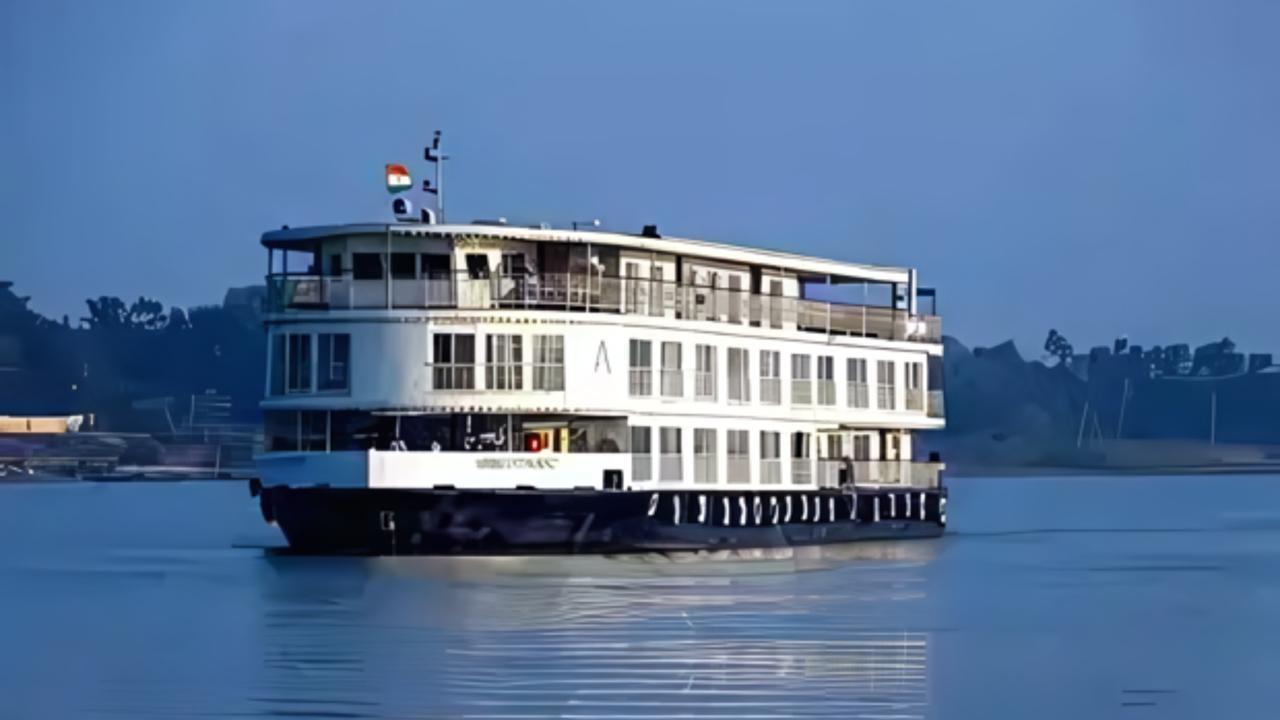
Photo : X / India & The World
Varanasi – A silent revolution is flowing through the rivers of Uttar Pradesh—one that could redefine the logistics and trade infrastructure of North India. Under the ambitious Sagarmala Programme, the state has accelerated work on several key Inland Water Transport (IWT) projects, aiming to transform the Ganga River and its tributaries into thriving economic corridors.
While India’s vast river network remains vastly underutilized, this initiative promises to correct decades of infrastructural neglect and shift cargo loads from overburdened highways and railways to cost-effective, eco-friendly waterways. For Uttar Pradesh, home to nearly 240 million people and a central player in national agriculture and manufacturing, inland water transport could be the missing link in its economic puzzle.
Sagarmala in Action: Building a River Economy
Launched by the Ministry of Ports, Shipping and Waterways, the Sagarmala Programme is India’s flagship initiative to modernize maritime infrastructure, reduce logistics costs, and promote port-led development. While much of its early focus was on coastal states, inland states like Uttar Pradesh are now gaining attention—thanks to their strategic location along National Waterway-1 (NW-1), the Ganga-Bhagirathi-Hooghly river system.
The Inland Waterways Authority of India (IWAI), in coordination with the UP government, has been rolling out a series of riverine infrastructure projects to build multi-modal terminals, floating jetties, cargo-handling hubs, and passenger ferry stations. Together, these efforts are aimed at converting the 1,620-km NW-1 stretch into a high-capacity, navigable channel.
Projects: Where the Work is Happening
Among the most notable developments currently underway:
1. Varanasi Multi-Modal Terminal (VMMT):
The VMMT is operational and already functioning as a key cargo gateway on NW-1. Designed to handle over 1.2 million metric tonnes of cargo annually, the terminal is crucial for linking Eastern UP with ports in Kolkata and Haldia. It includes container handling facilities, warehousing, parking, and road-rail connectivity.
2. Ghazipur and Kalughat Terminals:
These upcoming terminals will cater to the growing cargo movement across the Bihar-UP border. Ghazipur is being developed as an integrated cargo hub, with plans to link it to major agricultural mandis.
3. Floating Jetties in Prayagraj, Ballia, and Chunar:
These modular, low-impact structures are vital for connecting smaller cargo vessels and local ferry routes. They provide easy access to rural areas, where traditional transport infrastructure is limited.
4. Passenger Terminals in Ramnagar and Kashi:
A major push is being made toward passenger transport as well. Ferry terminals are being developed to enable eco-tourism, intercity river travel, and pilgrim routes during peak festivals and religious gatherings like the Kumbh Mela.
5. IWAI’s Centre of Excellence in Varanasi:
This newly announced research and training centre will focus on river hydrodynamics, cargo handling technology, and green shipping solutions—positioning Varanasi as an inland waterway innovation hub.
A Logistics Gamechanger: Lower Costs, Greener Future
Why does this matter? Because inland water transport is up to 60% cheaper than road freight and 30% more energy-efficient than rail, according to estimates from the NITI Aayog and the World Bank.
For a landlocked but resource-rich state like Uttar Pradesh, this could unlock enormous trade potential across sectors such as:
Moreover, river transport significantly reduces road congestion, fuel consumption, and vehicular emissions, aligning with India’s COP26 climate commitments.
Farmers and Industries to Benefit
At the ground level, the impact could be transformative. Farmers in Eastern UP, long hampered by poor market access and high transport costs, will be able to move their produce to large mandis and ports with less spoilage and cost.
Industrial units in districts like Chandauli, Mirzapur, and Bhadohi, known for carpets, handicrafts, and ceramics, will gain quicker access to eastern ports and export markets. Many such clusters lie within 20–30 kilometers of NW-1, making river freight a natural logistics solution.
Voices from the Field
Speaking at a recent event in Varanasi, Union Minister Sarbananda Sonowal emphasized, “Uttar Pradesh is key to the inland waterway revolution. By turning our rivers into commerce highways, we are making a bold shift in how India moves goods.”
UP Transport Minister Daya Shankar Singh echoed the sentiment, adding, “We are working to integrate waterways with road, rail, and air networks, especially around cargo hubs and industrial zones.”
Local entrepreneur Vishal Yadav, who runs a ceramic unit in Bhadohi, said, “If I can ship my tiles to Kolkata by river instead of truck, I’ll save 15–20% on transport. That’s the difference between profit and loss for small businesses like ours.”
Depth, Dredging, and Bureaucracy
Despite the optimism, experts caution that a number of operational challenges must still be overcome for the IWT dream to fully materialize:
Still, IWAI officials say new technologies, like hydrographic mapping and modular barge designs, are helping navigate these obstacles.
UP’s Inland Ports in the Making
The UP government is also preparing for the future by identifying new potential terminal sites along NW-1 and other rivers like the Yamuna and Ghaghara. A plan to link Kanpur and Prayagraj via inland ferries is under review, with potential expansion toward Agra.
Efforts are also underway to integrate IWT into UP’s broader logistics strategy, especially in conjunction with:
These multi-modal connections would allow cargo to shift seamlessly between river, rail, and road—greatly enhancing speed and efficiency.
A Model for Other Inland States
Uttar Pradesh’s IWT push is being closely watched by other inland states like Bihar, Madhya Pradesh, and Jharkhand. If successful, it could become a template for scalable riverine logistics across the Hindi heartland.
Already, interest is picking up among private logistics players and barge operators, who are eyeing the Ganga corridor as the next big logistics route after India’s coastal highways.
According to the Federation of Indian Chambers of Commerce & Industry (FICCI), inland water transport has the potential to carry up to 20% of India’s freight load by 2035, up from the current 2%. UP is seen as central to achieving that.
Cultural and Ecological Considerations
Given the Ganga’s cultural and ecological significance, there’s also a strong focus on sustainable practices and green tech adoption.
New barge designs with electric or LNG propulsion, waste-management systems at terminals, and zero-discharge regulations are being incorporated to protect the river’s health.
Environmental Impact Assessments (EIAs) are mandatory for major terminals, and NGOs have been invited to participate in oversight and river monitoring.
The Road—Or River—ahead
With several projects nearing completion and more on the drawing board, the next 2–3 years will be critical in shaping Uttar Pradesh’s inland water transport ecosystem.
If successfully executed, this quiet riverine movement could deliver a rare convergence of economic upliftment, environmental sustainability, and cultural revival. It offers a chance to bring back India’s ancient tradition of river trade—once central to its civilization—and adapt it to modern economic realities.
As the cargo barges begin to glide through the Ganga with increasing frequency, Uttar Pradesh may very well redefine how Bharat moves its goods in the 21st century.
The river, once again, is becoming a lifeline.
Uttar Pradesh, Water Transport, Sagarmala



Advances in Aerospace Technology and Commercial Aviation Recovery
Insights into breakthrough aerospace technologies and commercial aviation’s recovery amid 2025 chall

Defense Modernization and Strategic Spending Trends
Explore key trends in global defense modernization and strategic military spending shaping 2025 secu

Tens of Thousands Protest in Serbia on Anniversary of Deadly Roof Collapse
Tens of thousands in Novi Sad mark a year since a deadly station roof collapse that killed 16, prote

Canada PM Carney Apologizes to Trump Over Controversial Reagan Anti-Tariff Ad
Canadian PM Mark Carney apologized to President Trump over an Ontario anti-tariff ad quoting Reagan,

The ad that stirred a hornets nest, and made Canadian PM Carney say sorry to Trump
Canadian PM Mark Carney apologizes to US President Trump after a tariff-related ad causes diplomatic

Bengaluru-Mumbai Superfast Train Approved After 30-Year Wait
Railways approves new superfast train connecting Bengaluru and Mumbai, ending a 30-year demand, easi




