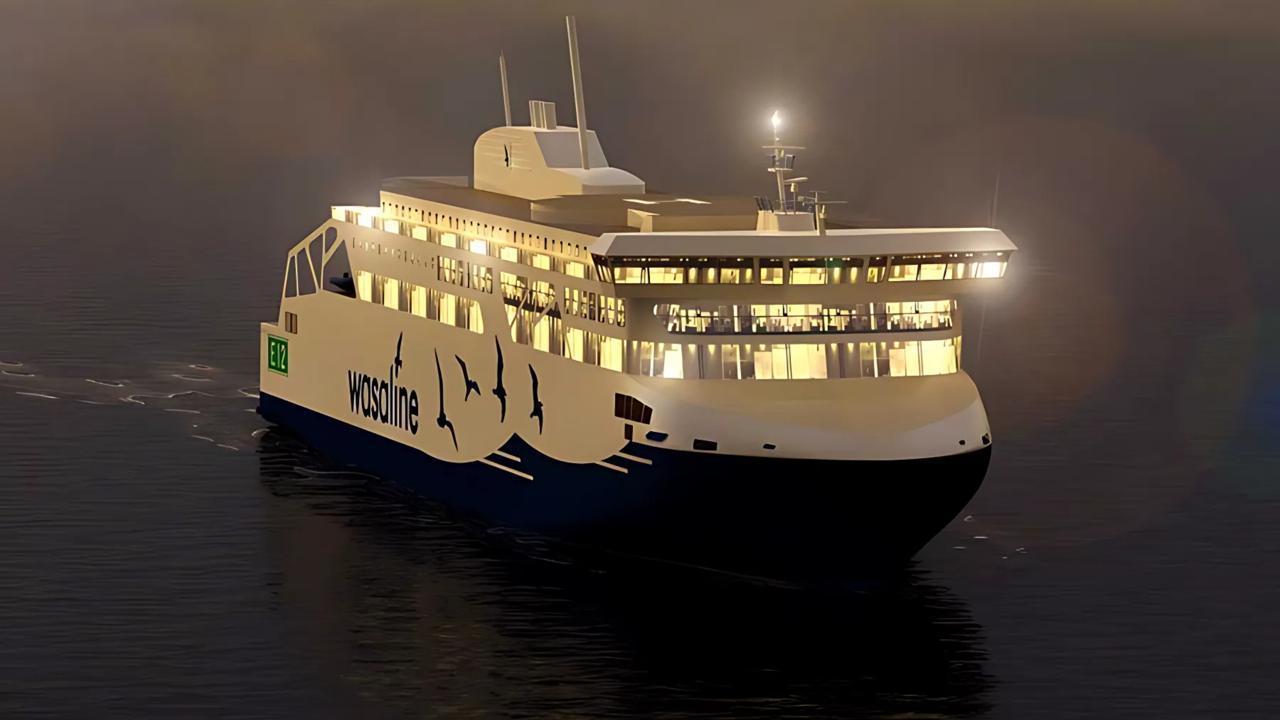
Post by : Amit
Photo : X / DNV - Maritime
Pioneering Sustainability in the Baltic
In a bold move that could reshape the environmental future of the Baltic Sea, Finnish-Swedish ferry operator Wasaline has announced plans to become the region’s first fully carbon-neutral shipping company. The initiative, unveiled in collaboration with Finnish energy company Wärtsilä and several environmental research partners, is part of a larger push across Europe’s maritime industry to meet and surpass international climate targets.
Wasaline’s primary route, connecting Vaasa in Finland to Umeå in Sweden, is already recognized for its efficiency and use of modern vessels like the Aurora Botnia. But the company’s new ambition takes its environmental commitment to the next level — aiming to completely eliminate net greenhouse gas emissions within a defined timeframe.
The strategy is built on a combination of advanced biofuels, battery-electric hybrid propulsion, and improved energy efficiency measures both onboard and ashore. According to Wasaline’s leadership, the shift toward carbon neutrality is not only a climate responsibility but also a competitive advantage in a market where sustainability increasingly shapes passenger and cargo choices.
The Road to Carbon Neutrality
Wasaline’s journey toward carbon neutrality began years before this formal announcement. The 2021 launch of Aurora Botnia was a significant milestone. Built at Rauma Marine Constructions, the ferry was designed as one of the most eco-friendly vessels in its class, featuring dual-fuel engines capable of running on liquefied natural gas (LNG) and biogas, coupled with battery packs to reduce fuel consumption during maneuvers and in port.
Now, the company plans to transition entirely to renewable biofuels and increase reliance on green electricity for charging its hybrid systems. This means replacing LNG with liquefied biogas (LBG) sourced from waste and agricultural byproducts, a change expected to drastically reduce lifecycle carbon emissions.
Another critical element is shore power connectivity. In both Vaasa and Umeå, port facilities are being upgraded to allow vessels to plug into the local electrical grid — ideally supplied by renewable energy — during layovers, eliminating emissions from idling engines.
Partnership With Wärtsilä and Green Tech Providers
The transition plan benefits from Wasaline’s close partnership with Wärtsilä, a Finnish technology group specializing in maritime propulsion and energy systems. Wärtsilä has committed to providing next-generation engine upgrades, advanced energy storage solutions, and real-time performance monitoring tools to maximize fuel efficiency.
Additionally, Wasaline is engaging with research institutes in Finland and Sweden to test emerging maritime fuels such as e-methanol and ammonia for future adaptability. While these fuels are not immediately part of the company’s plan, their potential as scalable, zero-emission alternatives ensures that Wasaline can stay ahead of regulatory and market shifts.
Meeting International and Regional Climate Goals
The International Maritime Organization (IMO) has set a target to reduce shipping emissions by at least 50% by 2050 compared to 2008 levels, with many nations pushing for net-zero. The European Union’s Fit for 55 package and its FuelEU Maritime regulation go even further, mandating stricter emission reduction timelines for vessels operating in European waters.
By positioning itself as an early adopter, Wasaline not only complies with these rules but also gains operational resilience against future regulatory tightening. The move is especially significant in the Baltic Sea, designated as a special emission control area (SECA) with strict sulfur and nitrogen oxide limits.
Financial Viability and Passenger Experience
While sustainability investments often raise concerns about operational costs, Wasaline’s management believes that efficiency gains and brand positioning will offset the expenses. The company expects lower long-term fuel costs through biofuel contracts and renewable energy sourcing, as well as reduced maintenance expenses from hybrid-electric systems.
Passenger experience is also central to the strategy. The Aurora Botnia is already marketed as the world’s most environmentally friendly passenger vessel in its category. Expanding that image to a fully carbon-neutral fleet can attract eco-conscious travelers and cargo clients seeking greener logistics options.
Wider Industry Impact
Maritime analysts see Wasaline’s carbon-neutral plan as a potential model for regional ferry operators worldwide. While deep-sea shipping faces technological and economic hurdles in decarbonization, short-sea routes like Vaasa–Umeå are ideal for rapid innovation because of shorter distances, frequent port calls, and easier access to shore-based infrastructure.
If successful, Wasaline’s blueprint could inspire Nordic shipping companies and other European ferry lines to accelerate their own decarbonization timelines. Already, other Baltic operators are experimenting with hybrid and all-electric ferries, but none have yet committed to achieving full carbon neutrality across their operations.
Potential Obstacles
The journey is not without obstacles. Biofuel availability and pricing remain volatile, and while LBG production is expanding in Finland and Sweden, scaling it to meet full operational needs will require new supply agreements. Additionally, installing and maintaining high-capacity shore power systems requires coordination between port authorities, energy providers, and ship operators.
Another factor is market demand. While passenger numbers on the Vaasa–Umeå route have been steadily increasing post-pandemic, global economic uncertainty could influence both travel and freight volumes, impacting return on investment for green technologies.
Long-Term Strategic Benefits
Despite these challenges, Wasaline sees carbon neutrality as a long-term strategic asset. By future-proofing its fleet, the company not only ensures compliance with environmental regulations but also positions itself to win sustainability-linked contracts with corporate clients who must meet their own decarbonization targets.
Moreover, public funding and EU grants for green maritime projects could offset some of the upfront costs. Several EU Horizon Europe programs and Nordic Green Transport corridors initiatives are aligned with Wasaline’s goals, potentially unlocking additional financial support.
Setting a New Standard in Baltic Maritime
The announcement marks a defining moment for the Baltic shipping industry. As climate change accelerates and maritime emissions come under increasing scrutiny, Wasaline’s decision signals a shift from incremental improvements to full-scale transformation.
“This is not just about reducing emissions,” said Peter Ståhlberg, CEO of Wasaline. “It’s about showing that regional shipping can be a leader in environmental responsibility without compromising service quality or economic viability. We want to inspire the industry and prove that sustainable shipping is not only possible — it’s the future.”
Looking Beyond 2030
Wasaline’s immediate goal is to achieve operational carbon neutrality within the decade. However, the company is already envisioning post-2030 technologies, such as fully electric vessels powered by offshore wind-generated hydrogen, autonomous navigation systems to optimize fuel use, and AI-driven maintenance to extend equipment life cycles.
By embedding sustainability in every layer of its operations — from fuel sourcing to crew training — Wasaline aims to remain ahead of technological disruptions and policy changes in the global shipping landscape.
A Catalyst for Change
As the first ferry operator in the Baltic to publicly commit to full carbon neutrality, Wasaline could be the catalyst for a wider industry transformation. Its success or failure will be closely watched by policymakers, environmental groups, and maritime competitors. If it succeeds, it will prove that even smaller operators can take decisive, pioneering steps toward a low-carbon future, setting a precedent for others to follow.
For now, the Aurora Botnia continues to sail between Finland and Sweden, but with each voyage, Wasaline is steering toward a greener horizon — one where carbon-neutral shipping in the Baltic Sea is no longer an aspiration but a daily reality.
Wasaline, Baltic’s First Carbon-Neutral Shipper



Advances in Aerospace Technology and Commercial Aviation Recovery
Insights into breakthrough aerospace technologies and commercial aviation’s recovery amid 2025 chall

Defense Modernization and Strategic Spending Trends
Explore key trends in global defense modernization and strategic military spending shaping 2025 secu

Tens of Thousands Protest in Serbia on Anniversary of Deadly Roof Collapse
Tens of thousands in Novi Sad mark a year since a deadly station roof collapse that killed 16, prote

Canada PM Carney Apologizes to Trump Over Controversial Reagan Anti-Tariff Ad
Canadian PM Mark Carney apologized to President Trump over an Ontario anti-tariff ad quoting Reagan,

The ad that stirred a hornets nest, and made Canadian PM Carney say sorry to Trump
Canadian PM Mark Carney apologizes to US President Trump after a tariff-related ad causes diplomatic

Bengaluru-Mumbai Superfast Train Approved After 30-Year Wait
Railways approves new superfast train connecting Bengaluru and Mumbai, ending a 30-year demand, easi




