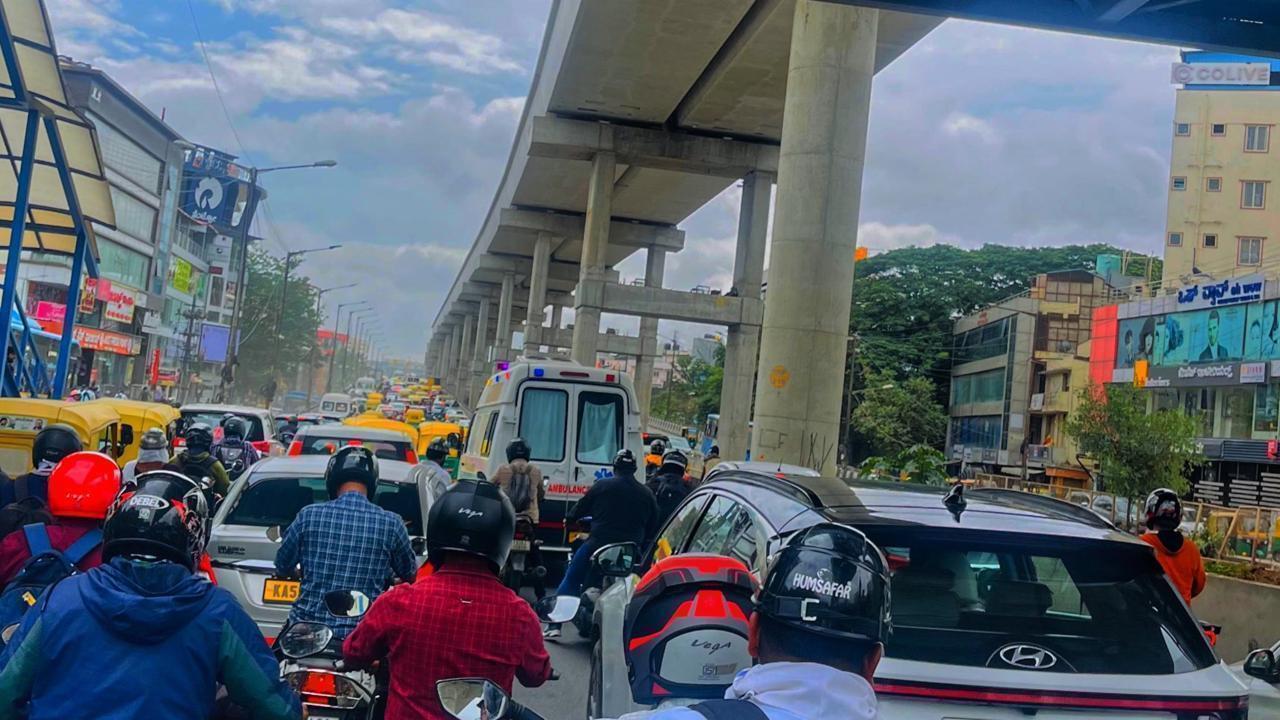
Post by : Amit
Photo : X / Subrat Padhi
Bengaluru’s Gridlock Crisis: A City Stuck in Traffic and Waiting for Change
Bengaluru, India’s teeming tech capital, has long been admired for its innovation and entrepreneurship. But despite its digital prowess, the city is facing an analog crisis—its streets are drowning in traffic. A recent joint survey conducted by the Lighthouse Mobility Institute (LMI) and Bounce Infinity underscores just how deep the congestion runs: commuters in Bengaluru spend 117 hours each year sitting in traffic. That’s nearly five full days lost, not just to movement but to sheer stillness.
Yet, amid these dismal numbers is a hopeful paradox—95% of city residents are ready to embrace public transport, but only if the city provides one missing link: efficient and safe last-mile connectivity. Without it, most remain trapped in a daily battle of delays, pollution, and mounting stress.
A Transit-Rich City That’s Still Struggling
At first glance, Bengaluru seems equipped to handle urban movement. It boasts an extensive BMTC bus network, and its Namma Metro system, while still expanding, serves lakhs of commuters each day. Ride-sharing apps, autos, and two-wheelers provide alternative options. But, as the report points out, none of these are working in harmony.
While 76% of survey respondents reported using some form of public transport, a mere 5% rely on it as their sole mode of commuting. That gap is telling. It highlights a systemic failure to link homes and workplaces to transit nodes—a failure most visibly seen in the last mile, the stretch between the nearest transit point and a commuter’s final destination.
This isn’t just a design flaw—it’s the central reason why people continue using personal vehicles even when better options might exist. A metro ride means little if it’s followed by a chaotic, unsafe, or expensive walk or rickshaw ride home.
Congestion's True Cost: Time, Money, Health, and Productivity
The average commuter in Bengaluru is not merely inconvenienced by traffic—they’re being robbed of time, energy, and health. With an estimated 117 hours per year lost to gridlock, the cumulative cost on the city’s productivity is staggering. These delays affect not just individual schedules, but business efficiency, economic growth, and the city’s global competitiveness.
On a microeconomic level, the survey revealed a significant impact on fuel consumption, vehicle wear-and-tear, and exposure to airborne pollutants—especially for two-wheeler users who spend hours idling amid fumes. For many, this is taking a toll on respiratory health and increasing daily stress.
Then there’s the human cost. Parents miss time with children. Workers arrive at meetings already exhausted. Students spend more time commuting than studying. In a city famed for coding the future, people are stuck trying to reach the present.
Why People Want to Shift—And What’s Holding Them Back
The revelation that 95% of Bengalureans are open to switching to public transport is both surprising and encouraging. It suggests a genuine willingness to change behavior—but only if the city provides an integrated, reliable, and safe system. The core issue is not resistance, but logistical and psychological barriers.
Respondents pointed to several deterrents: irregular bus timings, insufficient feeder services, lack of shaded walkways, absence of bike lanes, and concerns over safety—especially for women traveling after dark. Many also cited overcrowding, lack of cleanliness, and poor ticketing infrastructure.
To put it simply, people are not avoiding public transit because of preference. They are doing it because the system doesn’t meet them halfway.
Learning from Global Models: Intermodality in Action
Cities across the globe have faced—and solved—this problem. In Singapore, commuters use a single card to switch between trains, buses, bikes, and cabs. In Paris, integrated apps allow people to book scooters, hail rides, and pay metro fares from the same interface. These cities have invested heavily in intermodality—the seamless blending of transport modes.
Bengaluru doesn’t lack the technology to replicate this. It lacks the coordination, policy integration, and infrastructure scaling necessary to make it viable.
As Amit Gupta, CEO of Bounce Infinity, noted, “The people are ready. The demand is loud and clear. What’s needed now is a system that understands how people actually live and move.”
Digital Tools Could Unlock the Commute
Modern urban commuting is about more than physical infrastructure—it’s about data and access. The report calls for the creation of a unified digital ecosystem that brings together BMTC, Metro, private mobility operators, and even micro-mobility startups under a Mobility-as-a-Service (MaaS) platform.
Imagine a single app that lets users plan their route, book a shared bike, reserve a metro seat, and even predict delays—all in real time. Such systems already exist in cities like Helsinki and Barcelona. Bengaluru, with its tech industry muscle, should be a global leader in this space. Instead, it remains a case study in potential gone unrealized.
Budgeting for the Commute We Want, Not the Roads We Already Have
Urban planners have historically responded to traffic problems by expanding roads, flyovers, and highways. But that strategy, as experts argue, only invites more vehicles onto the roads. The real answer lies in shrinking the dependency on personal vehicles, not expanding their path.
The LMI-Bounce report urges the government to prioritize hyperlocal solutions in the next fiscal budget. That means channeling funds toward dedicated cycling corridors, widened sidewalks, multi-use transport hubs, and feeder services that make it easier to access buses and metros.
Experts suggest beginning with pilot zones—areas where real-time adjustments can be tested, and successful models scaled citywide.
Safety and Equity: The Invisible Crisis
Perhaps the most compelling aspect of the survey is how clearly it highlights the inequities within Bengaluru’s transit experience.
Women, in particular, raised concerns over unsafe last-mile stretches. Unlit alleyways, absence of CCTV, and a lack of female-friendly autos or buses mean many are forced to opt for cabs or private vehicles—even when more affordable public options exist.
Students and gig workers, too, find themselves in a mobility blind spot. Their income is often modest, but their mobility needs are extensive. For them, last-mile transit is not a convenience—it’s a critical economic lifeline.
Ignoring this isn’t just a failure of planning. It’s a failure of inclusion.
Existing Solutions Just Need the Right Push
Bengaluru already has the bones of a solution. Shared electric bikes in Indiranagar, pedestrian walkways in Jayanagar, and first-mile shuttle buses in Whitefield have all shown promise. But these remain isolated efforts, disconnected from the broader grid.
Transport specialists argue that scaling these up doesn’t require a revolution—it requires a clear roadmap, inter-agency collaboration, and public-private partnerships (PPPs). Startups are eager to innovate, but they need land access, regulatory clarity, and financial viability to thrive.
The tech is here. The will is here. What’s missing is institutional alignment.
The Final Signal: Stop Waiting, Start Moving
If there’s one truth the survey makes abundantly clear, it’s this: doing nothing is the most expensive option.
Every passing month adds to traffic hours lost, fuel wasted, and carbon pumped into the air. It diminishes productivity, strains mental health, and chips away at the city’s future.
With 95% of respondents already willing to shift to public transit, the challenge before the city isn’t about persuasion—it’s about preparation.
A Last-Mile Fix with First-Order Impact
The Bengaluru traffic crisis is not merely about cars, buses, or metro trains—it’s about people. People trying to get to work. Students chasing dreams. Workers delivering packages. Parents rushing home to kids.
It’s also about opportunity. The data is clear. The desire for change is loud. Bengaluru doesn’t need to wait for the next big technology or global summit. The future of its mobility depends on fixing the shortest—but most difficult—distance in its journey: the last mile.
Because only when that’s solved can the city truly move forward.
Bengaluru, Traffic



Advances in Aerospace Technology and Commercial Aviation Recovery
Insights into breakthrough aerospace technologies and commercial aviation’s recovery amid 2025 chall

Defense Modernization and Strategic Spending Trends
Explore key trends in global defense modernization and strategic military spending shaping 2025 secu

Tens of Thousands Protest in Serbia on Anniversary of Deadly Roof Collapse
Tens of thousands in Novi Sad mark a year since a deadly station roof collapse that killed 16, prote

Canada PM Carney Apologizes to Trump Over Controversial Reagan Anti-Tariff Ad
Canadian PM Mark Carney apologized to President Trump over an Ontario anti-tariff ad quoting Reagan,

The ad that stirred a hornets nest, and made Canadian PM Carney say sorry to Trump
Canadian PM Mark Carney apologizes to US President Trump after a tariff-related ad causes diplomatic

Bengaluru-Mumbai Superfast Train Approved After 30-Year Wait
Railways approves new superfast train connecting Bengaluru and Mumbai, ending a 30-year demand, easi




